

The Internet of Things in China in 2025 data
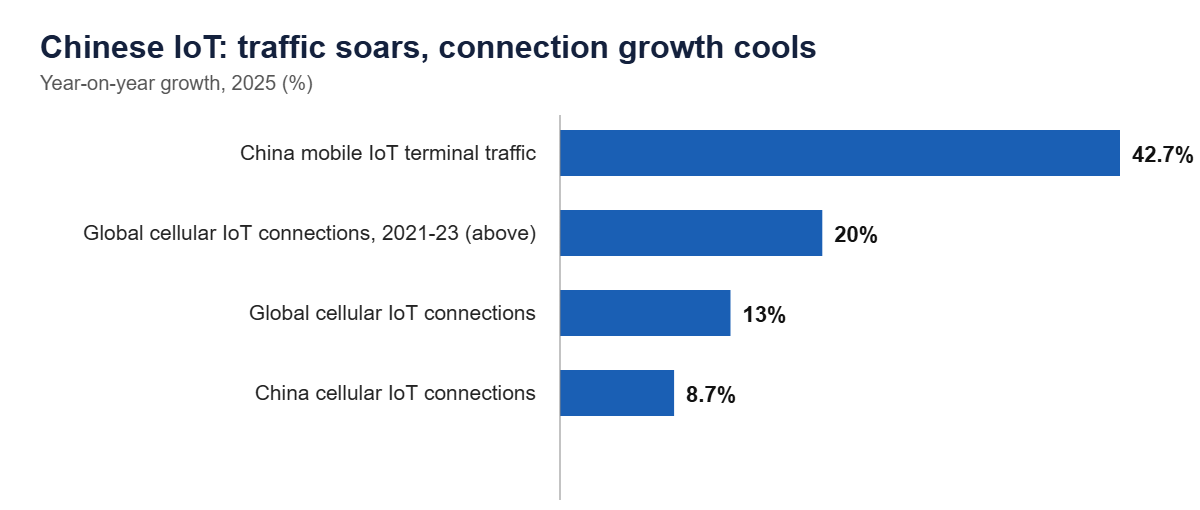
- Global cellular IoT connections reached 4.7 billion in 2025, up 13%, and China held 2.888 billion, about 61% of them, according to IoT Analytics as cited by GMT Eight.
- China’s growth slowed to 8.7%, which pulled down the worldwide rate, after global growth above 20% a year from 2021 to 2023.
- Mobile IoT terminal traffic in China rose 42.7% in 2025, and the country had 4.838 million 5G base stations by year-end, says the ministry communiqué summarized by Tiger Brokers.
- Cloud, big data, IoT and data centers formed 25.7% of telecom business revenue.
- A US proposal of April 30, 2026 would bar Chinese labs from certifying devices for the American market, a risk for exporters of IoT products.
The prediction in our first article, that China would lead the Internet of Things, came true in volume. The next question is value: what each connection earns.
What the Internet of Things means
The Internet of Things could be the next big technology that links physical objects in daily life, and it plays a key role in the next generation of information, networks, and communication. It broadly means that everyday objects can be uniquely identified and connected through a network, so they share data and interact, making life smoother and more convenient.
Technologies such as RFID, short-range wireless communication, real-time localization and sensor networks are crucial for The commercial use of this idea, linking the physical and cyber space for individuals and companies.
Why China was expected to lead
In earlier waves, leading economies developed the technologies, and many Asian nations paid royalties as followers. For the. Internet of Things, our early research said, the situation was different, with several factors favoring China:
- China can invest more than any other country.
- It has a centralized and walled internet that allows monitoring and control of usage, which helps with large national networks.
- National policies support research, with special state-owned zones. One example was the Chengdu Internet of Things Technology Institute in Sichuan, which developed a health system in which villagers could step into a telephone-booth-sized “health capsule” and receive a diagnosis and prescription from a distant doctor.
Where connections are used
- Smart meters and utilities. Large national grids and water systems use cellular modules at scale.
- Vehicles. Connected cars and charging networks use IoT links for data, updates and payment.
- Logistics. Tracking of parcels, containers and vehicles supports the large e-commerce system.
- Industry. Factories connect machines for monitoring, as in our work on Industry 4.0.
- Health and elderly care. Wearables and home sensors support remote care, as in elderly care.
The slowdown and the challenges
Connection growth of 8.7% is lower than in the boom years, since several large national deployments are already mature. Cheap modules also mean that revenue per connection is small. Operators earn more from platforms, data services and private 5G networks than from pure connectivity.
Challenges are also political. Device certification rules abroad, data export limits and security reviews reduce the freedom of Chinese IoT makers in some markets. At home, strict data rules raise compliance cost for foreign firms.
Business models that earn money from connections
A connected device earns little on its own. The value comes from what is done with the data. Three models are common in China. In the first, a manufacturer sells a device and later charges for software and updates, as in connected cars and industrial machines. In the second, an operator or platform sells connectivity and cloud services as a bundle, and the customer pays a monthly fee per connection. In the third, a service company uses data to offer a new service, such as insurance priced by driving behavior, or maintenance sold by the hour of machine use.
Each model needs a clear owner of the customer. A supplier who sells only sensors, with no link to the end client, risks being replaced by a cheaper module. A company that controls the relationship with the user, and holds the data in a compliant way, can add services for years. This is why many foreign companies pair with a local partner that has the customer relationship and the network license.
Data rules to plan for
China regulates data strictly, and IoT devices produce a lot of it. Rules on data security, personal information and cross-border transfers affect how a company stores and moves data, especially when devices collect location or health information. A foreign firm should plan to store data in China, to classify it by sensitivity and to document transfers abroad. Early legal review costs far less than a redesign after launch.
Daxue Take
We would consider these options, with their limits:
- If the company sells IoT hardware, focus on a sector where reliability and certification matter, because basic modules are cheap and heavily supplied locally.
- If the company sells software or analytics, work with an operator or an industrial platform, which already control customer access.
- If the company makes products for export, check certification and data rules in each target market early, in the light of the US proposal.
- If the company is an investor, favor firms that earn recurring revenue from services, not only from devices.
The limit is the same as in many fast markets: volume is easy to count, but profit per connection is hard to see, and public statistics do not show it.
What to watch next
- Whether connection growth returns above 10% with new uses such as vehicles and AI devices.
- Growth of IoT traffic compared with connections.
- Rules on device certification and data exports.
- Our related reading on internet use in China and lead-acid batteries.
FAQ
What is the Internet of Things?
A network of everyday objects that are identified and connected so that they share data.
How many IoT connections does China have?
2.888 billion cellular IoT connections, around 61% of the world total in 2025.
Is the market still growing?
Yes, but connection growth fell to 8.7%, while IoT traffic rose 42.7%.
Why did China lead?
Large investment capacity, central policy support and a controlled internet.
What is a main risk for exporters?
Certification and data rules in foreign markets, as the US proposal shows.
About Daxue Consulting
Daxue Consulting is a market research and strategy consulting firm focused on China, founded in Beijing in 2012, with offices in Shanghai, Beijing and Hong Kong. We have delivered more than 800 projects for international brands. To discuss the Internet of Things and connected devices in China, see our market research services or contact our team.