

The arrival of the Year of the Fire Horse recalibrated the emotional tempo of the market in 2026. If the Year of the Snake had encouraged reflection, healing, and controlled luxury, the Fire Horse signaled acceleration — velocity, vitality, and visible ambition. Consequently, Chinese New Year 2026 marketing campaigns had to navigate this surge of symbolic energy within a maturing economic climate defined by rational consumption.
The brands that succeeded were those that translated cultural symbolism into disciplined, systemized conversion strategies. Rather than relying on singular “viral moments,” leading players developed cross-platform systems that merged storytelling with frictionless checkout.
Breaking the “red-washing” mold
In 2026, superficial festivity proved insufficient. The most effective Chinese New Year 2026 marketing campaigns demonstrated curatorial precision: they interpreted the Fire Horse not as spectacle, but as a psychological state.
Kans, a domestic skincare brand, offered one of the clearest illustrations of this shift. Rather than projecting exaggerated optimism, Kans leaned into absurdist humor inspired by the “Mad Literature” (发疯文学) trend. By acknowledging burnout and emotional exhaustion, the brand built credibility through validation. In doing so, Kans reframed festivity as catharsis — a subtle but powerful move in a climate where authenticity outweighs artificial positivity.

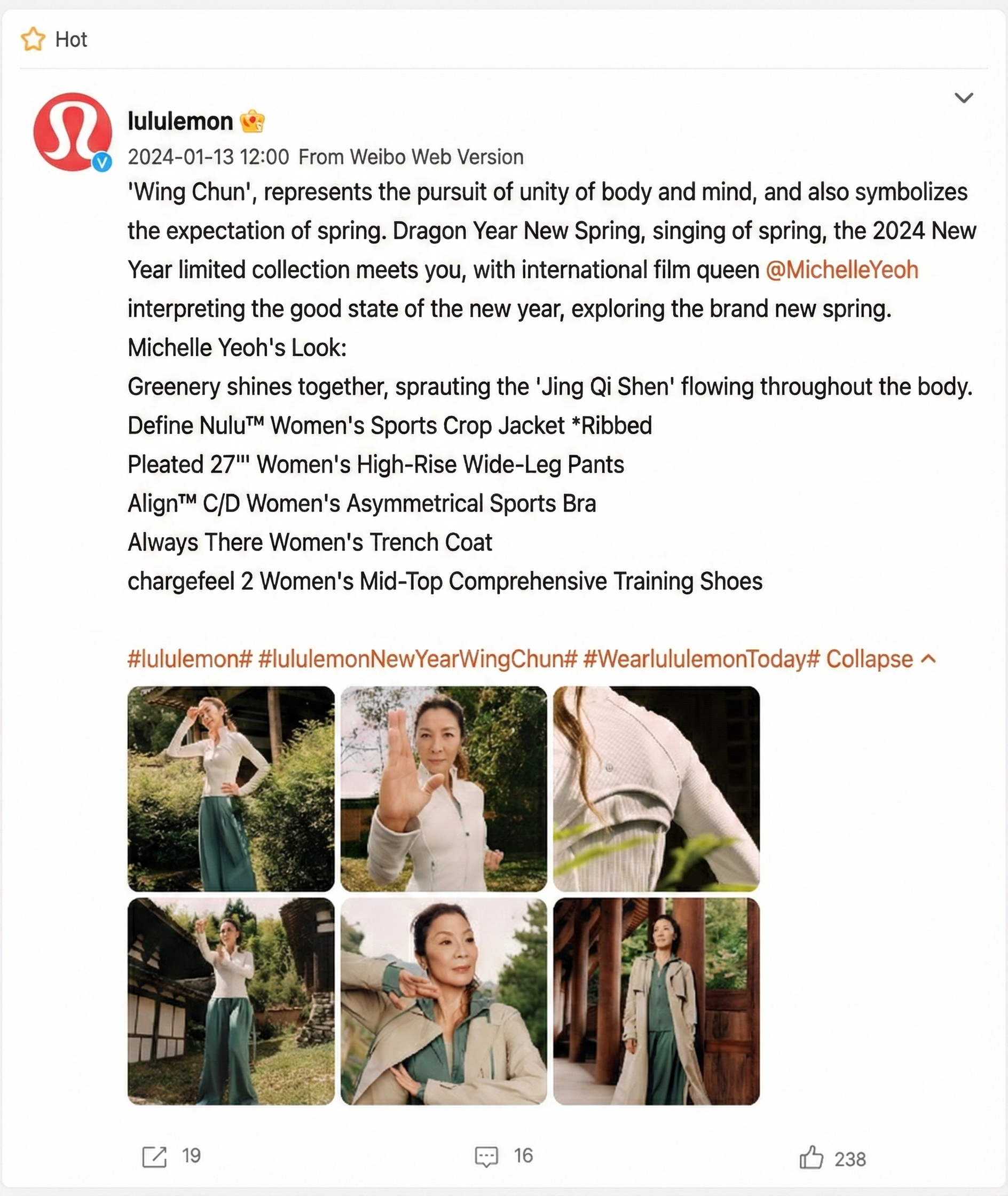
Lululemon adopted a contrasting yet equally deliberate approach. Its “Be Spring” campaign, featuring Michelle Yeoh and Wing Chun dancers, translated the Fire Horse’s symbolic energy into controlled movement rather than chaotic intensity. The campaign internalized vitality, resulting in resonance without aggression. With the promotional video accumulating 41,000 views on Weibo as of February 10th, 2026, the strategy demonstrated that rational consumers are actively responding to emotional alignment.
The lesson was clear: in 2026, cultural relevance required interpretation, not repetition.
Designing integrated platform systems
If cultural precision anchored emotional connection, platform architecture determined commercial success. Chinese New Year 2026 marketing campaigns could no longer depend on a single traffic engine. Instead, brands mapped the consumer journey across multiple interconnected platforms, each fulfilling a specific cognitive function.
Xiaohongshu operated as the “taste engine.” It seeded desire through narrative context and aesthetic explanation. Brands such as Diptyque used the platform to unpack the cultural nuance of their seasonal collections, appealing to consumers who research before they purchase.
Douyin functioned as the “conversion machine.” However, its role evolved from impulsive entertainment toward structured participation. Fenty Beauty leveraged user-generated content that linked directly to store checkouts, embedding purchase capability within interactive storytelling.
Tmall remained the infrastructural backbone. Even when discovery occurred on social platforms, final transactions frequently migrated to Tmall, where consumers perceived stronger guarantees of authenticity and price stability. In this layered system, each platform was not a competitor but a node within an orchestrated funnel.
The Fire Horse year rewarded brands that built ecosystems rather than campaigns.
Perceived value across big purchases and small treats
The luxury sector illustrated how symbolic energy could be monetized through fan economy dynamics. Prada’s “Triangle Fire Horse” motif strategically cast Olympian Ma Long and actress Yang Mi, bridging national pride and entertainment fandom. Consumers did not merely view the campaign — they demonstrated allegiance by posting purchase receipts online. The act of buying became participatory proof of identity, propelling the campaign video to 76 million views.
In contrast, the F&B sector revealed a different adaptation logic. Heytea’s collaboration with Pop Mart through its “Twinkle Twinkle” initiative exemplified what might be termed affordable indulgence. In a rationalized economy, consumers sought emotional uplift without financial overcommitment. A modestly priced beverage paired with a collectible keychain satisfied the desire for celebration while minimizing guilt. The integration of a digital red packet game increased daily active users by 25%, proving that low-ticket experiential products can generate both engagement and transaction velocity.

Together, these cases underscore that Chinese New Year 2026 marketing campaigns succeeded not by scaling expenditure, but by calibrating perceived value.
Emotional realism and the rise of store livestreaming
Two structural trends defined the broader landscape of 2026. The first was the emergence of emotional realism. The viral “Crying Horse” toy — initially the result of a manufacturing error — resonated precisely because it reflected fatigue rather than triumph. Brands that embraced this “ugly-cute” aesthetic tapped into a collective acknowledgment of pressure, or in other words, relatability.
This same demand for authenticity soon extended beyond creative expression into the mechanics of commerce itself. In 2026, there has been the pivot from “renting” traffic via influencers to “owning” traffic through store livestreaming. With top influencers now demanding commissions as high as 50% of revenue, brands have decentralized their strategy. On Douyin, 70% of all eCommerce livestreams are led by merchants rather than independent stars as of March 2025.
The concept of store livestreaming is rapidly expanding beyond the sales floor. Brands are now diversifying their content strategies to include broadcasts from pop-up events and behind-the-scenes tours. This decentralization allows companies to showcase limited-time offers in real-time or give viewers an intimate look into the craftsmanship and sourcing of their products. By pulling back the curtain, brands engage consumers with unscripted, transparent storytelling that reacts quickly to trends rather than adhering to a rigid corporate script. This shift effectively turns every physical touchpoint — from the atelier to the pop-up stall — into a potential broadcast studio, maximizing the value of offline assets.
Overall, these developments indicate that Chinese New Year 2026 marketing campaigns were moving toward earned credibility. Emotional realism and store-led livestreaming did not expand reach for its own sake; they restructured how trust is produced. Success during the Fire Horse cycle came from reducing distance between brand and consumer.
2026 Year of the Fire Horse marketing campaigns take a shift
- Success in the Fire Horse cycle was driven by calibrated value propositions — balancing symbolic energy with price sensitivity and long-term trust.
- Campaigns that moved beyond generic red imagery and instead linked zodiac symbolism to concrete emotional realities generated stronger engagement. Examples include humor around burnout or disciplined interpretations of vitality rather than exaggerated celebration.
- Sustainable performance requires coordinated cross-platform architecture. Discovery (e.g., Xiaohongshu), engagement (e.g., Douyin), and transaction validation (e.g., Tmall) increasingly operate as an integrated funnel rather than isolated activations.
- Rising influencer commissions and declining trust are accelerating the shift toward store livestreaming. Brand-operated streams reduce volatility, strengthen retention, and convert offline assets into digital sales infrastructure.