


Didi in 2025 data
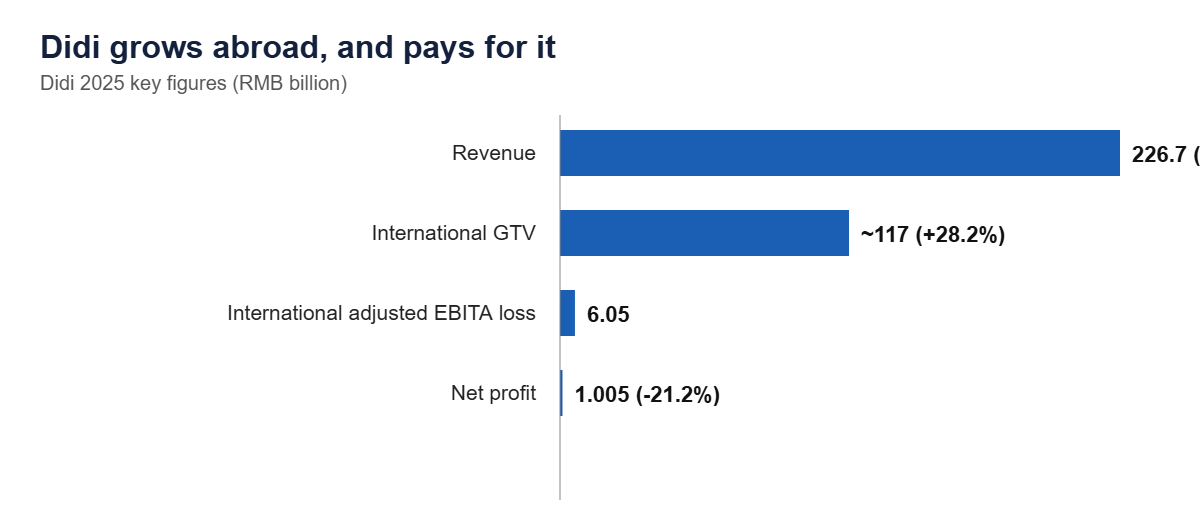
- Didi’s 2025 revenue was RMB 226.7 billion, up 9.6%, but net profit fell about 21.2% to RMB 1.005 billion, according to EqualOcean.
- Adjusted EBITA was RMB 3.67 billion, down about 15.2%, and the fourth quarter showed an adjusted EBITA loss of RMB 2.115 billion.
- International gross transaction value reached about RMB 117 billion, up 28.2%, and international orders hit 4.505 billion, up 24.7%.
- The international business lost RMB 6.05 billion at adjusted EBITA level, RMB 4.2 billion more than the year before, because of subsidies and marketing.
- Fourth-quarter revenue rose 10.5% to RMB 58.4 billion, and the quarterly net loss narrowed to RMB 333 million.
Didi started as a way to find a taxi. In 2025 it is a global mobility company that burns cash abroad to buy growth.
The problem it solved
It was becoming harder and harder to hail a cab in China’s first-tier cities such as Beijing, Shanghai, Guangzhou and Shenzhen. That led developers to a new idea: an app that lets riders find a nearby taxi willing to take them to their destination, and lets drivers avoid wandering the streets during off-peak hours. From this idea came Didi Da Che.
It was no small start-up for long. Backed by Tencent, the tech giant behind WeChat and QQ, Didi, doubled its registered users in one year, from 20 million to 40 million, after integration with WeChat.
The market was crowded. Didi Dache, with Tencent, and Kuaidi Dache, backed by Alibaba, held the biggest shares. Apps paid bonuses of RMB 30 to 50 a day to users, and Drivers prioritized app orders to win gifts such as laptops, electric fans and laundry detergent. Street customers without smartphones were pushed aside, and the whole idea of calling a cab changed.
We also noted that government regulation might shrink the app. market, since cities wanted to centralize taxi services.
What the numbers show about the new strategy
- Core China business. Still strong. The group made a net profit in 2025, and fourth-quarter revenue rose 10.5%.
- International expansion. GTV rose 28.2% for the year and 47.1% in the fourth quarter to RMB 36.59 billion, with orders up 24.5%.
- The cost. International adjusted EBITA losses widened to RMB 6.05 billion, mainly because of incentives and marketing.
- Result. Group profit shrinks while the overseas base grows, a trade-off that investors watch closely.
Regulation shaped the market
Our early warning about regulation came true. Authorities require licenses for vehicles and drivers, limit pricing practices and monitor data. Didi itself faced a major data security review after its listing in the United States, and later moved to a different listing structure. The result is a tighter environment for ride-hailing in China, with more compliance cost and less room for aggressive subsidies at home.
That is one reason why growth now comes from abroad, in markets where rules are less settled and competition is lighter in some cities.
How riders and drivers see the market
For riders, the app is a basic tool. They compare the estimated price and waiting time, choose between an economy car, a premium option or a shared ride, and pay through the app. Reliability matters more than a small price gap, and a long wait at night or in bad weather pushes users to try another app. In many cities, riders use two or three apps in parallel, which keeps price competition alive.
For drivers, the app is a source of income and a manager. They follow rules on commissions, bonuses and ratings, and they have little power to negotiate. Complaints about low pay and long hours led to calls for fairer commission rules, and platforms have adjusted them several times. A healthy ride-hailing market needs both sides satisfied, so rules on driver pay and rest hours are now part of the public debate.
Taxi companies and city governments also take part. Some cities connect traditional taxis to the apps, while others limit private cars. This mix explains why a national platform must manage hundreds of local rule sets, each with its own license, fare and insurance requirements.
Beyond cars
The platform also moves into services around mobility: bicycles, designated drivers, charging, car services and advertising inside the app. These lines use the same user base, and they help to spread the cost of the technology. The next step is autonomous driving, where Didi and others test robotaxi services in selected areas, though rules and costs limit the scale.
Lessons for mobility and platform businesses
- Network effects favor the leader. Once riders and drivers use one app, rivals struggle to catch up.
- Subsidies buy growth, but only a clear business model keeps it.
- Regulation can change the rules quickly, so compliance is part of the business model.
- Integration with a major social platform helps, as the doubling of users after the WeChat link showed.
Daxue Take
We would consider these options, with their limits:
- If the company is a foreign mobility player, partnership with a local platform is easier than a direct fight, and regulation requires local licenses in any case.
- If the company serves drivers, such as in charging, leasing or insurance, work with platforms and fleets, as Didi’s volume gives access to a large group.
- If the company is Chinese and plans to go abroad, plan the subsidy budget and the local rules in each country before launching.
- If the company is an investor, separate the China profit from the international loss when reading results.
The limit is comparability. Public figures mix group totals and adjusted measures, and China-only trips are not given in the main results, so a full view needs more data.
What to watch next
- Whether international losses shrink as volumes grow.
- Competition with other platforms and local players in new markets.
- Rules on autonomous vehicles and robotaxis in China.
- Our related reading on WeChat payments for foreigners, elderly care and the Internet of Things.
FAQ
What is Didi?
China’s largest ride-hailing platform, which started as the taxi-hailing app Didi Da Che.
How much did Didi earn in 2025?
Revenue was RMB 226.7 billion, and net profit RMB 1.005 billion.
Is Didi growing abroad?
Yes, international GTV rose 28.2% to about RMB 117 billion.
Why are profits falling?
Subsidies and marketing for international growth weigh on results.
Who backed Didi early?
Tencent, while its main rival Kuaidi was backed by Alibaba.
About Daxue Consulting
Daxue Consulting is a market research and strategy consulting firm focused on China, founded in Beijing in 2012, with offices in Shanghai, Beijing and Hong Kong. We have delivered more than 800 projects for international brands. To discuss mobility platforms and ride-hailing in China, see our market research services or contact our team.