

Updated on January 7, 2026
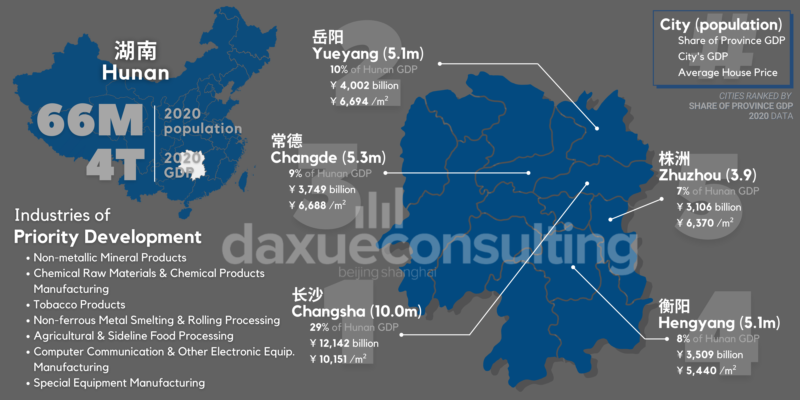
Why does Changsha, a city that grows slower than China, sell more milk tea, crayfish and weekend trips than its income level would suggest? Changsha, the capital of Hunan, has 10.7 million people and a GDP of RMB 1.57 trillion.
Its retail sales came to about RMB 53,500 per resident in 2025 (our calculation from the Changsha 2025 Statistical Bulletin). The same year it received 233 million tourist visits, so about 22 for every resident.
For a foreign brand, Changsha is two markets in one city. One is a test bench for consumer ideas aimed at young Chinese who watch their budget. The other is an industrial base built around machinery groups like Sany and Zoomlion.
We first wrote about Changsha in 2012, the year I founded Daxue in Beijing. Part of that note still holds, part of it was wrong, and I come back to both below.
Market research on Changsha: the latest figures
| Indicator | 2025 | Change |
| GDP | RMB 1,573.8 billion | +4.0% |
| Services (tertiary sector) | RMB 974.1 billion, about 62% of GDP | +4.5% |
| Industry and construction | RMB 550.5 billion | +3.1% |
| Resident population (year end) | 10.72 million | +1.0% |
| Urbanization rate | 84.51% | +0.52 pts |
| Retail sales of consumer goods | RMB 573.9 billion | +3.9% |
| Urban disposable income per capita | RMB 72,117 | +3.5% |
| Rural disposable income per capita | RMB 48,069 | +5.3% |
| Foreign trade | RMB 287.5 billion (exports 185.7, imports 101.8) | +3.5% |
| Tourist visits | 233.3 million | +8.8% |
| Tourism revenue | RMB 258.0 billion | +6.8% |
All figures come from the Changsha 2025 Statistical Bulletin (长沙市2025年国民经济和社会发展统计公报), published in May 2026. A few ratios help to read them. GDP per resident is about RMB 146,800 (our calculation). People in rural districts earn two thirds of what city people earn. For China this is a small gap, probably because much of “rural” Changsha is in fact suburbs.
Tourism is the number I find most telling: revenue was about RMB 1,100 per visit (our calculation). That is the budget of a weekend of food and photos, not a week of shopping.
Changsha grows slower than China, yet 233 million tourist visits in 2025 make it a fast test market for young, price-conscious consumers.
1. A city that still grows, but slower
Changsha’s GDP grew 4.0% in 2025. Hunan province as a whole did better, at 4.8%. In the first half of 2026, Changsha slowed to 2.5% (RMB 785.8 billion), under both the provincial and the national rate, as 36Kr noted in September 2026.
Among the Chinese cities above RMB 1 trillion of GDP, Changsha is now at the low end for growth.
Retail sales grew 3.9% in 2025. Urban incomes grew 3.5%. In other terms, people spend what they earn, not much more. The birth rate was 6.47 per thousand and the death rate 7.14. The city still adds about 1% of residents a year, but because people move in from the rest of Hunan, not because of births.
Should a brand skip Changsha then? No. But forget the picture from the 2010s, with double-digit growth and a new mall every season. Spending is stable, and it does not grow fast enough anymore to save a weak product. We see the same split in our analysis of China’s 6,700 shopping malls: some fill up, others empty.
2. Machinery: the other Changsha
People know Changsha for tea shops and TV shows. Its economy still stands on heavy industry. In 2025, five of the world’s 50 largest construction machinery makers were based in Changsha, according to Hunan Today: Sany, Zoomlion, CRCHI, Sunward and Sinoboom. Sany was fifth in the world and Zoomlion tenth.
When China’s construction market cooled, these groups went abroad. Zoomlion’s 2025 revenue was RMB 52.1 billion, up 14.6%. More than half of it, 58.6%, came from outside China, according to its 2025 annual results. In the city, equipment manufacturing grew 8.4% in 2025 and high-tech manufacturing 14.3%. That is much faster than the economy overall.
For a B2B supplier, this changes the pitch. Changsha buys components, automation, software, testing and industrial services, for machines that end up in Africa, Latin America and Southeast Asia. Selling to Sany is half a domestic deal and half an export deal.
3. Why Changsha became China’s “internet celebrity city”
Many of the 233 million visits in 2025 were weekends of eating and filming, planned from posts on Xiaohongshu and Douyin. On Wuyi Avenue on a Friday night, Chayan Yuese cups are everywhere.
The line for Wenheyou’s retro food hall goes out onto the street. At 1 am, the crayfish stalls near Pozi Street are still full.
Changsha is regularly in the top ten of Chinese night-economy rankings, and night spending is estimated at about 64% of daily consumption, according to China News Service Hunan. Our article on China’s nighttime economy compares it with other cities.
It started with television. In 2005, Hunan Satellite TV made Changsha a media capital with Super Girl, the talent show our 2012 note already called the most watched program on Chinese TV. Today its streaming arm Mango TV has 75.6 million paying members. Its platform revenue was RMB 11.2 billion in 2025, according to Eastmoney.
Then food did the rest. Hunan cuisine is spicy, cheap and looks good on camera, and the city eats late. Prices also help: a night out in Changsha costs a fraction of a night in Shanghai.
Who are these visitors? A topic which is more and more addressed is lower-tier cities, and many visitors come from the smaller cities of central China. In October 2025 I shared on LinkedIn our work on these places: “We scraped and analyzed millions of social media posts from lower-tier cities.” The 2025 China emerging-tier market report is based on 30 million posts.
Two findings fit Changsha very well. Cheap drinks have become small daily treats. And young people from big cities look for slower, cheaper trips in smaller places. Changsha sells both, at scale.

4. The “Changsha model” of consumer brands
For a city of this size, Changsha has produced a lot of consumer brands. The Hunan Department of Commerce calls five of them the city’s “five little tigers” of new consumption.
| Brand | What it does | Scale (latest figure) | Source |
| Chayan Yuese (茶颜悦色) | Chinese-style milk tea | 700+ directly run stores, 400+ of them in Hunan; RMB 3 billion+ revenue in 2024 | Hunan Dept. of Commerce, 2025 |
| Wenheyou (文和友) | Retro food halls and crayfish restaurants | 20,000-30,000 visitors a day in Changsha in early 2025 | Linkshop via Sina, 2025 |
| Mingming Hen Mang (鸣鸣很忙) | Discount snack stores (Snacks Very Busy, Zhao Yiming) | 21,948 stores, RMB 66.2 billion revenue in 2025 (+68.2%) | Cailian Press, 2026 |
| Anker Innovations (安克创新) | Chargers and consumer electronics, sold mostly abroad | RMB 20 billion+ revenue expected for 2024, 95%+ overseas | Hunan Dept. of Commerce, 2025 |
| Shuiyang Group (水羊集团) | Beauty brands and distribution | Acquired French brand EviDenS de Beauté | Hunan Dept. of Commerce, 2025 |
Do the math and the two food leaders look very different. Chayan Yuese makes roughly RMB 4 million a year per store. Mingming Hen Mang makes about RMB 3 million per store, mostly in smaller towns (our calculations, from the figures above). One sells an experience. The other sells a price.
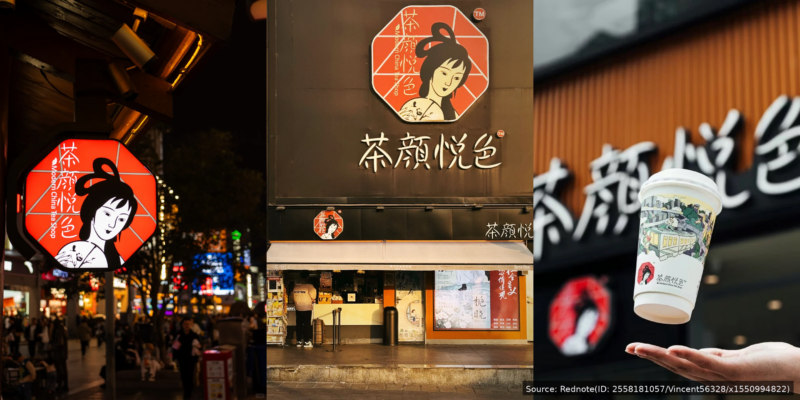
The interesting part is what happened when these brands left home. Wenheyou opened huge food halls in Guangzhou and Shenzhen. The Guangzhou one has closed, and the Shenzhen one reportedly has 70% of its space empty, according to Linkshop. Chayan Yuese’s stores in Wuhan, Nanjing and Wuxi no longer have the lines they had at opening.
Around Wuyi Square, meanwhile, there is a shop about every 50 meters. Our profile of Chayan Yuese, the tea brand that refuses to franchise explains how it protects that density.
Tourists come to Changsha partly to queue, film and tick places off a list. In Nanjing on a Tuesday afternoon, the same cup is just one more milk tea, in a market where 174,000 tea shops opened and 137,000 closed in a single year. Mingming Hen Mang is the exception, because cheap snacks in small towns travel well.
It is now a national chain listed in Hong Kong. It reminds me of what I wrote in September 2026 about a grocer from the next province: “Pangdonglai was an unknown regional grocery chain from Henan three years ago. Today it is the reference every retailer in China… benchmarks against.” Both grew up far from Shanghai.

5. Who is the Changsha consumer?
Younger, and more ready to spend than income alone suggests. Urban disposable income was RMB 72,117 in 2025, which is solid for central China. Housing is much cheaper than on the coast, and the universities bring a steady flow of students. A Changsha resident has less money than a Shanghai resident, but more left after rent.
Price comes first, even for “trendy” products. This is why discount snack chains and RMB 15 milk teas do so well; our article on China’s snack market follows that trend. The evening out is the purchase itself: food halls, livestream shows and night markets compete with malls for time and money.
Local pride gives brands born in Changsha an advantage at home that outsiders find hard to copy. And visitors and locals plan from the same Xiaohongshu and Douyin feeds. Our guide to Xiaohongshu (RedNote) explains how these notes shape decisions.
Luxury is there, but in a handful of malls. International premium brands usually treat Changsha as their hub for Hunan, with one or two flagship stores, not as a market for a dense network. Our piece on China’s new luxury hot spots looks at the cities where this is changing.
Daxue Take
Yonghui was THE retail chain when I arrived in China in 2009. Today it closes stores, while brands born in Henan or Hunan set the reference. As I wrote in September 2026, “the channels worth prioritizing shift faster than most multinationals can update their strategy.” For consumer brands, Changsha is a good place to watch this happen (and to learn from it, before a Shanghai team decides what young Chinese want).
So what would we do with Changsha? Use it as a test, but not as the only test. A concept that goes viral there has passed a hard exam with young people who live on social media.
Wenheyou and Chayan Yuese show that the buzz does not always travel, though: what we could name as “the queue effect” stays in Changsha.
Our hypothesis is that a Changsha pilot should go with a second test in a city without the tourist effect, let’s say Wuhan or Hefei, before a national launch. If the product sells in both, it is the product. If it sells only in Changsha, it was the queue.
A concept that goes viral in Changsha has passed a hard exam, but the queue often stays in Changsha: test a second city before going national.
Set prices for central China. With urban incomes around RMB 72,000 a year, a 20% to 30% premium over local options can work if the product is clearly better. A 100% premium usually fails, whatever the brand means in Shanghai. The price architecture requires to be built city by city.
Look at the B2B side too. Changsha’s machinery groups are big buyers with global plans. Going abroad, they need international standards, certification, software and after-sales networks. In our experience, these openings are less crowded than consumer markets.
And work with the locals. Mango TV, the tea and snack brands and Changsha’s livestreaming agencies know their audience better than any newcomer. A co-branded limited edition or a stand in a food hall can open doors faster than an own flagship.
Before all this, start with consumer research and social listening on Xiaohongshu and Douyin, to see how people talk about the category in Changsha. Then run a short pilot with clear targets, before you sign for retail space.
To know how consumers in Changsha or other central Chinese cities see a category: Daxue Consulting runs consumer research and social listening across China. Contact our team.
What to watch next
- Chayan Yuese and other local tea brands, and whether they keep their Changsha base as they expand to other cities.
- Co-branded limited editions and food-hall stands, which can open doors faster than an own flagship.
- How people in Changsha talk about each category on Xiaohongshu and Douyin, tracked through social listening.
- Pilot results from brands that test in Changsha before signing for retail space.
FAQ about the Changsha market
How big is Changsha’s economy?
Changsha’s GDP reached RMB 1,573.8 billion in 2025, up 4.0%, according to the Changsha Statistical Bulletin. Services are about 62% of the total.
What is the population of Changsha?
Changsha had 10.72 million residents at the end of 2025, with an urbanization rate of 84.5%. The 2010 census counted 7.04 million.
What are Changsha’s main industries?
Construction machinery (Sany, Zoomlion, CRCHI, Sunward, Sinoboom) and other equipment, media and entertainment (Hunan TV, Mango TV), tourism, and consumer brands such as Chayan Yuese and Mingming Hen Mang.
Why is Changsha called an “internet celebrity city”?
Its food streets, tea brands, nightlife and TV culture are shared a lot on Xiaohongshu and Douyin, and many visitors plan their trip from these posts. The city received 233 million tourist visits in 2025.
Is Changsha a good market for foreign brands?
Yes, as a hub for Hunan and a test market for consumer ideas aimed at young, price-conscious people. Brands should adapt prices to central China and check that a success in Changsha also works in other cities.
About Daxue Consulting
Daxue Consulting is a market research and strategy consulting firm focused on China, founded in Beijing in 2012, with offices in Shanghai, Beijing and Hong Kong. We have delivered more than 800 projects for international brands. To discuss market entry in Changsha and Hunan, see our consumer understanding services or contact our team.