
The underwear market in China reached RMB 254.3 billion in 2024, with women’s underwear at RMB 172.9 billion and men’s at RMB 81.4 billion. In this article, underwear includes bras, underpants, thermal underwear, sleepwear, and shapewear. Across these categories, Chinese consumers bought 4.57 billion pieces in 2024 at an average price of RMB 55.7 per piece.
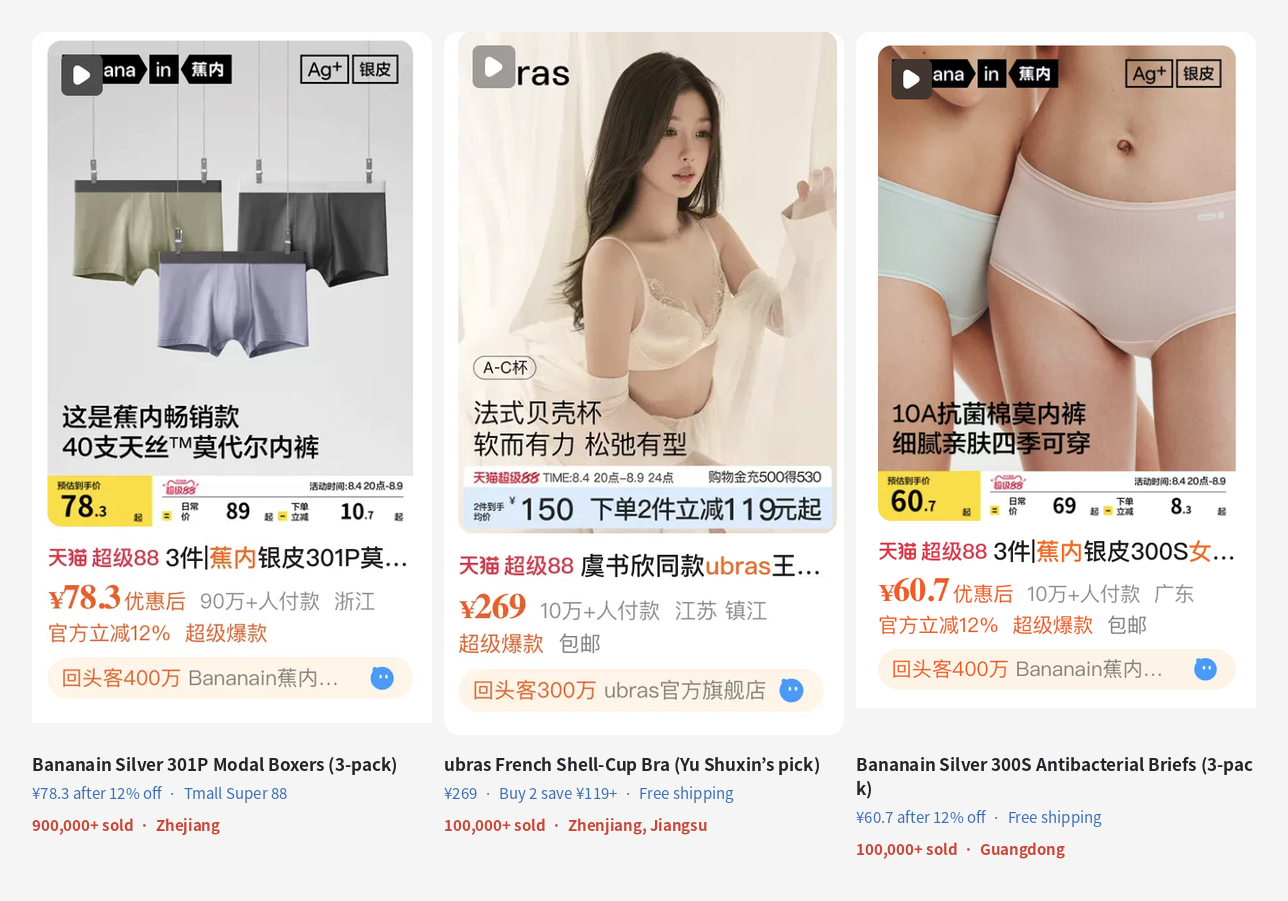
The market is fragmented, with the five biggest brands holding only about 6% of sales combined, against the 20% to 50% that leading brands hold in Western markets. 9,500 new underwear companies were registered in the first eleven months of 2025. According to the total retail sales by platform sales, Ubras and Bananain (蕉内), built on one-size wireless bras and tagless basics, took the top two store spots in Tmall’s 2025 Double 11 (天猫双十一) underwear ranking, and Bananain’s RMB 89 three-pack of breathable boxer briefs has passed one million units sold on Tmall.
Comfort and practicality are the top purchase drivers in the underwear market in China
For women, comfort has overtaken appearance in the purchase decision. Antibacterial treatment, moisture-wicking, and cooling fabrics are becoming standard across bands, seamless knitting and heat-bonded edges have matured into common techniques, and lyocell, a high-end regenerated fiber, is expected to lead the premium segment.
Bras indicates the same shift. 78.4% of consumers choose wireless styles when buying a bra, wireless designs held about 68% of the market by mid-2024 and underwire keeps a 21.6% preference as a smaller segment sitting alongside sleep bras and other zero-restraint styles favored by younger consumers. Meanwhile, one-size designs carry five to eight SKUs against more than 50 for a traditional style. Brands now compete on skin feel, and product development increasingly centers on how smooth the fabric feels on the body.
For men’s, the checklist is shorter and centers on fit, fabric, and hygiene. Loose boxer cuts lead the category and account for 33.6% of the men’s underwear market in 2024. Cotton remains the mainstream fabric, with modal and bamboo fiber gaining ground and silk serving the premium end. Hygiene functions complete the list, and a 2025 industry report describes antibacterial linings, moisture-wicking, and odor control as new baseline requirements in the category.
Winners of today’s underwear market in China
Domestic underwear brands took 90% of the top 20 spots in the 2025 Double 11 ranking. The only international names left in the top 10 are Uniqlo and Victoria’s Secret, and the traditional domestic brands that remain, Miiow (猫人) and Fenteng (芬腾), hold their places through thermal wear and sleepwear.
Foreign underwear brands face a specific challenge in China: The business empire that these brands built were for fitting-room era, with structured products sold through large store networks, and both assets turned into costs once the purchase moved online and the criteria moved to comfort. Triumph carried the heaviest version of this model, running more than 1,000 stores at its peak, and closed its mainland business on December 31, 2025 with fewer than 70 left. Domestic brands following this model suffered as well, Maniform (曼妮芬), whose core product is the structured bra, dropped out of the top 10 in 2025.
Calvin Klein has the same problem in the men’s market. Ten years ago, men bought CK partly to show the waistband. The logo was visible, so paying extra for it made sense. That look has passed, and underwear is back to being something nobody sees. Buyers now pick on fit, fabric, and hygiene, and a RMB 89 domestic three-pack covers all three. Online price comparison made things harder for CK. Its official three-pack costs RMB 490 on Tmall, while the same pack sells for around RMB 200 in secondary channels. In the 2026 618 festival, CK ranked 19th in Tmall’s men’s underwear category.
Tmall Double 11 underwear sales, top 10 flagship stores, 2025
| Rank | Flagship store | Main products | Brand type |
| 1 | Bananain (蕉内) | Tagless basics, thermal wear | Domestic, online-native |
| 2 | Ubras | One-size wireless bras | Domestic, online-native |
| 3 | Victoria’s Secret | Lingerie | International |
| 4 | Miow (猫人) | Thermal and basic underwear | Domestic, traditional |
| 5 | Youkeshu (有棵树) | Cotton basics | Domestic, online-native |
| 6 | Uniqlo | Basics, HEATTECH thermal wear | International |
| 7 | Oyeahzi (小野和子) | Home and lounge wear | Domestic, online-native |
| 8 | Miow underwear store (猫人内衣) | Thermal and basic underwear | Domestic, traditional |
| 9 | Fenteng (芬腾) | Sleepwear and home wear | Domestic, traditional |
| 10 | TBH Beast home (野兽派家居) | Home and lounge wear | Domestic, online-native |
Growth is coming from sports, seniors, and upgraded basics
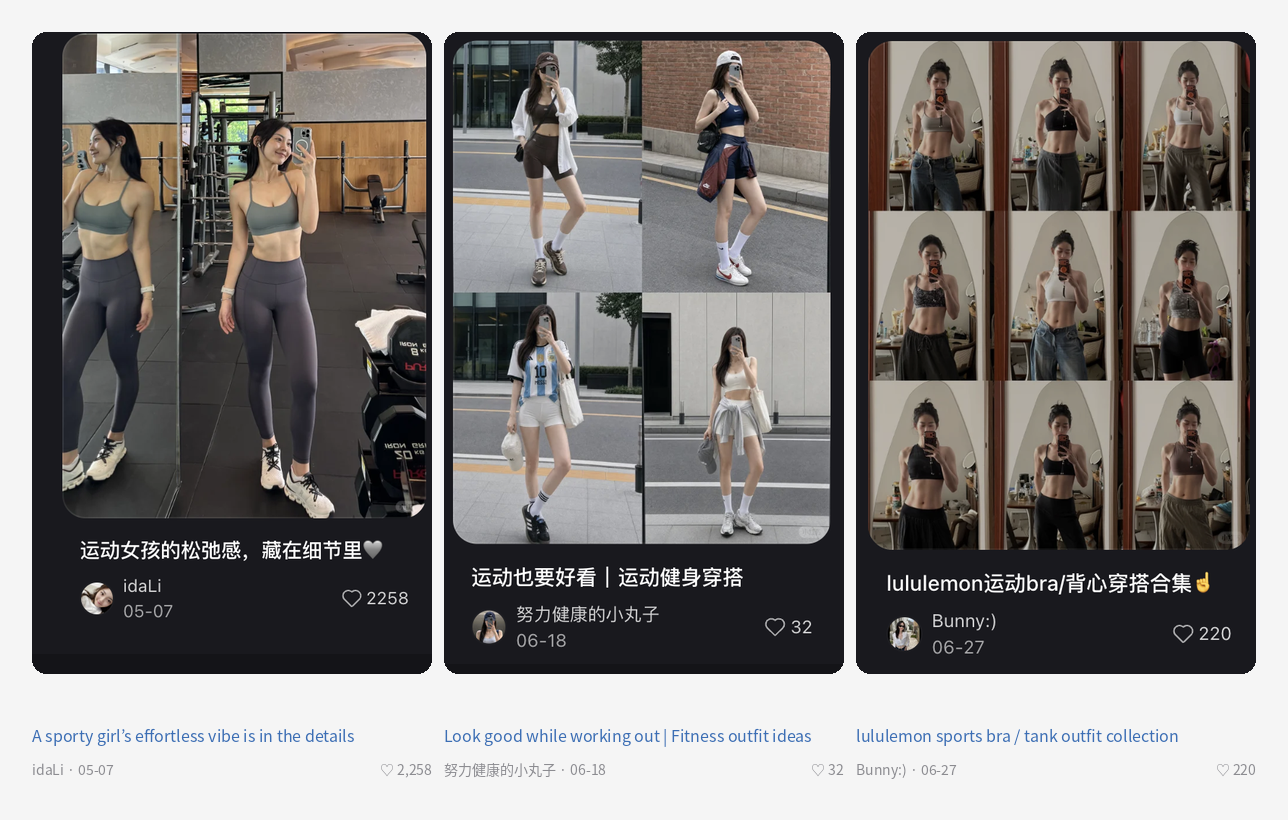
In 2025, retail sales of sports and entertainment goods grew 15.7% while clothing, footwear, and knitwear grew 3.2%. Moreover, of all the products that have sporting elements, sports bras are now worn as daily wear and as tops. Furthermore, fitness and outdoor settings are among the fastest-growing scenarios for women’s underwear by discussion volume.
The bestseller in Ubras’ own Tmall store is a sports bra, Bananain’s quick-dry sports bra passed 4 million units on Douyin, Aimer reached 74,000 runners through four marathon partnerships in the first half of 2026, and JU ACTIVE, a yoga-wear brand, grew from 43 stores in April 2025 to more than 100 by December. Aimer prices its running bras at RMB 350 to 600, and these premium price points sit almost entirely in women’s lines for now.
Growth also shows up outside sport. Zero-restraint styles, sleep bras included, are rising 23.8% a year, health-focused senior underwear is adding about 25% a year as China’s silver economy grows, and JD reported thermal underwear sales more than doubled during the 2024 Double 11. In men’s underwear, the upgrade runs through fabric, with modal and bamboo fiber gaining ground on cotton.
Key takeaways on the underwear market in China
- China’s underwear market was worth RMB 254.3 billion in 2024, but no brand has won it. The top five together hold about 6%, where Western markets usually see 20% to 50%. The door is still open, and about 9,500 new companies came in during the first eleven months of 2025.
- Nearly four in five bra buyers (78.4%) choose wireless styles, and in briefs, comfort has overtaken appearance as the top purchase criterion. That is why fabrics got softer, designs got simpler, and buying moved online.
- Men choose underwear by fit, fabric, and hygiene. A functional three-pack now costs RMB 89, so an RMB 490 pack needs a reason beyond the logo, and Calvin Klein has slipped to 19th in Tmall’s men’s ranking.
- Online-born brands hold the top of the Double 11 ranking, and traditional names now live on thermal wear and sleepwear. Triumph, which once had over 1,000 stores in China, closed the last of them in December 2025.
- Money is still being made where the product does something extra. Sports underwear sells at RMB 350 to 600 while everyday basics fight a price war, sporting goods retail grew about five times as fast as clothing in 2025, and senior health underwear is growing about 25% a year for both genders.
Author: Allison Malmsten, edited by Ming Yii Lai, with additional research by Zekai Zhang