


How Chinese tourists plan trips online in 2025 data
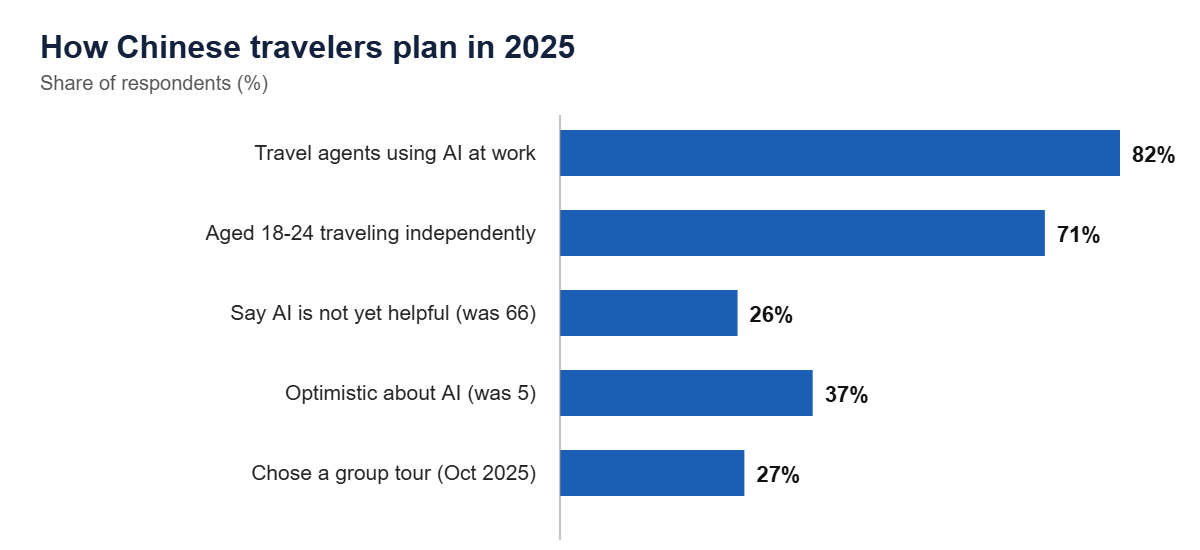
- In Dragon Trail’s spring survey, Xiaohongshu ranked second only to Ctrip as a source of outbound destination information, and first for travelers under 35, according to Dragon Trail.
- Only 27% of people planning an outbound trip in October 2025 chose a group tour, and 71% of those aged 18 to 24 plan alone.
- Travelers who said AI is not yet helpful for trips fell from 66% to 26%, while optimistic ones rose from 5% to 37%.
- By summer 2025, 82% of Chinese outbound travel agents used AI at work.
- China had 697 million border crossings in 2025, up 14.2%, per Jing Daily.
In 2014 we described a Chinese traveler who read booking sites. In 2025 this traveler watches short videos, reads notes and asks an AI assistant.
What we found in the first research
China had a billion inhabitants and 618 million internet users, and the habits of preparing a trip were changing. A market study found that 16% of tourists relied on consumer review sites to plan their journey, ahead of friends at 14% and family at 13%.
Chinese consumers like to learn about a product before they buy it, especially a major purchase such as a trip. They do not want to be disappointed with their investment, so they spend time on planning and turn to several sources.
- Search engines. Most tourists type keywords into Baidu, which then lists many sites selling services.
- Online booking platforms. The most popular were Ctrip, Tuniu, Qunar, Trip.taobao, Xinxin, Lumama, Baidu Luyou, Lotour and eLong. A Hotels.com study found that Chinese consumers consulted family and booking platforms equally, at 13% each.
- Reviews. Comments from previous visitors were the first criterion for 47% of Chinese tourists, and booking sites offered photos, videos and consumer reviews.
- Social networks. About 90% of Chinese internet users were on at least one network. Weibo led with 500 million registered users, of whom 50 million were active every day.
- Key opinion leaders. Bloggers and Weibo accounts could “make the sun shine or make it rain” on a destination.
The 2025 planning journey
- Inspiration. Short videos and notes on Douyin and Xiaohongshu give the first idea. For under-35s, Xiaohongshu is the top source for destination information.
- Research. Ctrip and other platforms confirm prices, flights and hotels, and reviews decide the final choice.
- AI help. Travelers use assistants to draft itineraries, translate and compare, and trust in them is growing fast.
- Booking. More than half book independently, and only 27% choose a group tour. Groups are now smaller, with 20 people or fewer.
- Sharing. During and after the trip, they post photos and reviews that feed the next traveler.
Content that wins attention
Not all content works equally. Chinese travelers react to material that answers a concrete question: how to get from the airport to the hotel with a phone and no local, language, which dishes are safe and tasty, what a day trip costs, and where a quiet photo spot can be found. Long brand stories and generic slogans rarely help.
The format matters as well. A one-minute video of a real walk through a hotel, a note with ten photos and a short list of tips, or a live session from a market can all bring More bookings than a polished advertisement. Travelers also look for signs that the content comes from people like them, such as comments in Chinese, tagged locations and posts from visitors of the same age and family type.
It helps to build a small library of material in Chinese: a destination guide, a map with the main sights and eating places, a list of payment options, a short guide on transport, and a set of answers. to the ten most common questions. This library serves both humans and AI tools, since assistants summarize what they can find, and a destination with no clear Chinese content is simply left out of the summary.
Measuring the effect
A destination should track which platform each booking came from, how many views turned into messages, and which creators produced stays and not only likes. A few months of data usually show that a small number of posts and partners bring most of the results, and the budget can then follow them.
What this means for hotels and destinations
- Reviews and notes in Chinese are the new shop window. A hotel with no Chinese content is invisible to young travelers.
- Photos and videos should show real rooms, food and neighborhoods, since users distrust edited images.
- Replies to reviews show care. A hotel that answers complaints in Chinese earns trust.
- Offers should be simple and bookable on the main platforms, with clear cancellation rules.
Daxue Take
We would consider these options, with their limits:
- If the company is a hotel or attraction, start with a Xiaohongshu presence and a few local creators, and link every post to a booking page on a major platform.
- If the company is a destination board, build a simple Chinese guide and invite creators for real visits, and publish itineraries ready for AI tools to read.
- If the company is a tour operator, offer small private groups and flexible routes, since 71% of young travelers prefer independence.
- If the company is a tech provider, test AI planning tools with travel agents, as 82% already use them.
The limit is control. Reviews and AI summaries are outside the brand’s hands, so quality of service remains the strongest marketing.
What to watch next
- How AI assistants change the order of sources for destination research.
- The share of bookings made directly through social platforms.
- Policy changes that affect flows, such as visa rules and advisories.
- Our related reading on Chinese outbound tourists, social networks in China and online advertising.
FAQ
Where do Chinese tourists find information?
On Ctrip, Xiaohongshu, Douyin and review platforms, plus AI assistants.
Do they still read reviews?
Yes. Reviews were the first criterion for 47% of tourists in our early survey, and remain central.
Do Chinese tourists travel in groups?
Less and less. Only 27% chose group tours in October 2025.
Is AI used in travel planning?
Yes, 82% of Chinese outbound travel agents used AI at work by summer 2025.
Which platform is best for young travelers?
Xiaohongshu is the top source for travelers under 35.
About Daxue Consulting
Daxue Consulting is a market research and strategy consulting firm focused on China, founded in Beijing in 2012, with offices in Shanghai, Beijing and Hong Kong. We have delivered more than 800 projects for international brands. To discuss Chinese travelers and online travel marketing, see our market research services or contact our team.