

Chuseok (추석), often referred to as Korea’s version of the Mid-Autumn Festival in China, is one of the largest celebrations in South Korea. The festival occurs on the 15th day of the 8th lunar month each year and is legally recognized as a three-day holiday, including the day before and after. In 2026, the Chuseok holidays in Korea lasted for four days, including the weekend. Similar to the previous year, people participated less in ancestral rites and dedicated their time to family connection, rest, and simpler holiday preparation. For example, instead of making jeon (전), or Korean pancakes, they order delivery food or eat at restaurants.
How high inflation and shorter holidays transformed the 2026 Chuseok in Korea
High inflation and a relatively shorter holiday period reinforced this shift in Chuseok consumer trends, moving Chuseok in 2026 away from traditional obligations toward a focus on rest and practicality. The Chuseok holiday in 2026, including the weekend, lasts about four days, which is shorter than last year, when it lasted up to seven days. As a result, demand for large-scale domestic and international travel has declined, with the intention to travel domestically standing at 18.9% and the intention to travel abroad at 6.0%. Rising living costs and the financial burden of holiday expenses have also been major factors driving consumers to prioritize value over overspending.
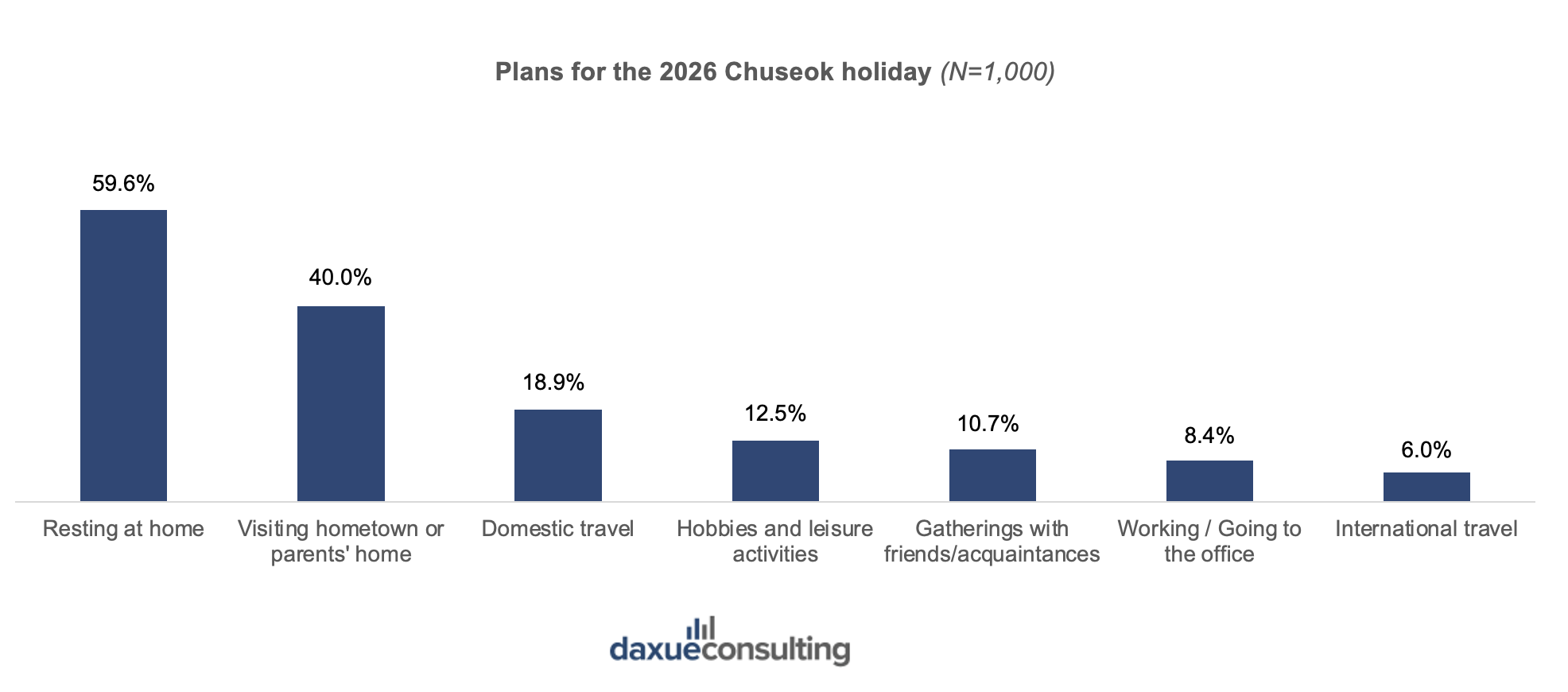
Changes in consumer perceptions have led to specific changes in how people spend their holidays. According to a 2026 survey by PMI, 59.6% of respondents chose to “rest at home” as their plan for this holiday, showing a tendency to use the holiday as an opportunity for personal relaxation. The number of households staying in their hometowns for extended periods has decreased, while a more practical holiday culture emerged, with people preferring short, efficient gatherings, such as brief visits to their parents’ homes or day-trip get-togethers at nearby hotels.
The polarization between cost-effective and premium consumption
For the 2026 Chuseok holiday, consumer spending has clearly taken on a “K-shaped” structure, with spending split between two opposite extremes: value-oriented purchases of KRW 50,000 or less and premium purchases of KRW 500,000 or more, while the mid-range price segment has weakened. In terms of cost-effective consumption, E-Mart’s pre-order sales of Chuseok gift sets showed a 9.7% YoY increase, with items priced under KRW 50,000 accounting for 77.4% of total sales. Lotte Mart also showed the highest proportion of items priced under KRW 50,000, at 57.5%, indicating a clear trend toward cost-effective consumption.
Premium spending, on the other hand, has strengthened at department stores. As of September 8th, 2026, sales from Shinsegae Department Store’s pre-order sales of Chuseok gift sets had increased by 62.1% compared to the same period last year, with items priced at KRW 500,000 or more accounting for around 40% of the department store’s total sales. In the alcoholic beverage gift set category, Shinsegae Department Store saw demand for ultra-high-end whiskey such as 71-year-old Macallan (KRW 180 million).
Skipping the traditional family meal and the culinary habits of the stay-at-home (집콕) group

During the 2026 Chuseok holiday, as the traditional culture of family-style dining waned, demand for convenience foods and small-packaged items increased, particularly among the stay-at-home group (집콕족) and solo Chuseok celebrators (혼추족). The number of single-person households in South Korea increased from 5,203,440 in 2015 to 8,244,308 in 2025, accounting for 36.6% of all households. Demand for convenient holiday meals has grown, and sales of Chuseok-related products at CU convenience stores have steadily increased. In particular, locations with a high concentration of single-person households accounted for 60.5% of total sales.
This Chuseok consumer trend has also led to growth in the markets for small-packaged premium products and ready-to-eat meals. At Hyundai Department Store, the sales of the “Sodam Set (소담세트)”, which consists of individually packaged portions, were expected to account for more than 40% of total Hanwoo gift set sales for the first time in 2026. Demand for ready-to-eat meals was also particularly strong in the e-commerce sector. On SSG.com, from September 1st to 17th, sales of side dishes rose 86% compared to the same period before the 2025 Chuseok, while sales of rice cakes increased by 39%.

Eating out instead of eating at home
Meanwhile, there has been a growing Chuseok consumer trend toward holding family gatherings at restaurants instead of preparing holiday meals at home. The percentage of households planning to hold ancestral rites during Chuseok in 2026 stood at 27.3%, down 13.1 percentage points from the previous year, while searches for family gatherings on the dining reservation platform CatchTable surged to 4.2 times the usual level during the week leading up to Chuseok. At Ashley Queens’ three major locations in the Seoul Metropolitan Area, 1,300 customers made reservations for the Chuseok holiday, and approximately 88% of all reservations were for groups of five or more. Hotels have also set out to capitalize on the holiday season by promoting special Chuseok buffets and combined Chuseok-staycation packages, and the proportion of searches for 4- and 5-star hotels during the Chuseok holiday exceeded 60%, reflecting a trend toward short but luxurious consumption.
Hand-carry and personalized gifts becoming popular
For Chuseok in 2026, hand-carry gift sets, which people take with them on their trips home, emerged as a major Chuseok consumer trend. This is because the Chuseok holiday was only four days long, and because logistics companies suspended deliveries starting the day before the holiday, the nationwide delivery cutoff date was moved up to September 22nd. In addition, the Compact Premium Set, which combines portability and practicality while reflecting individual tastes and values, drew significant attention. The Han Jeong-seon Lotte Exclusive Set, a signature product of Lotte Department Store consisting of a 9-piece set of fresh fruit glutinous rice cakes and handmade ceramics, proved its immense popularity by selling out completely.
Key learning points in the Chuseok consumer trends
- In 2026, Chuseok was viewed not as a mandatory holiday for ancestor worship, but as a practical holiday for reconnecting with family and refreshing oneself.
- The market has split into cost-effective options priced at KRW 50,000 or less and premium options priced at KRW 500,000 or more, with the mid-range segment weakening.
- As the tradition of preparing family meals has waned, demand for convenience foods and small-packaged products has grown, particularly among people who stay home a lot and those who celebrate holidays alone.
- There has been a clear trend toward holding family gatherings at restaurants instead of preparing holiday meals at home.
- With nationwide shipping deadlines being moved up due to delivery suspensions by courier companies, hand-carry gift sets have become the trend.
Author: Sory Park, with additional research by Zhixin Park