


Huawei and Xiaomi in 2025 data
- Xiaomi’s 2025 revenue reached RMB 457.3 billion, up 25%, with adjusted net profit of RMB 39.2 billion, up 43.8%, reports Caixin Global.
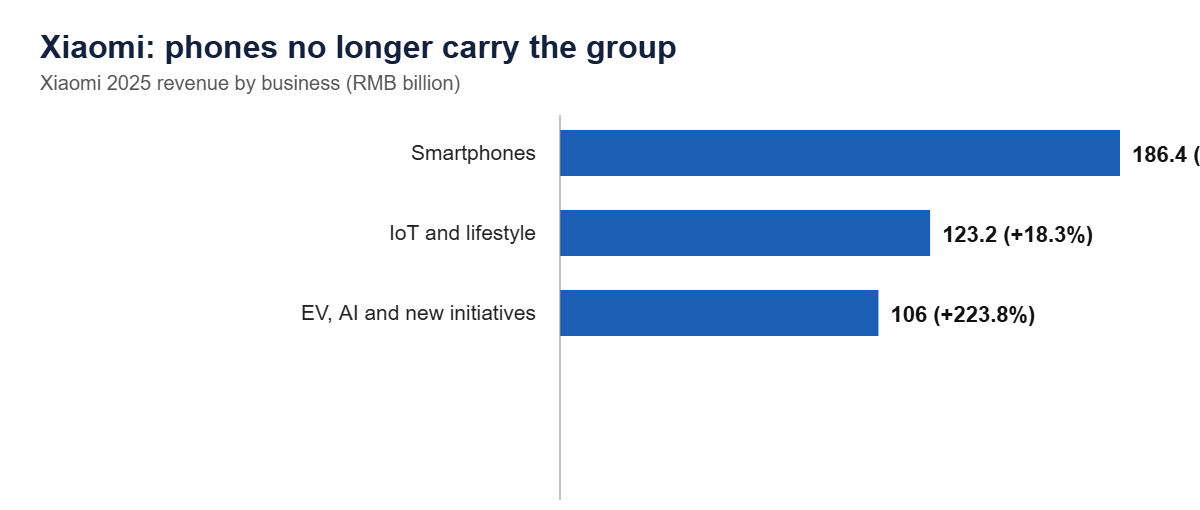
- Xiaomi’s smartphone revenue fell 2.8% to RMB 186.4 billion, and shipments dropped 1.9% to 165 million units, a 13.3% global share and third place.
- Its EV, AI and new initiatives business earned RMB 106 billion, up 223.8%, with about 411,000 cars delivered against a 300,000 target.
- Huawei’s 2025 revenue was RMB 880.9 billion, up 2.18%, and net profit RMB 68 billion, up 8.7%, according to the Huawei annual report.
- The Huawei-led auto alliance moved 589,100 vehicles in 2025, up 32%.
The two rivals no longer fight over the same product. Both turned from phones to cars, AI and ecosystems, and the battle is about who builds the better one.
Where the rivalry began
Huawei and Xiaomi both took leading roles in China’s smartphone market, and the competition was fierce, with each trying to win more share. In the, second quarter of 2015, Huawei was recognized for the first time as the top smartphone vendor in China, while Xiaomi fell to second place.
The success of Xiaomi was starting to fade as other Chinese makers moved in, most of all Huawei. Xiaomi suffered A year-on-year drop in shipments, while Huawei exceeded all expectations, which was impressive given the cutthroat nature of the Chinese market.
Eleven years later, the two have swapped many roles. Huawei survived sanctions and. rebuilt its high end, and Xiaomi grew beyond its online-only origin.
Xiaomi: from phones to a car maker
- Phones. Revenue fell and the fourth quarter dropped 13.6%. Memory chip prices in early 2026 were roughly four times higher than a year earlier, so Xiaomi expects to raise prices, as OPPO and vivo already did.
- Connected devices. The IoT and lifestyle line posted a record RMB 123.2 billion, up 18.3%.
- Cars. The EV unit turned a profit of RMB 900 million, with a 24.3% gross margin, above Li Auto at 17.9%, Nio at 14.6% and XPeng at 12.8%. The average selling price rose 7.1% to RMB 251,000.
- R&D. Spending passed RMB 33 billion in 2025 and should exceed RMB 40 billion in 2026, with RMB 16 billion for AI.
Huawei: the closed ecosystem
- HarmonyOS reached about 36 million devices, a base that no longer needs Android.
- R&D stayed very high, at RMB 192.3 billion, or 21.8% of revenue.
- Cars come through partner brands under the Huawei alliance, so Huawei supplies technology and brand without carrying all the capital risk.
- Revenue is still below the record of RMB 891.37 billion from 2020, but profit is growing again.
For more on its early years, see our article on how Huawei started.
Who wins which customer
Xiaomi targets value for money and a very large user base, with a ladder from cheap phones to premium electric cars. Huawei targets users who pay for quality and trust, especially in business and in high-end phones and cars. In practice, the two rarely fight for the same buyer any more, which is why both could grow in 2025.
What they do share is the pressure of cost. Memory prices push phone makers to raise prices, and a price rise tests loyalty. Xiaomi may feel it more, since its buyers are more price sensitive.
Three lessons from ten years of rivalry
- Online sales alone do not last. Xiaomi built its name with online flash sales, then needed thousands of physical stores and partners to keep growing. Huawei always had operators and retail channels behind it.
- Technology depth protects the high end. Huawei lost access to some foreign chips, yet kept a loyal group of buyers by investing heavily in its own design. Xiaomi kept its edge by moving fast and keeping prices low.
- The ecosystem beats the device. A phone is one product, while a phone, a watch, a car and a home system together create habits that are hard to leave.
These lessons apply well beyond phones. Any foreign brand that sells a single product in China may meet a rival that sells a full system, and that rival can afford to lose money on one piece to win the whole.
For marketing teams, the rivalry also shows how fast preferences can move. In one decade the Chinese buyer went from “cheap and good enough” to “premium and local”, and then back to “careful about every yuan”. Brands that watch these swings with regular research, rather than annual guesses, have time to adapt.
Daxue Take
For a foreign brand or investor, we would consider these options:
- If the company sells components, both groups are large buyers. Xiaomi offers volume and Huawei offers technical standards that are hard to meet but loyal.
- If the company sells consumer devices, expect both to enter the category through their ecosystems, which lowers the chance of a stand-alone success.
- If the company works in cars, partnership with a platform player is likely cheaper than building alone, but it gives up part of the brand.
- If the company is an investor, read the segment numbers, not the headline. Xiaomi’s strength comes from cars and devices, while its phones shrink.
The limit is dependency on chips and memory. Both groups rely on supply chains that political and price shocks can disrupt.
What to watch next
- Whether Xiaomi can keep a car margin above 20% as competition grows.
- The size of the HarmonyOS base next year.
- Phone price rises and their effect on shipments.
- Related reading on Huawei in the European market and industry 4.0 in China.
FAQ
Who sells more smartphones, Huawei or Xiaomi?
Xiaomi shipped 165 million units in 2025 and ranks third worldwide. Huawei does not publish full unit numbers in the same way.
Is Xiaomi profitable in cars?
Yes, the EV business posted an operating profit of RMB 900 million in 2025.
When did Huawei first pass Xiaomi in China?
In the second quarter of 2015, according to our early research.
What is HarmonyOS?
Huawei’s own operating system, now on around 36 million devices.
Why are phone prices rising?
Memory chip costs rose sharply, and makers pass part of it to buyers.
About Daxue Consulting
Daxue Consulting is a market research and strategy consulting firm focused on China, founded in Beijing in 2012, with offices in Shanghai, Beijing and Hong Kong. We have delivered more than 800 projects for international brands. To discuss the Chinese smartphone and electronics market, see our market research services or contact our team.