

China is experiencing a renewed wave of interest in Korean fashion. Since 2023, Korean fashion has been gaining strong momentum. While this is the third wave after the 2000s drama-led Hallyu spillover and K-drama fashion boom in 2011-2016, it rose in China at a different scale and with a different consumption agenda. In response, many K-fashion brands rode on the rapid development of Korean fashion in China, opening new stores and experiencing a sharp increase in sales.
How the Hallyu wave influences the Chinese market
The Hallyu wave has influenced the Chinese market in multiple waves. In 2016, the textile and apparel imports from Korea to China was around USD 1.88 billion and nearly doubled by 2024, reaching USD 3.6 billion. However, the growth was uneven.
In the 2010s, Korean fashion in China was closely tied to the broader Korean cultural wave, including dramas, K-pop, and celebrity influence. An MDPI academic study covering 2011 to 2020 shows that, before the Terminal High Altitude Area Defense (THAAD), interest in Hallyu in 2003-2009 helped increase the export of Korean consumer goods, including the fashion category. But after the deployment of the THAAD system, this effect became weaker. In other words, previous surges in the popularity of Korean fashion in China were driven by the overall rise of Korea’s cultural appeal in China. However, the end of the wave of popularity was driven by political factors.
Today, the wave is driven less by broad enthusiasm for Korean culture and more by the lifestyle image that Korean brands present to consumers on Chinese platforms. Consumers first discover the products more broadly, then become attached to the idea and social image promoted by brands of Korean fashion in China, and only after that does further conversion into purchases take place. The most recent surge happened in 2024-2025, when, compared to 2022-2023, imports of Korean apparel to China increased significantly by 59% from 2023 to 2025.

Bestselling fashion categories in China
The bestselling categories in K-fashion in China in 2025 are T-shirts, sweatshirts and hoodies, baseball caps, bags, and casual outerwear. A defining feature across these products is their simple design combined with a strong visual code that is easy to recognize on Xiaohongshu feeds or on celebrities. Among all categories, baseball caps are particularly strong. According to the OEC import/export profile, South Korea was among the fastest-growing origins for China’s knitted hat imports between 2024 and 2025 (+USD 5.5M). Caps’ appeal lies in offering consumers a relatively affordable entry point into the brand and a relatively low-cost investment in style. Moreover, Chinese digital media outlet Jiemian stated that customers most strongly recognize the brand through hats.
As the City News Service reported, what sells in this new wave is not fashion statement pieces in the narrow sense, but rather a modern system of everyday dressing. At present, Korean fashion in China is built on a combination of casual comfort, visual recognizability, urban styling, and low-friction wearability.
Leading Korean fashion brands in China
Among the most visible brands in current K-fashion wave are MUSINSA STANDARD, EMIS, Matin Kim, and Mardi Mercredi, as well as Rest & Recreation. They are opening their first mainland stores, moving from pop-ups to permanent locations, and their social media posts on Xiaohogshu reached more than a hundred million views.
Nowadays, mainly three brands have established a strong presence in Mainland China: MUSINSA, EMIS, and Rest & Recreation. Matin Kim is actively expanding in Hong Kong and Macau, while Mardi Mercredi announced the closure of its stores in November 2025; even so, it remains highly popular among Chinese consumers and is still present on platforms such as Tmall and Douyin. Smaller sellers are also present, mainly through e-commerce on Tmall or similar, but their presence is less visible due to strong competition from Chinese brands replicating the Korean style.
The target audience of K-fashion in China
The core target consumers consist of Gen Z and young millennials aged 18-34. The strongest concentration of target audience is located in tier-1 cities and strong new tier-1. Consumption is mainly female-led urban casual fashion, but some categories, especially caps, sweatshirts, sporty basics, and bags, remain unisex or gender-flexible. What is more important, all the leading brands mentioned show that consumers purchase a lifestyle script instead of a simple fashion item. Target audience also passionate about social proofs and social values. They get the values through posts and mentions in Xiaohongshu.
In terms of pricing, Korean fashion brands in China are positioned mainly in the affordable premium segment, with some variation toward upper mass and lower premium. Based on current price bands, T-shirts and caps cluster mostly in affordable premium, shoulder bags span upper mass and affordable premium, while hoodies are the most premium category, extending from affordable premium into lower premium.
Individual trends in Korean fashion in China
Among the most visible and successful Korean fashion brands in China are MUSINSA Standard, EMIS and Rest & Recreation. These brands follow a similar three-step market entry strategy, which is highly common for international brands in China nowadays.
General cases of entering Chinese fashion market
First, brands focus on strong development on Xiaohongshu, which remains one of the main channels for fashion discovery. Through marketing campaigns, brands build an initial “warmed-up” audience ready to purchase their products. The second step is entering e-commerce platforms such as Tmall and Douyin. Tier-1 cities’ consumers use significantly more online channels of purchasing in fashion, than consumers in the lower-tier cities. As for offline retail, customers mainly use stores to explore product quality and for entertainment and emotional experience, while most purchases still happen online. Therefore, the third step is opening an official offline store – not primarily to sell, but to create brand experience and strengthen market presence.
Korean brands’ uniqueness in Chinese fashion market
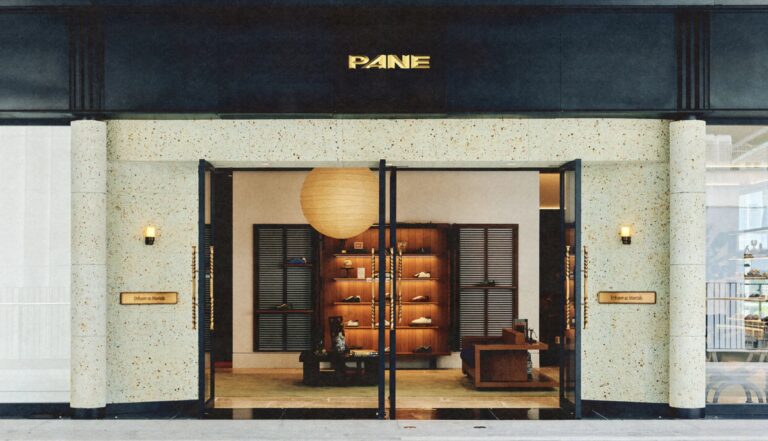
The elements that remain particularly distinctive to Korean fashion in China can be seen in the design of offline retail spaces. First, the offline store is often conceived as a content-driven setting with different photo zones and high-fashion design. Second, the decor of these spaces is used to convey Seoul’s visual culture, with stores designed to reflect the style of specific districts or flagship stores in South Korea. Third, offline stores often incorporate visible references to Hallyu. For example, MUSINSA’s store in Shanghai features a dedicated K-pop Zone with monthly exhibitions of personal items worn by K-pop idols.
Many foreign brands use celebrities to promote their products, but Korean fashion in China stands out for its use of idol-worn products as part of retail promotion. Last but not least, another distinctive feature of Korean brands is their role in helping other Korean brands expand into the Chinese market. MUSINSA STANDARD positions itself as a partner platform that provides Korean brands with marketing, logistics, and global expansion support, that has already supported more than 60 small Korean fashion brands.
Korean brands trending on Xiaohongshu
Korean brands’ Xiaohongshu entry strategy is based on promoting style and emotions through visual content rather than focusing on specific products. Although the leading brands mentioned above entered China in 2023-2024, many of them adjusted their Xiaohongshu marketing strategy at the same time in early 2025, transforming their content and building a more recognizable visual identity. Their earlier posts were closer to standard Instagram-style content – studio high-fashion shoots with a more experimental or editorial aesthetic, or simple lifestyle visuals.
However, since 2025, each brand has developed a consistent storytelling style: through photo editing and composition, they sell a feeling first, and only then the product itself. Detailed presentations of new collections are rare. Instead, from a single image, users can clearly imagine how others would perceive them wearing the brand. These accounts sell a recognizable lifestyle rather than individual products, follow a clear visual direction, and prioritize photo content over video.
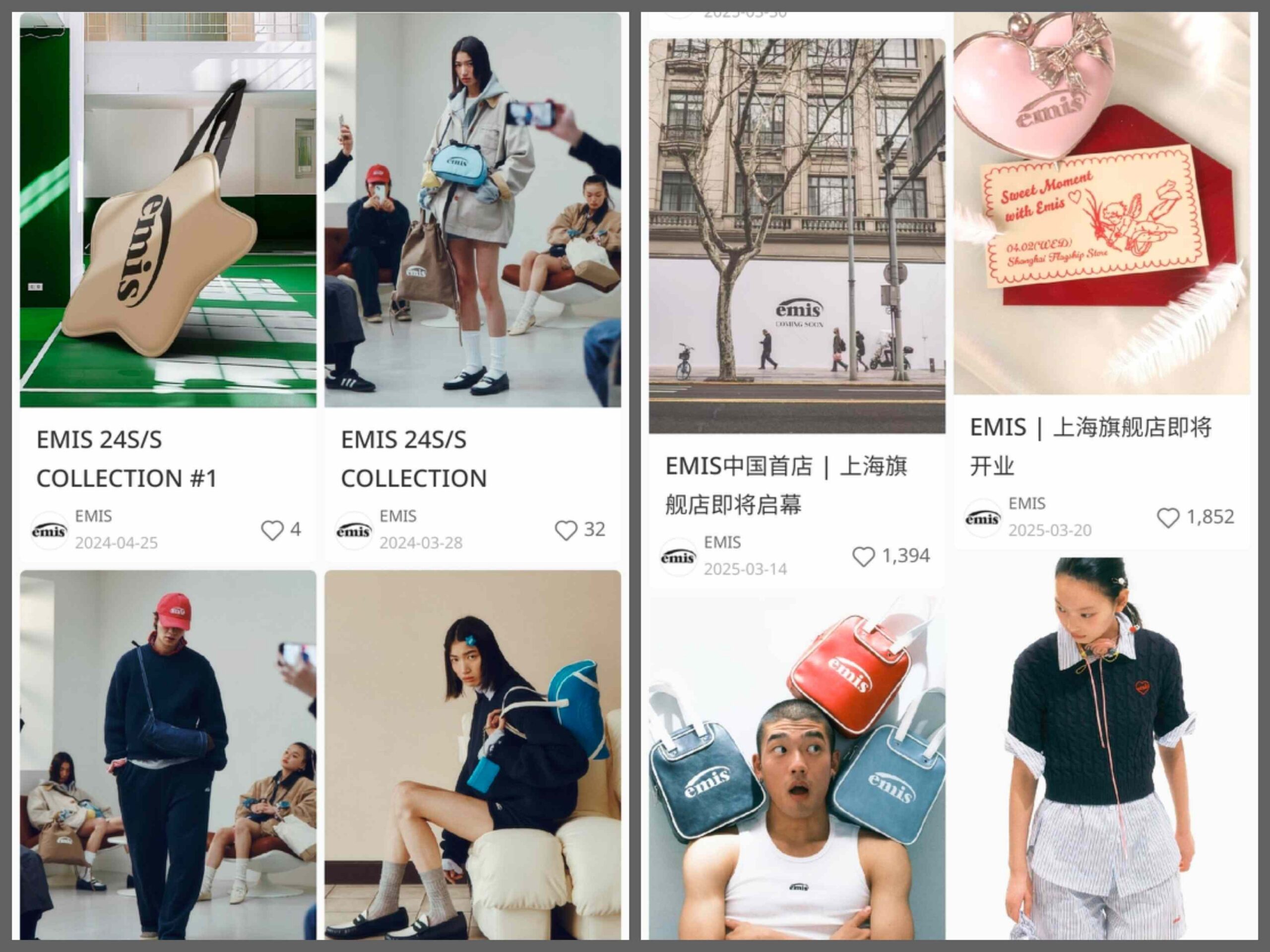

It is also important to note that the most common content locations are offline stores. They serve as a source for check-in content, store tours, outfit photos, and user-generated recommendations. Xiaohongshu highly values real-world proof of visiting. Through this mechanimsm, Korean brands make a cycle of emotions – turning online emotion from Xiaohongshu account into offline experience, and the same back by the followers’ content.
Collaborations between brands as a localization strategy
To establish themselves in the market, Korean brands actively use collaborations with global players already well integrated into the Chinese consumer culture. These collaborations happen across different industries, but one key element remains consistent: the partner always aligns with the core idea of the Korean brand. For example, MUSINSA, a sporty streetwear brand, launched joint collections with Puma and Salomon. Such collaborations help target audiences, both in terms of lifestyle and budget, discover new brands in a more natural and relevant way.

Direct collaborations with Chinese brands to promote Korean fashion in China have not been widely observed. However, collaborations of the reverse kind are taking place. For example, the MUSINSA STANDARD multi-brand store in Shanghai carries products from six local Chinese brands. In this sense, MUSINSA acts as a platform bridge between Korean and Chinese brands, while also helping local Chinese brands expand in the Korean market.
Local China nuances
On the consumer side, China’s fashion industry is shaped by a fast consumption economy, where attention quickly shifts between brands. This makes it difficult to build long-term loyalty. The perception of Korean fashion in China is further complicated by the Guochao trend – Chinese consumers increasingly prefer local brands as a reflection of cultural identity. Due to that, political factors play a key role in K-fashion, making Korean fashion in China a cyclical trend rather than a stable one. Another important aspect is the boom of offline high-fashion stores in Tier-1 cities – as already mentioned, Mardi Mercredi decided to close offline stores in the end of 2025, citing increases in rents in core commercial districts and highly competitive landscape.
Government policies and regulation
There are no strong signs of increased import restrictions on Korean goods from the Chinese government. However, compliance requirements significantly raise operational costs. All international brands must follow Chinese labeling regulations, expand communication teams, and adapt product fit to Chinese consumers – that means, to succeed Korean brands need to become “Korean-style but China-relevant”. At the same time, major constraints often come not from government policy but from the platform regulation. The Chinese market is highly competitive, and e-commerce platforms such as Xiaohongshu and Tmall, can quickly change traffic rules, increase requirements for brands, and raise promotion costs.
What to know about K-fashion in China in 2026
- In 2024-2025, Korean fashion in China sharply accelerated its expansion in the Chinese market.
- The main target audience consists of Gen Z and young millennials aged 18-34 from tier-1 cities.
- Market entry typically follows three steps: first building presence on Xiaohongshu, then expanding to e-commerce platforms, and finally opening offline stores in key cities.
- The pricing segment is positioned as upper mass / affordable premium / lower premium.
- In social media promotion, brands avoid aggressive selling and instead focus on lifestyle and image rather than the products themselves.