


Mobile payments for foreigners in China in 2026 data
- More than 10 million inbound travelers used Alipay’s related services in 2025, and their consumption more than doubled year on year, according to Yicai Global, citing Xinhua.
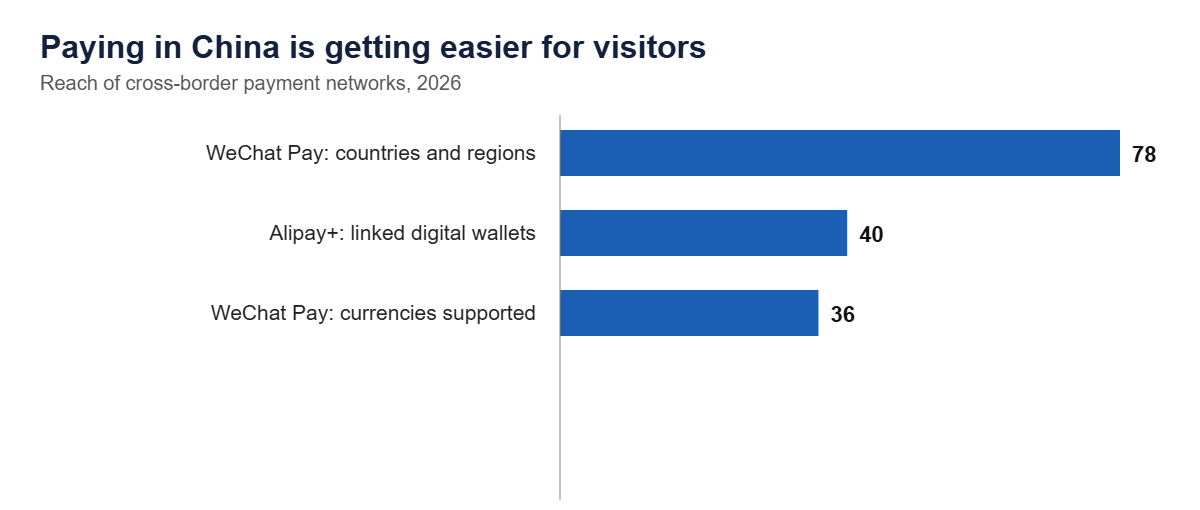
- WeChat Pay’s cross-border service covers 78 countries and regions and supports 36 currencies, while Alipay+ links more than 40 digital wallets.
- WeChat Pay now works directly with national QR-code systems in South Korea, Sri Lanka, Thailand, Malaysia and Singapore.
- Earlier in 2026, China issued a guideline requiring support for foreign bank cards and overseas e-wallets in retail, dining, transport, hotels and tourism.
- Inbound trips passed 150 million in 2025, up 17%, per People’s Daily.
When we wrote the first version of this guide, a foreigner needed a Chinese bank card to pay with WeChat. In 2026 a visitor can link a foreign card or wallet before landing.
The old rule and the new rule
In our early research, WeChat payments worked only with Chinese banks, and not with all of them. Foreigners living, in China had to open a local account first, which was a real barrier for short stays.
The picture has changed in three steps:
- Foreign cards were allowed to link to the wallet, with limits per transaction.
- Platforms such as WeChat Pay and Alipay opened cross-border links with overseas e-wallets.
- The government now asks merchants in tourism sectors to support foreign cards and overseas wallets.
How a visitor sets it up
The steps from our first guide remain a useful base, though menus change:
- Open the “Me” tab, then “My Bank Cards” (in some versions the name changes after an update).
- If the tab is missing, switching the app language to Chinese for a while may bring it back.
- Choose “Cards”, then “add a card”, and enter the card number, personal details and phone number.
- Complete the identity check required by the app, which can change over time.
At the counter, the app shows a QR code or scans the merchant’s code. In the early Version, small amounts below RMB 300 could be paid without entering a password, and larger sums needed one.
What visitors can do with the app
- Order a taxi through Didi, in most large cities.
- Top up a mobile phone without buying cards.
- Shop online through the integrated e-commerce partner platforms.
- Send money to other accounts, and split a bill with friends.
- Book restaurant deals through Dianping and cinema tickets.
- Pay at shops, restaurants, hotels and transport networks.
The old list looks short compared with today. Mini programs now cover trains, museums, parking,. city services and hotel booking, so the app works as a travel companion.
Why this matters for brands
Inbound visitors often shop for gifts and local products, and when payment works smoothly, a shop can serve them without staff using English or handling foreign cash. Brands that accept foreign wallets, show clear prices and offer tax-refund help are more likely to win these visitors.
For foreign companies living inside China, the change is also practical. Employees can pay for meals, taxis and online orders from their first week, which reduces onboarding friction.
Limits and risks
- Transaction limits still apply to foreign cards, so large purchases may need a bank transfer.
- Foreign card fees can add costs.
- Some small shops still prefer local accounts and may refuse unfamiliar wallets.
- Data and identity rules are strict, so visitors must keep documents ready.
A short history of why this was hard
Mobile payment in China grew first among residents with local bank accounts. Platforms had to meet anti-money-laundering rules, identity checks and strict limits on foreign exchange. For several years, a foreigner who wanted to pay by phone needed a local bank account, a local phone number and a Chinese address, which many short-term visitors did not have.
Policy changed because the cost of exclusion became visible. Inbound tourism fell during the pandemic years, and when borders reopened, visitors complained that they could not pay for a taxi or a meal. Authorities, banks and platforms responded with a mix of rule changes, wallet links and support for foreign cards in the places visitors use the most, such as airports, hotels and scenic spots.
For businesses, the lesson is that regulation can move quickly when it blocks growth. A shop or a service company that watches these changes can be early, instead of waiting for visitors to complain.
Daxue Take
We would consider these options, with their limits:
- If the company is a retailer, display QR codes for the main wallets and prepare English or multilingual signs. Test with a small number of stores near tourist flows.
- If the company is a hotel or restaurant, link payment with booking, so that visitors can pay before arrival.
- If the company is a foreign brand selling online in China, use a local payment partner. A foreign card is a payment tool for visitors, not a sales channel for a company.
- If the company is a start-up in payments, expect a market dominated by two giants, with room only for specialist links such as business travel or tax refunds.
The limit is policy. Payment rules and anti-fraud checks change often, so processes should be reviewed every year.
What to watch next
- The number of merchants that accept foreign cards in practice.
- New wallet links with more countries.
- Growth in inbound spending after visa-free policies.
- Our related reading on WeChat for business, leisure in China and Chinese tourists online.
FAQ
Can foreigners use WeChat Pay in China?
Yes, by linking a foreign card or an overseas wallet that is supported.
Where is the payment menu?
In the “Me” tab, under “My Bank Cards” or the payment section.
How many countries does WeChat Pay cover?
78 countries and regions, with 36 currencies.
Is Alipay an alternative?
Yes, Alipay and Alipay+ serve many inbound visitors, and both are widely accepted.
Is cash still accepted?
Often yes, but many places prefer mobile payment, so visitors should link a wallet before arrival.
About Daxue Consulting
Daxue Consulting is a market research and strategy consulting firm focused on China, founded in Beijing in 2012, with offices in Shanghai, Beijing and Hong Kong. We have delivered more than 800 projects for international brands. To discuss digital payments and travel in China, see our market research services or contact our team.