
When the Phoenix Suns and Brooklyn Nets tipped off in Macao in October 2025, the headlines focused on the NBA’s return to Mainland China after a six-year freeze-out. While the NBA was shut out, an enormous domestic basketball market grew up. Today, China is the world’s second biggest basketball market behind the United States, propelled by a massive youth base and rising homegrown brands, and underwritten by government support that supplies both growth fuel and risk.

Basketball has found itself a home in China
An estimated 300 million people play basketball in China, and the NBA is the most-followed sports league on Chinese social media, with 425 million followers across its platforms. This makes basketball not a foreign novelty in China but a mainstream national sport, a market no global brand or league can afford to ignore. At the top of the domestic game sits the Chinese Basketball Association (CBA), often ranked the most financially powerful league in Asia, with budgets that let clubs consistently hire experienced international coaches and players. Moreover, the sport continues to expand inland. Although the eastern provinces dominate at a 35.3% market share, central and western China are now growing the fastest at 15.7% in 2025.

Homegrown brands are overtaking Nike
For two decades, Nike was synonymous with basketball in China. However, that is no longer the case today. In the second quarter of 2025, Nike’s sales in China fell 21%, and the market now accounts for only about 15% of Nike’s global revenue. Meanwhile, domestic rivals Anta Group and Li-Ning together hold roughly 28% of the country’s sneaker sales. Many other local brands including Peak and 361 Degrees are also moving upmarket and gaining popularity.
The main drivers behind this development are Guochao (国潮), a wave of national pride that has made homegrown labels aspirational rather than merely cheap, along with Chinese brands’ diversified reach throughout local platforms. For example, since its acquisition of Fila’s China operations in 2009, Anta Group, reinforced by its multi-brand playbook, has repositioned itself from a mass-market manufacturer to a premium player who possesses tremendous fluency in China’s own retail world of Tmall, Douyin, and WeChat.

NBA stars are also turning to Chinese brands
The most striking proof of Chinese brands’ growth is on the feet of NBA stars themselves. Since the mid-2000s, over 50 NBA players have signed sneaker deals with brands in China. Notably, Anta signed Kyrie Irving in 2023, making him a chief creative officer after Nike terminated its partnership with him. Li-Ning, which already had Dwyane Wade on a lifetime deal, signed Stephen Curry in June 2026 to a 10-year, USD 400 million contract, with plans for Curry-brand stores opening in the US. The league that made basketball famous in China is now watching Chinese companies sign its biggest names.

Youth training is the growth engine
Beneath the brands sits the market’s most durable driver: a booming youth base. More than 12,000 registered youth-training operators now compete for about 3.9 million young basketball participants across the country. Furthermore, with many Chinese parents treating coaching as essential, demand for these operators is close to inelastic, allowing leading academies to retain roughly three-quarters of their students year to year and giving the segment high cash-flow quality. Despite youth training’s rapid growth, regulatory risk still exists. As local authorities tighten oversight, small “workshop” operators are being squeezed out in favor of professional chains, a consolidation that may, in any case, stabilize and strengthen the segment.
Strong government backing, with strings attached
In contrast to the US, where basketball grew bottom-up from a Massachusetts YMCA in 1891 through colleges and a privately owned NBA, China is building its game top-down. In December 2025, a basketball reform plan released by The General Administration of Sport of China sets dated goals for a larger youth playing base, stronger professional leagues, and the men’s team qualifying for the 2028 Olympics. Furthermore, the 14th Five-Year Plan for Sports Development designated basketball as a key youth-sports initiative, fueling the number of basketball-specialty primary and secondary schools to rise from 7,856 in 2025 to 9,230 in 2026.
Without a doubt, such backing is a powerful accelerant to the market. But nonetheless, a state-built market also depends on sustained political will. China has run this playbook before, in soccer. After a 2015 reform plan tied soccer to national rejuvenation, money flooded in. In the 2016 winter transfer window, the Chinese Super League outspent every league in the world, including England’s Premier League. Then priorities shifted, spending caps landed. The reigning champion, Jiangsu FC, dissolved in 2021 just months after winning the title. Although basketball in China’s broad consumer-driven base makes it sturdier than soccer’s billionaire-owned clubs ever were, the lesson still holds: when the government’s priorities move, the money can move with them.
The NBA is back, but on Beijing’s terms
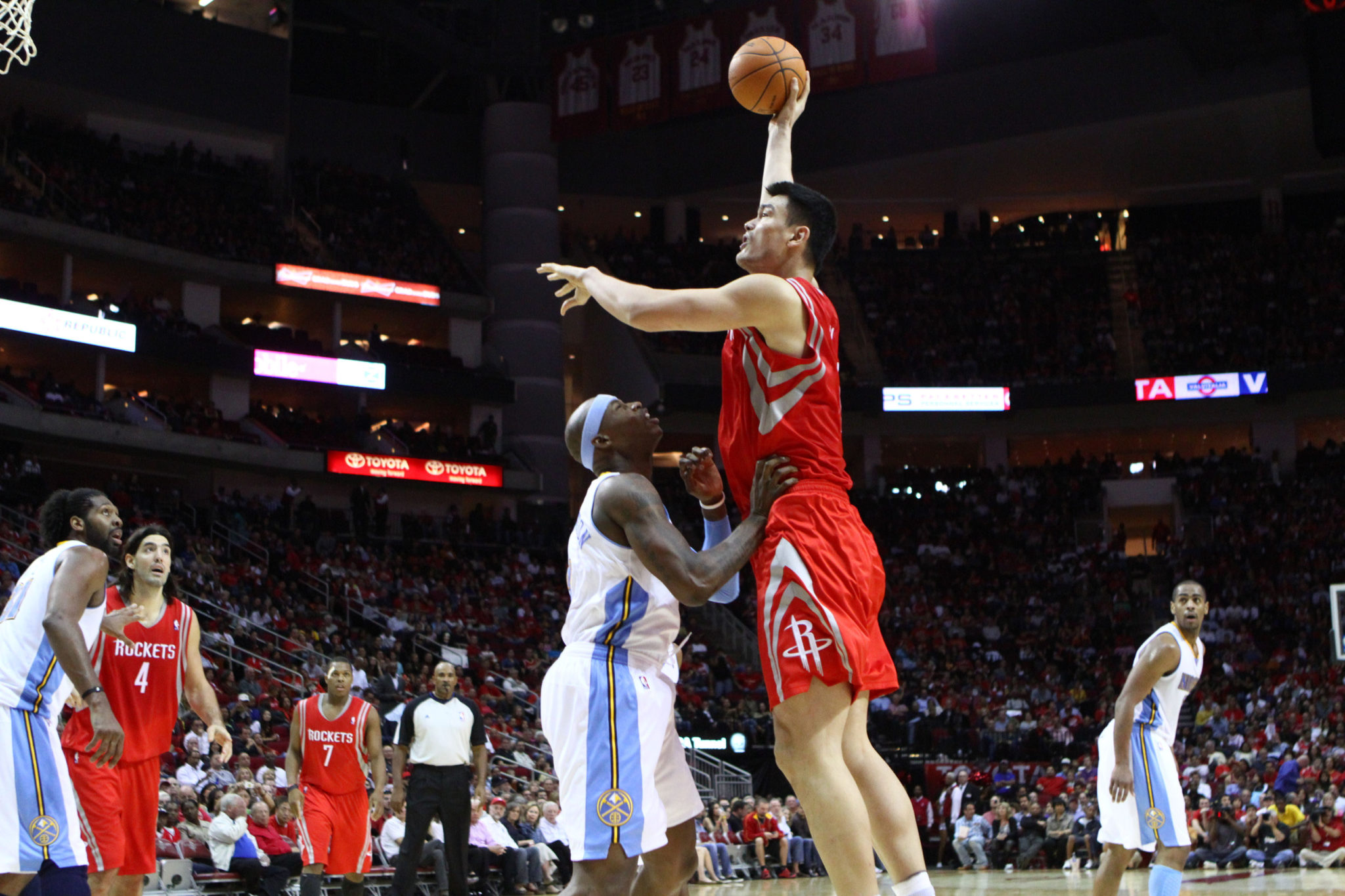
The market’s openness is real but conditional, and the NBA knows better than anyone. In 2019, a tweet by Houston Rockets general manager Daryl Morey supporting Hong Kong protesters instantly infuriated the national government. State broadcaster CCTV canceled NBA games, sponsors fled. The league was effectively shut out of its most valuable foreign market for six years.
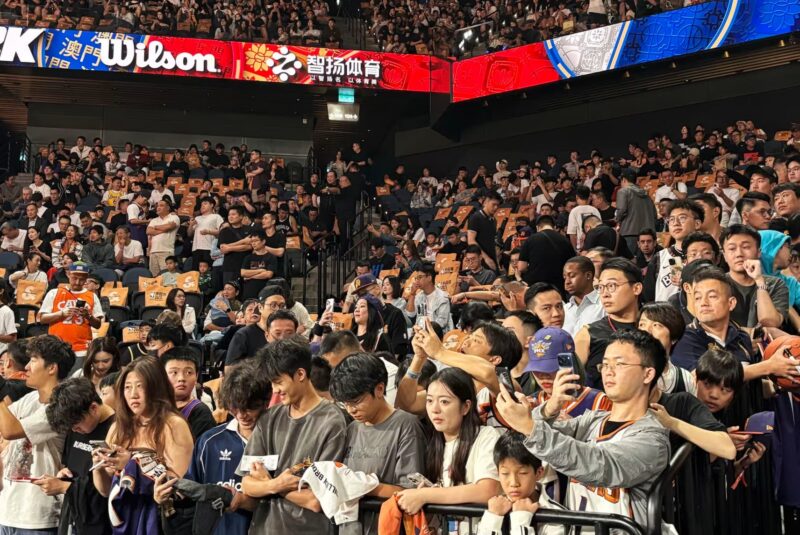
Yet the fans never left. Demand for the 2025 NBA Macao games was extremely high, with tickets going for more than USD 3,000. Far exceeding the highest secondary market ticket price of about USD 1,180 (RMB 8,000) for the 2026 CBA final. More future ties are forming too, with People’s Daily posting an essay attributed to LeBron James calling basketball “a bridge that connects us”, while the NBA partnered with the CBA to allow top Chinese teams to compete in the U.S. Overall, the upside here is tremendous, but a single misstep can still freeze it overnight.
What to remember about basketball in China
- With a fan base larger than the entire US population, basketball is a true national sport in China and the most valuable basketball market outside America, too big for anyone to ignore.
- Homegrown brands have flipped the hierarchy. Anta and Li-Ning are overtaking a faltering Nike on national pride and Chinese platforms. They now sign NBA stars like Curry and Irving.
- Sticky, recurring demand makes youth basketball training the segment to watch, with regulation-led consolidation favoring professional operators.
- Top-down funding and school mandates drive growth fast, but Chinese soccer’s collapse shows momentum can reverse when political priorities change.
- Even after a six-year freeze-out, the NBA still attracts a gigantic crowd in China who are willing to pay high amounts for merchandise and tickets. The access is lucrative and politically fragile at once.
Author and editor: Ming Yii Lai, with additional research by Hansel Guo