

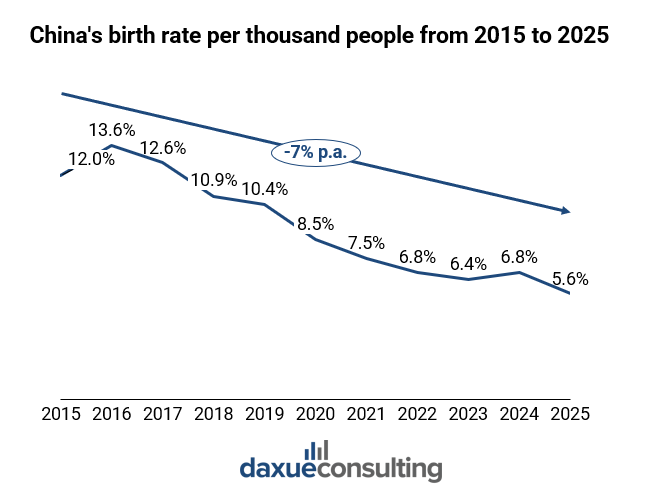
China’s recent healthcare reforms aim to address the challenges posed by its demographic transition and chart a new trajectory for economic growth. In 2025, the number of newborns reached 7.92 million, a 16.98% decrease from 9.54 million in 2024, with the birth rate per thousand people falling to 5.63, the lowest level since the founding of the People’s Republic. This demographic shift has raised concerns about how a shrinking workforce will support a growing elderly population, straining pension and healthcare systems while dampening long-term growth.
To address this challenge, China is leveraging healthcare reforms to ease families’ financial burdens and encourage higher fertility, for example, by making childbirth essentially free. However, high childcare costs remain a primary deterrent to having children. Education and housing expenses account for the bulk of these costs, whereas direct healthcare expenditures constitute only a small share of the total. Another notable objective of China’s healthcare reform is to position the country as an internationally competitive medical tourism destination. According to external projections, China’s medical tourism market is expected to reach USD 3.4 billion (approximately RMB 23.8 billion).
China’s healthcare market at a glance
China’s healthcare market remains vast. Total national healthcare expenditure reached RMB 9.09 trillion in 2024, slightly up from RMB 9.06 trillion in 2023. This positions China as the world’s second-largest healthcare spender, equivalent to 6.7% of its GDP. By comparison, U.S. healthcare spending reached USD 5.3 trillion (approximately RMB 37.1 trillion) in 2024, accounting for 17.2% of its GDP. This indicates there is still room for growth. Policy reforms have played a pivotal role in shaping the market landscape. Starting from 2024, China has overhauled its drug procurement system to reduce costs and expanded the national medical insurance drug directory to enhance patients’ access to treatment. These initiatives aim to improve healthcare efficiency and coverage.

The cost of childbearing has become a key factor in declining fertility rates
In China, the cost of raising children is extremely high, ranking second-highest globally, surpassing even those of developed countries such as the United States and Japan. According to YuWa Population, the average cost of raising a child to age 18 in China is RMB 538,000, which is more than 6.3 times the country’s per capita GDP. By comparison, this figure stands at 4.11 times in the United States and 4.26 times in Japan.
Furthermore, the cost of raising children in urban and rural areas further diverges due to differing living expenses. The average cost of raising a child from birth to age 18 in China’s urban areas is RMB 666,699, while in rural areas it is RMB 364,868. Shanghai and Beijing are the two most expensive cities for child-rearing in China, with costs reaching RMB 1,010,130 and RMB 936,375, respectively. These average expenditures underscore a critical limitation of current healthcare reforms: even if childbirth were entirely free, it would address only a fraction of the overall financial burden on families.
What percentage of the total cost of childbirth is accounted for by healthcare expenses?
Healthcare expenditures constitute only a small share of the substantial costs associated with child-rearing, with education and living expenses often accounting for a larger share. Educational costs include tuition fees, tutoring expenses, examination registration fees, and other related expenses. As education continues to advance, these costs are steadily increasing. YuWa Population breaks down the cost of raising a child from pregnancy through age 18 based on China’s national per-capita consumption composition. The three stages with the highest proportions are: ages 6-14, ages 3-5, and ages 15-17. These stages typically involve higher proportions of education expenses and related living costs (food, clothing, housing). From ages 6 to 18, education expenses account for 34% of the total child-rearing costs.

Beyond direct expenses, childbirth also incurs substantial indirect costs. Career interruptions and opportunity costs disproportionately affect women. In China, women typically experience reduced working hours and income after having children, especially during early childhood, while men face minimal impact on their paid work time. Research shows that Chinese women accumulate 2,106 fewer working hours and approximately 17% lower wages during their children’s ages 0-4. In contrast, women in the UK, US, and Japan experience smaller wage declines of 4-7% after having one child. This discourages highly educated Chinese women from interrupting their careers to have multiple children. The difficulty of balancing work and family, coupled with inadequate childcare services, increases the intangible costs of child-rearing. As YuWa points out, the ideal number of children for Chinese people is now less than two, making China one of the countries with the lowest ideal family size in the world.
Recent healthcare reforms to encourage childbearing
The Chinese government has recognized the fertility crisis and plans to introduce multiple healthcare-related initiatives aimed at reducing the cost of childbirth. Among the most notable measures announced in late 2025 is a plan to achieve essentially free childbirth nationwide by 2026.
According to the National Healthcare Security Administration, the goal is to achieve “zero out-of-pocket expenses” for standard childbirth services under the public medical insurance system. However, it is important to note that current healthcare reform policies primarily cover basic expenses, such as delivery and hospitalization costs, which correspond to those incurred during pregnancy and the postpartum confinement period. The combined total of these two categories accounts for less than 5% of the overall child-rearing expenses. This means that while reducing medical costs can alleviate the financial burden on families, its impact on the overall economic situation remains negligible. Nevertheless, these policies at least demonstrate that the government prioritizes families and is willing to invest in the birth and health of the next generation.
Opening China’s healthcare sector to foreign patients
Foreign patients are already coming to China for healthcare, and this trend is evident on overseas social media platforms. On TikTok, the hashtag #medicaltourism attracts a large volume of posts from foreigners documenting treatment in China, with common destinations including dentists, ophthalmologists, and traditional Chinese medicine practitioners. This demand is also reflected in hospital statistics. Driven by years of rising demand, Chinese hospitals welcomed 1.28 million foreign patients in 2025, a 73.6% increase from 2022. Shenzhen alone provided medical services to 770,000 international patients, including 640,000 from Hong Kong and Macau, with the remainder from countries such as the United States, Canada, and Japan. Shanghai’s 13 designated hospitals treated nearly 270,000 foreign patients, a 15% year-on-year increase.
The main drivers are price competitiveness and high treatment efficiency. Dentistry is a typical example: because dental care is often not covered by insurance in many countries, a simple teeth cleaning at a Chinese hospital can cost several dozen times less, and treatment is often available on the same day as the appointment. Most foreign patients are not seeking treatment for rare or complex diseases. Their needs are concentrated on routine, high-frequency services, including dental, ophthalmic, cardiovascular, dermatological, and gastrointestinal care, as well as physical examinations and affordable alternatives to costly procedures.
The government is vigorously promoting the medical tourism industry
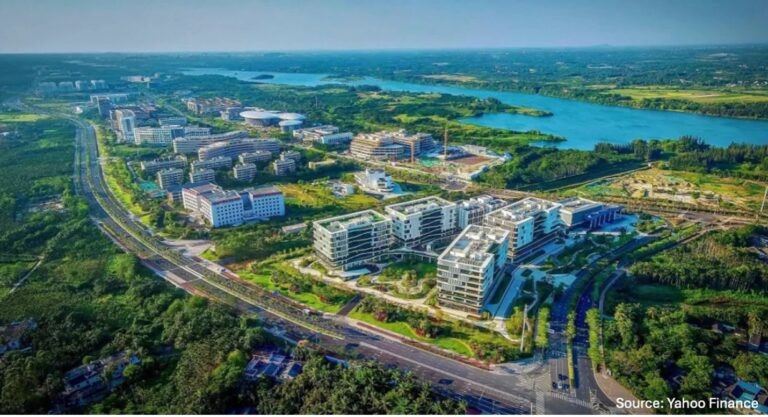
In response to this growing demand, the Chinese government is actively expanding the supply of international-facing healthcare services and accelerating sector opening. Since late 2024, China has implemented a pilot program permitting wholly foreign-owned hospitals in nine designated regions, including Beijing, Shanghai, and Hainan Island. This initiative aims to expand healthcare services for foreign nationals, diversify the supply, and meet both domestic and international demand. The most prominent example is the Boao Lecheng International Medical Tourism Pilot Zone in Hainan.
As China’s sole dedicated medical industry zone, it has introduced more than 500 innovative drugs and medical devices approved overseas but not yet launched domestically, thereby enabling medical tourists to access more advanced treatment options. The zone’s unique “zero-tariff” policy for imported medical devices and pharmaceuticals also delivers significant cost advantages to enterprises. Data indicates that from December 2024 to the end of 2025, approximately RMB 62 million in tariffs were saved. In 2025, the zone recorded 865,300 medical tourism visits, representing a 109.18% increase over the previous year.
Key takeaways at a glance from China’s healthcare reform
- China’s demographic pressure is accelerating. In 2025, the number of newborns fell to 7.92 million, and the total fertility rate declined to 5.63 births per thousand, reinforcing concerns about a shrinking workforce and a rising aging-related fiscal burden.
- Healthcare is a major economic sector, but it remains smaller than its peers in terms of its share of GDP. Total national healthcare expenditure reached RMB 9.09 trillion in 2024 (approximately 6.7% of GDP), which remains well below that of other developed countries, indicating scope for market expansion.
- Child-rearing affordability is the core constraint, not the delivery bill. The cost of raising a child to age 18 in China averages RMB 538,000, equivalent to 6.3 times GDP per capita, higher than in the U.S. (4.11 times) and Japan (4.26 times).
- Healthcare costs are a small share of total fertility costs, limiting the direct fertility uplift from “free childbirth.” Combined pregnancy and postpartum medical expenses are under 5% of total child-rearing costs, whereas education alone accounts for 34% of costs from ages 6–18.
- A second reform track is emerging: the opening of medical services and inbound demand. China reported 1.28 million foreign patients in 2025, while Boao Lecheng’s policy advantages, including “zero-tariff” imports, supported 865,300 medical tourism visits in 2025, up 109.18% year-on-year.