
South Korea’s coffee market remains large and steadily expanding, growing from USD 3.54 billion in 2024 and projected to reach USD 5.57 billion by 2033 at a 5.21% CAGR. However, as the market moves toward saturation, growth is no longer driven primarily by store expansion. Instead, it is increasingly shaped by premiumization, product diversification, and experience-led consumption. The market is driven more by import dependency, café culture, and convenience store/RTD habits than by local coffee growing in South Korea, a rare example of a non-producing nation with extraordinarily high coffee demand.
Koreans relieve their stress and heavy workload through coffee
In South Korea, coffee has become a daily essential, deeply embedded in both social interactions and work routines, reflecting one of the world’s strongest cafe cultures. As consumers face heavy workloads and fast-paced lifestyles, coffee is increasingly relied upon not just for enjoyment but for its functional benefits, enhancing focus, creativity, and providing a quick energy boost. This shift has also fueled demand for convenience, with more consumers turning to easy-to-prepare options such as coffee pods, capsules, and instant coffee, enabling high-quality coffee consumption at home with minimal time and effort, and ultimately supporting continued market growth.
Koreans choose fast coffee for their fast-paced lifestyle
Convenience and RTD (ready-to-drink) coffee continue to grow in South Korea as they align closely with the country’s fast-paced, on-the-go lifestyle and demand for affordable, grab-and-go options. According to Grand View Horizon statistics, the market was USD 854.7 million in 2024 and is expected to grow up to USD 1,204.7 million by 2030. The RTD coffee market is steadily expanding, supported by formats such as canned and cartoned drinks, strong retail and online distribution, and increasing interest in premium-style coffee at accessible prices. Convenience stores play a central role in this growth, offering quick, low-cost coffee while continuously upgrading quality and variety. As a result, RTD and convenience-store coffee have become practical everyday options: cheaper, faster, and more accessible, fitting seamlessly into long commutes, busy work environments, and value-driven consumption habits.
Two-speed coffee market: Loyalty at the top, growth at the bottom
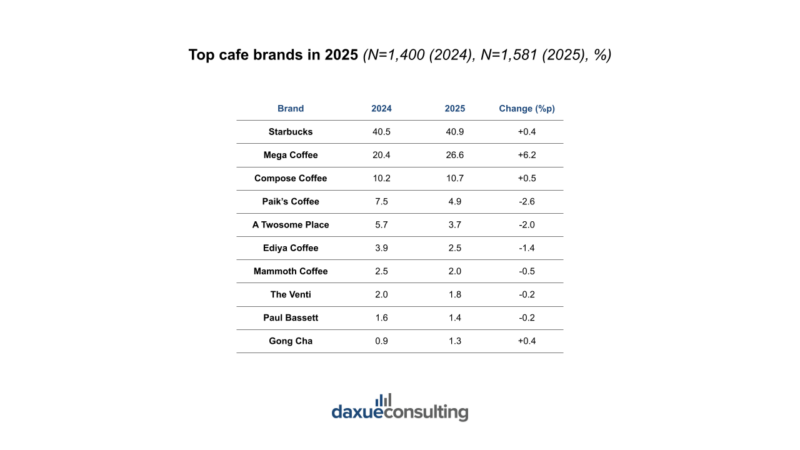
South Korea’s coffee market is splitting into two distinct tracks. According to a survey of 1,581 respodnents conducted by Opensurvey Dataspace in 2025, Starbucks maintained a dominant 40.9% share and showed an increased visit frequency from 6.73 to 7.22 times per month, signaling deepening loyalty among established consumers. Mega Coffee rapidly expanded, jumping from 20.4% to 26.6% in just one year and solidifying its position as the clear number two player. This sharp rise, far ahead of Compose Coffee (10.7%), Paik’s Coffee (4.9%), and A Twosome Place (3.7%), reflects strong adoption among MZ Generation consumers, particularly those in their 20s and students, who prioritize affordability and frequency. In contrast, older consumers continue to favor premium brands, reinforcing a clear generational divide where one segment trades up for experience and brand, while another trades down for value and accessibility.
Price is not the main factor defining premium cafe
Consumers perceive cafes as premium spaces in South Korea. When evaluating a cafe’s level of sophistication, coffee quality and bean standards rank highest, followed by interior design and atmosphere (49.8%) and the quality of bakery and dessert offerings (40.9%). This shows that the cafe experience is expanding beyond drinking into a broader food experience, where desserts and overall ambiance play a key role. At the same time, factors like layout, service, and branding also carry meaningful weight, while price alone is less important, suggesting that Korean consumers define “premium” through a combination of quality, space, and overall experience rather than cost.

Korea’s cafe-goers chase aesthetic, novelty, and moments
In Korea, going to a cafe is less about grabbing a quick drink and more about the overall experience. Cafes differentiate themselves through inventive beverages, such as honeycomb lattes, dalgona coffee, and matcha, that encourage customers to seek out unique, signature drinks rather than familiar options. At the same time, many choose cafes based on how “shareable” they are, reflecting how closely social media is tied to everyday choices. Complementing these offerings are carefully curated interiors, often built around distinct themes or minimalist aesthetics, which transform cafes into Instagrammable destinations. This shows the Korean mindset that values discovery, atmosphere, and small moments of enjoyment, with people willing to explore and spend more for places that feel unique and memorable.
Korean style cafes are going global with design, dessert, and a slower coffee experience
Korean-style cafes are gaining traction overseas, particularly in cities like Paris, London, and Hong Kong, where they introduce not just drinks but a distinct cafe format built around curated menus, design-led spaces, and a slower, stay-longer experience that contrasts with more transactional coffee cultures.
Matcha is not niche anymore
In South Korea, matcha has evolved into a major cafe and retail trend, driven by its strong social media presence and its alignment with health-conscious consumption among younger consumers. The MZ Generation increasingly associates matcha with a “better-for-you” image, linked to antioxidants, a smoother and more balanced caffeine effect, and an overall cleaner lifestyle choice compared to traditional coffee. At the same time, its soft green color and minimalist aesthetic fit seamlessly into Korea’s highly visual cafe culture, where appearance plays a key role in purchase decisions. Major chains such as Starbucks have further normalized matcha by integrating it into everyday drink menus, accelerating its shift from a niche ingredient to a daily option.
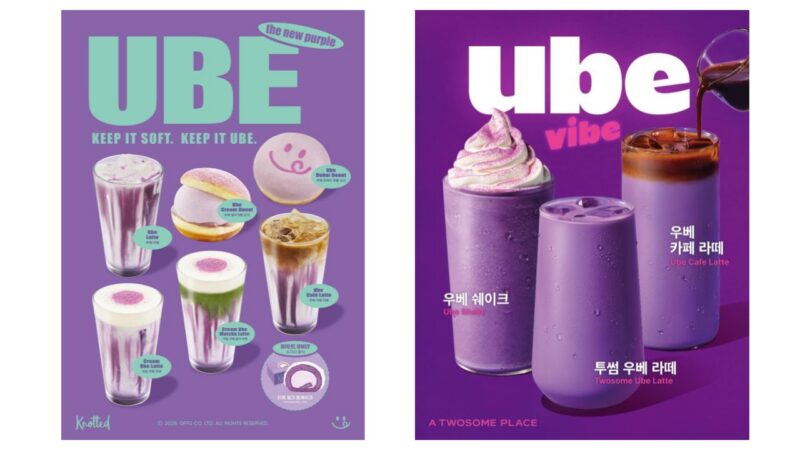
From green to purple: Ube is taking over South Korea as a new cafe obsession
Ube is gaining popularity in South Korea’s coffee market because it offers a strong visual impact with minimal taste risk. Used mainly in latte-based drinks, its vivid purple color creates instant differentiation while keeping the familiar coffee experience intact. Consumers see ube coffee as a “low-commitment novelty”, drawn by its aesthetic but reassured by its mild, creamy sweetness that blends easily with milk and espresso. However, low awareness of ube means demand is still driven more by visuals than flavor, making clear descriptions and familiar latte positioning key to repeat purchases. This trend shows that Korean consumers are visually driven trend adopters who prefer trying new drinks when they look distinctive but still taste familiar.
South Korea’s coffee market is maturing with a clear premium-value split
- In South Korea’s F&B market, coffee is shifting from expansion to experience-driven value.
- Coffee is a daily functional necessity for energy, focus, and stress relief.
- Convenience formats like RTD and instant coffee are rising due to fast-paced lifestyles and affordability.
- The market splits into premium loyalty (e.g., Starbucks) and fast-growing budget brands (e.g., Mega Coffee). Premium cafes are defined more by quality, design, and experience than by price.
- Cafe visits are driven by aesthetics, social media, and the overall experience rather than just coffee. Trend-driven drinks like matcha and ube show strong demand for visually appealing and familiar drinks.
- Korean-style cafes are expanding globally with a focus on design and slower, experience-based consumption.
Author: Sory Park, with additional research by Mukaddam