
In 2024, South Korea’s oral care market stood at USD 975.9 million. While significantly smaller than the United States (USD 11.4 billion), the gap compared to neighboring countries, such as China (USD 2.6 billion) and Japan (USD 1.6 billion), is smaller than expected given their significantly larger populations. Overall, Koreans show high awareness of oral care, but usage patterns vary across age groups. By 2030, the oral care market in Korea is expected to reach USD 1.5 billion, growing at a compound annual growth rate of 6.9% from 2025 to 2030.
Read our Korea’s MZ Generation report

Korean consumers treat oral care as a part of beauty and self-care
South Korea’s oral care market can be divided into several key categories, including toothpaste, toothbrushes, mouthwash, and dental accessories such as dental floss and interdental brushes. Toothpaste remains the largest segment, valued at about USD 410 million in 2024. However, growth in other categories is expected to increase as consumers view oral care not just as a health need but as part of beauty and wellness routines. Consumers pay attention to their oral condition not only after waking up, within 30 minutes after meals, and before bed, but across multiple moments throughout the day.
Mouthwash and breath-care products are among the fastest-growing categories. Their sales rose from KRW 116.3 billion in 2019 to KRW 182 billion in 2024, reflecting increasing demand for fresh breath and convenient oral hygiene solutions. Moreover, consumers are seeking more functional oral care products with whitening, sensitivity-care, and eco-friendly formulations.
Koreans take preventive oral care
According to a survey conducted by Korea Research Co., Ltd. with 1,000 participants between January 23rd and 26th, 2026, 77% of respondents use dental floss or interdental brushes, making them among the most widely used oral care products. This is followed by fluoride toothpaste (66%) and mouthwash (64%). This shows that these products are commonly integrated into everyday hygiene routines. In contrast, products such as electric toothbrushes (20%), tartar removers (18%), teeth whiteners (15%), and mouthpieces (9%) show significantly lower adoption. This pattern indicates that preventive plaque removal remains the core focus of daily oral care routines.
High awareness, but behavior does not always meet recommendations
Korean consumers generally show high awareness of oral health, but their daily habits do not always match recommended practices. According to the aforementioned survey, around 82% of Koreans said they were concerned about oral health, showing a level of attention comparable to physical health management. However, this concern does not fully translate into optimal routines, with interest in oral health increasing with age.
Koreans fall short in brushing their teeth enough times, but they use other products throughout the day
Brushing twice a day is the most common across all age groups. Only 38% brush three times or more per day, falling short of the “three times per day” guideline recommended by dental experts. However, consumers partially compensate by using other oral care tools like dental floss and interdental brushes throughout the day.

Generational divide shapes oral care perceptions and usage
In Korea, young consumers increasingly view oral care not only as a health practice but also as part of social etiquette and personal grooming. Those under 30 years old use a wider range of products, including mouthwashes, tongue cleaners, and breath fresheners, compared to other age groups. This trend highlights how oral hygiene among younger Koreans is evolving into a lifestyle habit tied to social interaction and appearance.
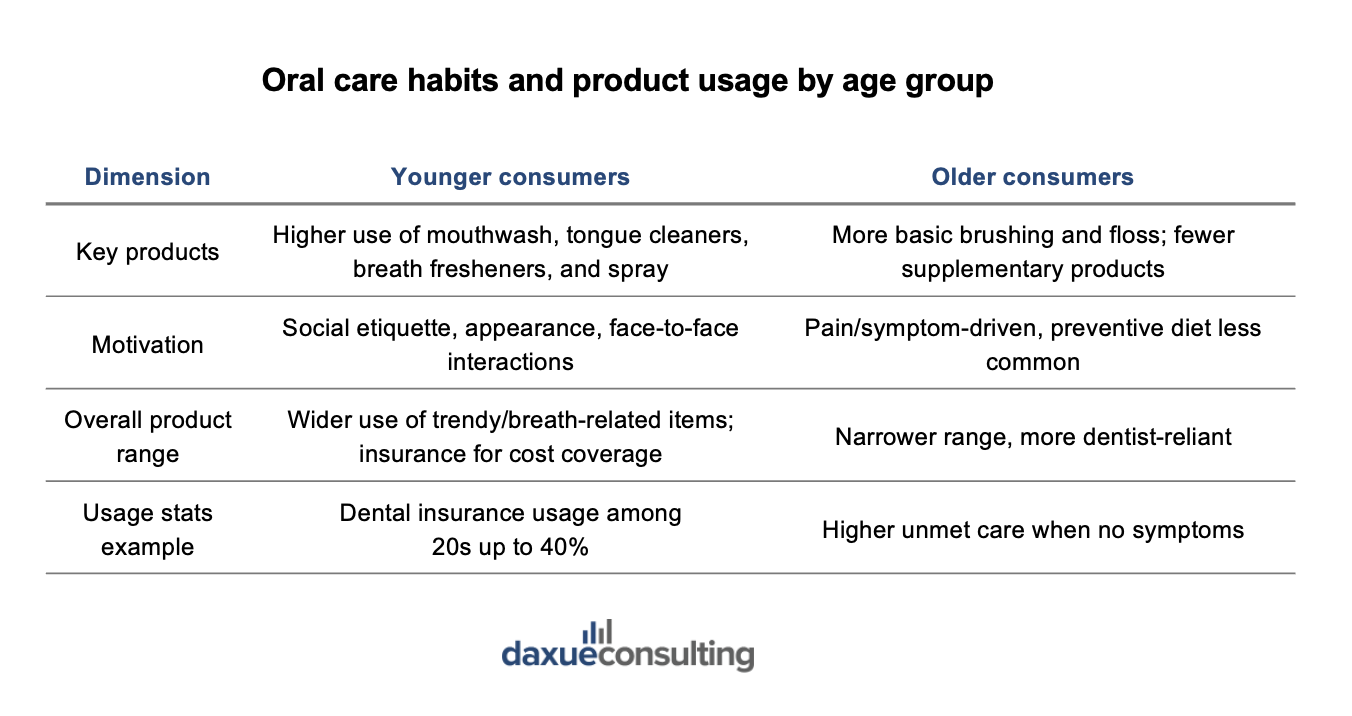
Older Korean consumers show greater health concern. 72% of people in their 20s and 30s reported interest in oral health, compared with 80% of those in their 40s and 50s and 90% among those aged 60 and older. In particular, more than 20% of respondents in their 60s and above stated that they were “very concerned” about oral health, reflecting a stronger awareness of dental and gum health as age-related changes became more noticeable.
Parental awareness drives growth in children’s oral care
Rising parental awareness of preventive dental health is supporting growth in the children’s oral care segment. The pediatric oral care market in South Korea reached USD 228 million in 2024 and is projected to grow to USD 332 million by 2030, expanding at a CAGR of 6.5%. Demand is increasing for products such as flavored toothpaste, educational brushing tools, and child-friendly toothbrush designs, reflecting stronger focus on early dental care habits. This trend shows that preventive oral health is becoming a priority for families with young children. That is partly because in Korea’s appearance-conscious society, parents place strong emphasis on healthy and well-maintained teeth from an early age, while high parental investment in children’s health and development further supports demand for specialized pediatric oral care products.
Korean consumers prefer local brands for daily oral care, but also explore premium products
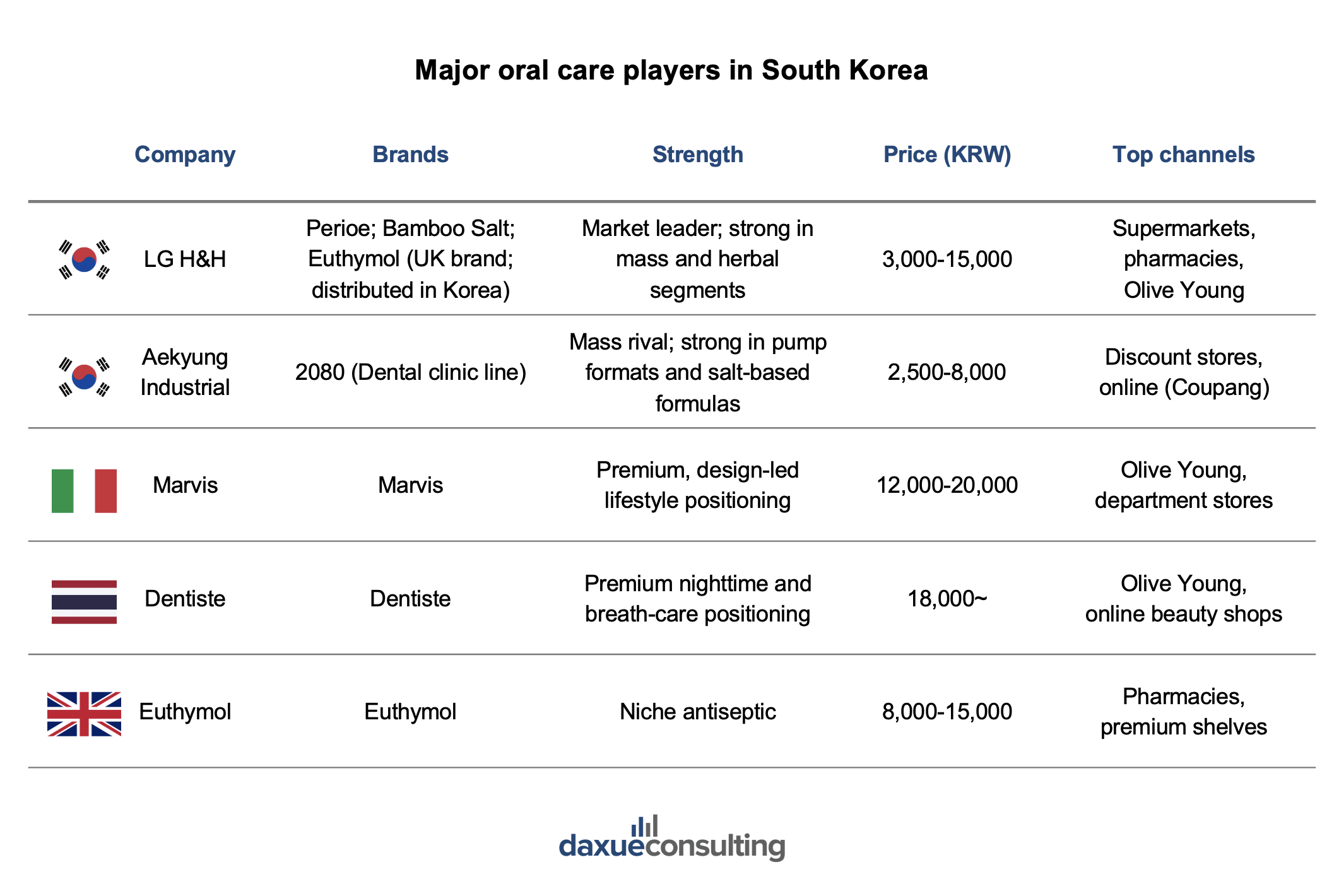
In South Korea’s oral care market, consumers prefer domestic brands such as Perioe, Bamboo Salt from LG Household & Health Care and Dental Clinic 2080 from Aekyung Industrial, which hold a strong position in the mass toothpaste segment. However, premium imported brands like Marvis, Dentiste, and Euthymol are gaining popularity, showing that Korean consumers stay loyal to local essentials but seek foreign brands for premium or “small luxury” products.
Marvis transforms toothpaste into a premium “small luxury” in South Korea
Marvis, an Italian brand, entered the Korean market around 2018 as a premium European-style toothpaste, positioning itself not as a daily commodity but as a lifestyle product. Priced at around 19,900 KRW per tube, significantly higher than mass brands such as Perioe and Dental Clinic 2080, the brand focused on beauty and lifestyle channels like Olive Young in South Korea rather than supermarkets. Its retro European apothecary image, colorful packaging, and emphasis on natural mint ingredients appealed particularly to younger consumers seeking affordable “small luxury” items that also function as aesthetic bathroom accessories. Marvis has sold over 4 million units in Korea from 2018 to 2024 and achieved annual sales growth above 20%, supported by strong online performance and gifting demand through platforms such as KakaoTalk.
Tongue care is gaining popularity in oral care routines
Tongue care is emerging as a notable trend in South Korea’s oral care market, with tongue-cleaning gels and dedicated tongue-care products increasingly positioned as stand-alone solutions rather than simple toothbrush accessories. These products target issues such as tongue coating, sour breath, and oral discomfort while emphasizing convenience through easy-to-apply gel formats that require minimal brushing. For example, Dental-B’s Ora Clean Gel is promoted specifically for tongue hygiene and quick breath improvement. Early consumer interest has been visible on major e-commerce platforms in South Korea such as Coupang, where online reviews and product buzz highlight these solutions as fast and convenient options for managing halitosis.

In South Korea’s oral care market, oral hygiene is part of beauty
- South Korea’s oral care market was valued at USD 975.9 million in 2024. It is significantly smaller than the United States. However, the gap compared to more populous countries, including China (USD 2.6 billion) and Japan (USD 1.6 billion) is smaller than expected given the population size. By 2030, the market is projected to reach USD 1.5 billion by 2030.
- Product categories are expanding beyond toothbrushes and toothpastes. Floss and interdental brushes are widely used, showing a strong focus on preventive care practiced throughout the day.
- Overall, Koreans have a high awareness of oral health. However, younger Koreans tend to view oral hygiene as part of appearance, wellness, and lifestyle, not just basic health, compared to older adults.
- The MZ Generation in South Korea uses more products like mouthwash and tongue cleaners. They treat oral care as part of social etiquette and grooming.
- Koreans prefer local brands for everyday use, while premium imported brands are growing.
Author: Sory Park, with additional research by Mukaddam