
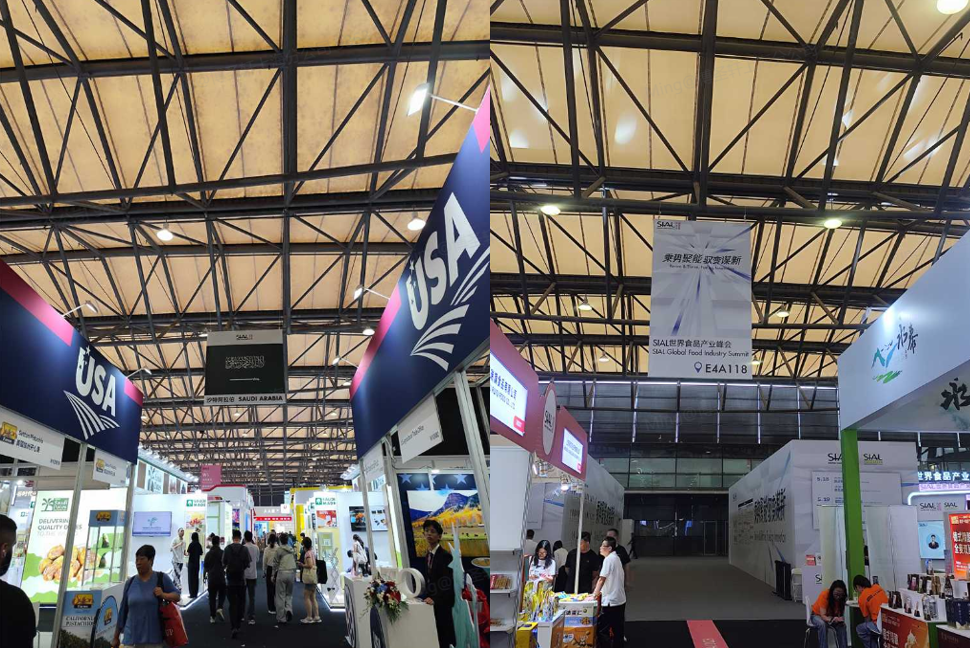
The recent SIAL China 2026 exhibition revealed a food and beverage industry increasingly focused on trust, provenance, and functional value. Across the exhibition halls, organic products graduated into a standalone category, geographical origin became a front-of-pack selling point, and brands showcased visible fruit, vegetable, and functional ingredients as proof of authenticity. Meanwhile, categories that dominated previous years, notably coconut water and camel milk, largely disappeared from the spotlight.
Download our China F&B White Paper
The common thread is that the market is moving from claims to verification. Consumers are becoming more skeptical of broad health and naturalness narratives, while rewarding signals that feel tangible and defensible: certified organic standards, traceable origins, and ingredients they can actually see.
Below are our observations on what’s emerging, what’s enduring, and what’s fading in China’s F&B market.
What’s emerging at SIAL China 2026
Organic and functional food:
This year, the organic and functional food segment had its own hall. Covering categories from agricultural produce to packaged food to organic raw materials, it has graduated from a niche label to a standalone category. The trend goes by “organic plus X”: organic + geographical indication, organic + functional ingredients, organic + infant/senior demographics. But there are none on organic + post-surgery recovery/chemotherapy/ similar variants due to stricter regulations on this segment. Speaking of regulations, there are booths that are introducing services on streamlining international organic standards to Chinese ones and vice versa.
On the functional side, two tracks are running in parallel. The Western evidence-based route which focus on probiotics, collagen peptides and the Chinese route which is on food-as-medicine (药食同源) path. For the latter, these manufacturers aren’t filing for 蓝帽子 (health food registration). These brands are still sidestepping the red tape entirely by telling stories rooted in TCM perception and centuries of food tradition. To a certain extent, infusing goji berries for macular health, poria for dampness eradication, and Chinese yams for stomach health are somehow instilled in consumers’ cultural DNA that bypassed clinical trials. So, Chinese manufacturers leverage the positive perception in creating snacks and breakfast drinks that resonate with Chinese consumers.
Geographical origin as a selling point for authenticity
Origin has moved from the fine print to the front of the purchase decision. The logic behind it is that terroir can’t be replicated, and scarcity is the premium. Due to the geographical difference in China, consumers often have the perception that certain regions are better at producing certain things. Generations of culinary tradition have hardwired the belief that certain regions are simply better at producing certain agricultural goods. Zhejiang for Longjing tea, Ningxia for goji berries, Xinjiang for tomatoes, Yunnan for walnuts and coffee, and Heilongjiang for rice.
What’s new is how systematically provincial governments are now weaponizing this. entire provinces or cities exhibiting under a unified geographical banner. It’s a public-private push: the government lends institutional credibility, the brands ride the origin halo. For consumers, “Zhangye Pavilion” or “Hunan Green Food Collective” reads as pre-vetted authenticity. For brands, it’s a shortcut to trust that would take years to build alone. That’s what turns a provenance claim into a defensible moat.

Infusing natural ingredients into daily snacks
As freeze-drying technology has scaled and costs have come down, real fruit cubes, vegetable flakes, and juice-infused pieces are finding their way into biscuits, chocolate, and granola bars. The consumer shift is subtle but important: people are starting to read ingredient lists with more suspicion toward erythritol and sucralose, and gravitating toward snacks where you can see the raw material. For instance, a cookie with visible cranberry pieces is more persuasive than any “natural flavor” claim. In the Chinese market context, it will be resonate more if they mention the geographical origin, such as Xinjiang’s raisins in granola bars, Changbaishan blueberries in yoghurts, etc.

What’s remaining at SIAL China 2026
Convenience is still one of the biggest drivers in the industry
Most exhibition halls are dominated by snacks and ultra-processed foods. The market’s gravitational pull remains convenience and speed. Moreover, consumers are looking for guilt-free convenience and transparency in the ingredient list. Korean and Japanese manufacturers are also making the same bet with instant meals. There were preservative-free microwavable rice boxes (both white and brown rice), hot-water instant konjac noodles, and portable meal replacements that taste like actual food. Among Chinese manufacturers, the self-heating meal boxes hype was gone, and most of them focused on vacuum-packed eggs, meat, seafood strips, and preserved vegetables or fruits.
Low-GI: awareness is there, supply is not
Most booths still stress “zero sugar.” Diving deeper into the ingredient list, sucrose is replaced by erythritol, allulose, sucralose, or other synthetic sugar replacements. Very few booths dared to put a certified low-GI claim.

High protein is being commoditized on the nutrition table
Last year, high protein could anchor a booth’s entire pitch, especially in meat-based snack booths. This year, they focused more on the traceability and the lack of antibiotics of meat or seafood sources. It seems that consumers expect it to be there, but won’t pay a premium for it anymore.
IP collaboration is still a big thing
For young adults: Le Petit Prince, One Piece, Doraemon, Crayon Shin-chan, Hello Kitty. Nostalgia and character affinity drive gifting and social sharing.
For kids: PAW Patrol, Peppa Pig, and similar. Equal effort was given to the “ingredient story,” like natural vegetable powders in the dough, easy-chew shapes, and clean-label reassurance.

What’s disappearing at SIAL China 2026
Coconut water
Last year, coconut water was the hype. This year, due to the scandal where even well-known brands such as If, Jiaguoyuan, and others were found passing off flavored sugar water as NFC (not-from-concentrate) coconut water, very few overseas brands are in the exhibition. The scandal damages the entire “natural hydration” claim architecture. Consumers who thought they were buying pure coconut water now read labels with suspicion.
It will also have a tailwind for other F&B brands. Consumers are more concerned about origin transparency, visible real ingredients, and organic certification. The market is now pricing in verification, not just claims. This is also part of the drivers pushing geographical origin and organic certification needs.
Camel milk
There were at least 20 booths last year, from both the Middle East and China. The camel milk segment disappeared this year. There are less than five registered names in the booklet and two spotted in the hall.
Key takeaways from SIAL China 2026:
- Organic + X is on the rise where organic products now have a standalone hall. Innovations spans across geographical origin, functional ingredients, and senior/infant-focused offerings. Post-surgery or medical-use variants remain absent due to regulatory restrictions.
- Geographical origin now drives premium perception in China. Chinese provinces and cities are unifying brands under collective booths, turning terroir into a defensible competitive moat.
- Visible, natural ingredients gain trust. Hence, there are freeze-dried fruits and vegetables in snacks, along with clearly sourced ingredients, are increasingly valued by consumers.
- Convenience remains essential. So, instant meals, vacuum-packed proteins, and clean-label products continue to dominate. This reflects sustained consumer demand for speed and practicality.
- The number of coconut water and camel milk booths decline sharply. Scandals and waning interest caused coconut water to lose momentum, while camel milk virtually disappeared from the exhibition, most likely due to challenges in consumer education and stability of supply chain.
Author: Ming Yii Lai