

Updated in July 2026.
Converse in China in 3 figures
USD 1.69 billion
Converse revenue in fiscal 2025, down 19% (NIKE, Inc.).
USD 6.59 billion
NIKE, Inc. revenue in Greater China in fiscal 2025, down 13%.
USD 10 to 20
price of a pair of Feiyue sneakers in China, against a price overseas similar to Converse.
Why does a sneaker controversy in China still matter years later? On 1 April 2019, a Converse store in Jining, in Shandong province, published an announcement that triggered strong criticism among Chinese consumers. The retailer set a release date and conditions for buying the Converse Chuck 70 High Top: consumers had to queue, buyers would be chosen by lottery, and shoppers had to bring a personal ID and wear a complete Converse outfit, shoes and clothes included. “Don’t wear anything from other sports brands. Please respect the brand, thank you!” said the announcement.
The episode remains a reference for how international brands are judged in China on fairness and respect. The brand’s financial results show a market under pressure: Converse revenue fell 19% in fiscal 2025 to USD 1.69 billion, and Greater China revenue of NIKE, Inc. fell 13% to USD 6.59 billion.
Converse and the sneaker market in China: key figures
| Indicator | Figure | Source |
|---|---|---|
| Converse revenue, fiscal 2025 | USD 1,692 million, down 19% (18% currency-neutral) | NIKE, Inc. |
| NIKE, Inc. Greater China revenue, fiscal 2025 | USD 6,586 million, down 13% (12% currency-neutral) | NIKE, Inc. |
| NIKE, Inc. total revenue, fiscal 2025 | USD 46,309 million, down 10% | NIKE, Inc. |
| Price of Feiyue in China | USD 10 to 20 | Tmall store |
| Chuck 70 High Top release | 5 April 2019, by lottery in a Jining store | Retailer announcement |
Converse’s problem in China was never the sneaker: it was the message that ordinary shoes could be made hard to buy, and consumers noticed they cost less elsewhere.
The 2019 controversy
It is not unusual for brands to use a lottery to decide who can buy a product , and it is also common for stores to ask consumers to bring ID and wear the brand’s outfits. The reasoning is to prevent speculation and ensure that products reach actual enthusiasts and not scalpers. So why did Converse receive such discontent from consumers in China? The reason most often mentioned is that the Converse Chuck 70 High Top is neither a limited edition nor a collaboration, and not even a unique color or design, but a standard pair of black sneakers. Many accused Converse of being “cocky” and of treating Chinese consumers like fools.

Source: Chinese Converse retailer announcement, translated by Daxue Consulting.
The announcement, translated:
- Make sure the registration information agrees with your ID.
- Comply with the release time, and do not enter the store early.
- Wear a complete Converse outfit (shoes and clothes) and nothing from other sports brands (“Please respect the brand, thank you”).
- Comply with all rules for the release, since any inappropriate behavior cancels the event.
The announcement was not an exception. According to Daxue Consulting’s observations at the time all colors of this collection were sold out on both the Converse official Chinese online store and on Tmall, while the same pair was available on the US and European Converse online stores. Chinese consumers criticized the brand for making ordinary products inaccessible, and some netizens believed that it was a sales strategy to make the product more exclusive and desirable.
Shortly after, Converse published a public letter on Weibo that denied any intention to sensationalize and said that it had not encouraged such behavior.. It explained that the shortage was not planned: the quantity produced and supplied is regulated by the related department on the basis of the previous year’s sales data. Converse said it had contacted the authorized retailer, which canceled all queuing and lotteries for non-special editions, and that Converse in China had reported the shortage to headquarters so that production could increase gradually to meet demand.

Source: Daxue Consulting, Converse Chuck 70 High Top sold out on both Tmall and the Converse Chinese official online store.
Consumers turn to local sneaker brands such as Huili and Feiyue
In the Comments of a WeChat post about the controversy, the local sneaker brand Feiyue (飞跃, “flying forward”) was mentioned frequently, with users saying that Feiyue shoes were much more comfortable and cheaper.

Source: Daxue Consulting, screenshot of a WeChat post’s top comments on the Converse controversy.
What is Feiyue and why is it popular?
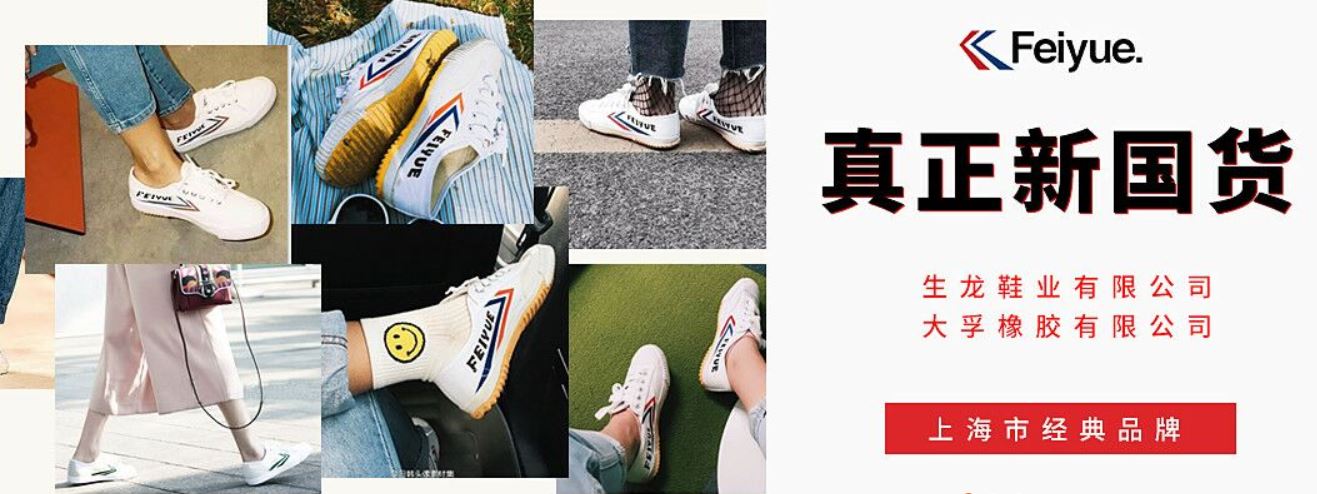
Feiyue originated in Shanghai in the 1920s and is known for its flexibility and comfort. It was loved by the Whole country, from the working class to politicians, football players and Shaolin monks. Its light canvas and soft cushioning make it suitable for martial arts, and at the 2008 Beijing Olympics all martial arts performers in the opening ceremony wore Feiyue.

Source: a warrior monk of the Shaolin Temple displays his Kung Fu skills while wearing Feiyue shoes at the Songshan Mountain (The Globe and Mail).
After the economy opened up in the 1980s, overseas shoe brands took the dominant position in China and Feiyue disappeared from the sight of mass consumers. Chinese millennials turned back to it for its humble prices and good quality, and the brand keeps an authentic retro flair that attracts fashionable young people.
A Frenchman, Patrice Bastian, brought Feiyue back into fashion after falling in love with its history and martial character. In 2006 he registered the trademark in Europe and established Feiyue Shoes Holding, kept the vintage charm and modified the material and design for an urban lifestyle. The brand peaked when Orlando Bloom was seen wearing classic Feiyue shoes in 2008. In 2010 alone, his company sold a million pairs overseas, before selling the brand in 2014 to BBC International LLC, a footwear design and production company that works with Polo Ralph Lauren, Teva, Cole Haan and Disney.
The Chinese Feiyue disputed this. “No one in China knew about commodity intellectual property rights at the time, and it wasn’t until 2007-08 that we found out the French had registered the trademark,” said Liu, manager of Shanghai Da Fu Rubber Co., considered the original Feiyue manufacturer. The Chinese and French Feiyue co-exist: a pair in China costs around USD 10 to 20, while the price overseas is similar to Converse sneakers.

Huili was also revived
After Feiyue, another Chinese shoe brand, Huili (回力, “Warrior” in English), was revived. Founded in Shanghai in the 1930s, it was once the shoe of the working class. Like Feiyue, it has a fanbase overseas where prices are much higher than in China. After being discovered by foreign trendsetters, these local brands gained popularity among young Chinese fashion chasers. Insiders suggest that foreigners are excellent at branding and packaging, and that when a very small minority adopts a brand that gradually becomes rare, it becomes popular among young people.

Source: screenshots of Huili’s Instagram account wos33.
What this means for international brands in the Chinese sneaker market
Converse’s 2019 episode and its fiscal 2025 revenue decline of 19% point to the same pattern: Chinese consumers compare prices across markets, are sensitive to being treated “fairly” and “respectfully”, and have local alternatives that offer comfort, a retro identity and a lower price. International brands compete with other foreign brands and with emerging domestic brands that often have a more attractive price and a better understanding of Chinese consumers.
Daxue Consulting’s market research and consulting teams study these questions with local data: how consumers read scarcity and pricing, how local heritage brands are perceived, and how a launch is received on Weibo, Xiaohongshu and Tmall. Details are available through consumer understanding in China and branding in China.

Challenges for international brands on the sneaker market in China
- Chinese consumers have become more mature in their shopping: they value how brands treat them, have access to global trends, compare prices across markets and are sensitive to being treated fairly and respectfully.
- International brands compete with other foreign brands and with emerging domestic brands that often have more attractive prices and a better understanding of Chinese consumers.
- More Chinese millennials appreciate traditional Chinese brands with a long history, which gives them retro charm and the sense of supporting domestic companies.
FAQ
What happened with Converse in China in 2019?
On 1 April 2019, a Converse retailer in Jining, Shandong, announced that buyers of the Chuck 70 High Top had to queue, be picked by lottery, bring ID and wear a full Converse outfit. Consumers criticized the rules for a standard black sneaker, and Converse answered with a public letter on Weibo.
How did Converse perform recently?
According to NIKE, Inc., Converse revenue fell 19% to USD 1.69 billion in fiscal 2025, and NIKE, Inc. revenue in Greater China fell 13% to USD 6.59 billion.
What are Feiyue and Huili?
Feiyue (飞跃) is a Shanghai canvas sneaker brand from the 1920s, and Huili (回力, Warrior) a Shanghai brand from the 1930s. Both were revived among young Chinese consumers for their price, comfort and retro look.
About Daxue Consulting. Daxue Consulting is a market research and strategy consulting firm focused on China, with teams in Shanghai, Beijing and Hong Kong. Its mission is to guide businesses to holistic growth in China, through consumer research, market analysis and tech-enabled data collection. Contact the team through the contact page.