
China’s hair-coloring market is shifting from a niche beauty category into a mainstream part of personal care, with sales reaching around RMB 22 billion in 2025. Online engagement also shows how visible the category has become. By April 2026, hair-color-related content on RedNote had generated more than 9.06 billion views. Meanwhile, related discussions on Douyin had attracted 56.74 million engagements. In short, coloring your hair in China is no longer a fringe grooming habit. It is becoming a commercially significant segment of China’s beauty market.
From rebellious statement to beauty practice
As China’s beauty standards evolve, dyed hair is becoming more socially acceptable in everyday settings. Once associated with non-mainstream identity, dyed hair is now increasingly viewed as part of routine personal image management. A 2024 survey of 648 consumers found that 63.6% had dyed or bleached their hair in the past year. Only 13.0% had neither done so nor intended to try in the coming year. This suggests that hair coloring is no longer a fringe choice, but a practice with consumer acceptance.
This shift is also visible in online discourse. On RedNote, the hashtag #女性不被发色定义 (“women should not be defined by their hair color”) had received 96.79 million views. This reflects growing resistance to appearance-based stereotypes around dyed hair.
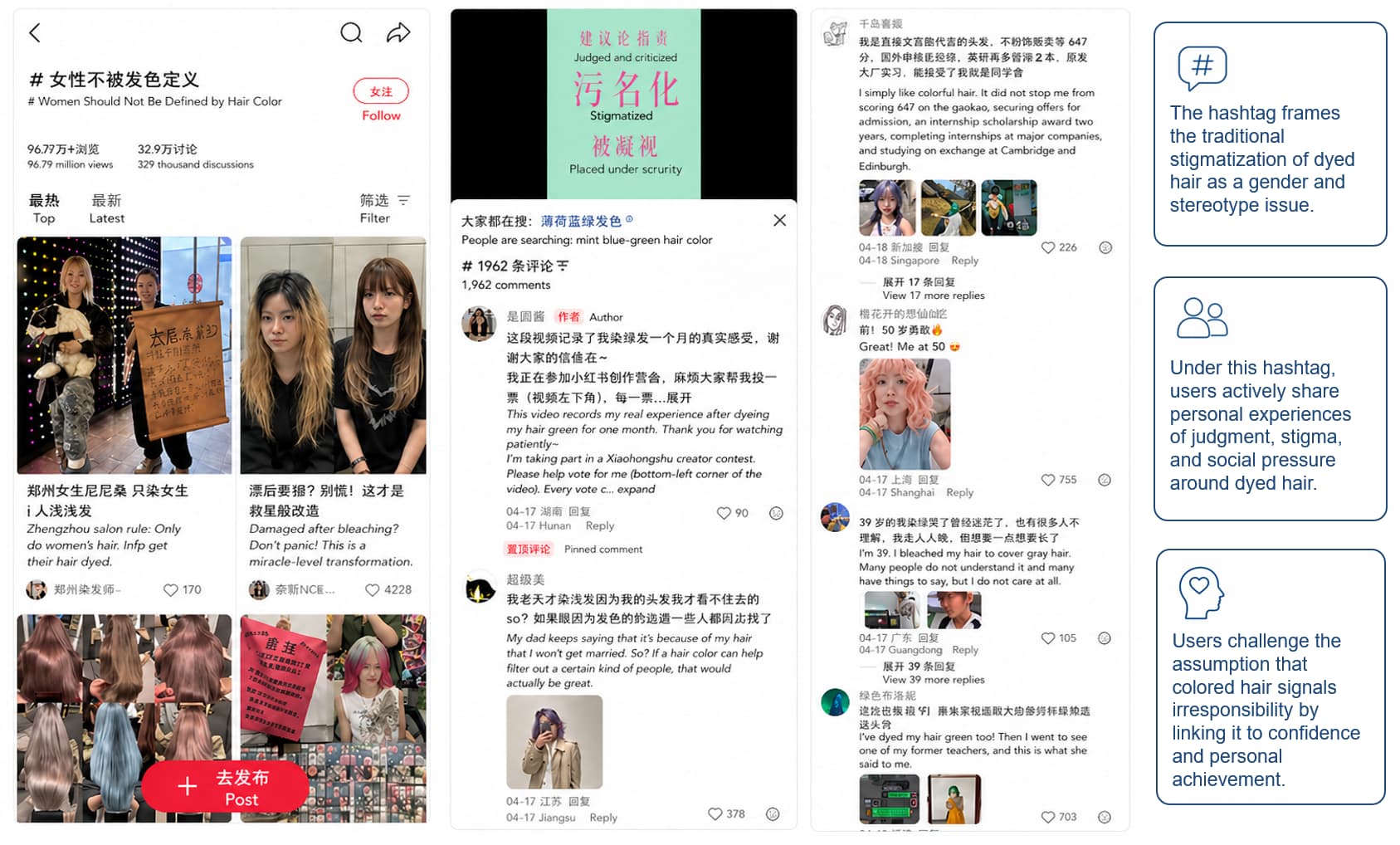
Meanwhile, consumers increasingly discuss hair coloring as a way to refresh their overall appearance. This is especially evident in the popularity of the term “显白发色” (“skin-brightening hair colors”). It became one of the most discussed topics within RedNote’s 200 million hair-styling content ecosystem in 2025. Together, these signals show that hair coloring in China is being reframed as a normal extension of beauty maintenance and personal image management.
Popular culture is making hair color more aspirational
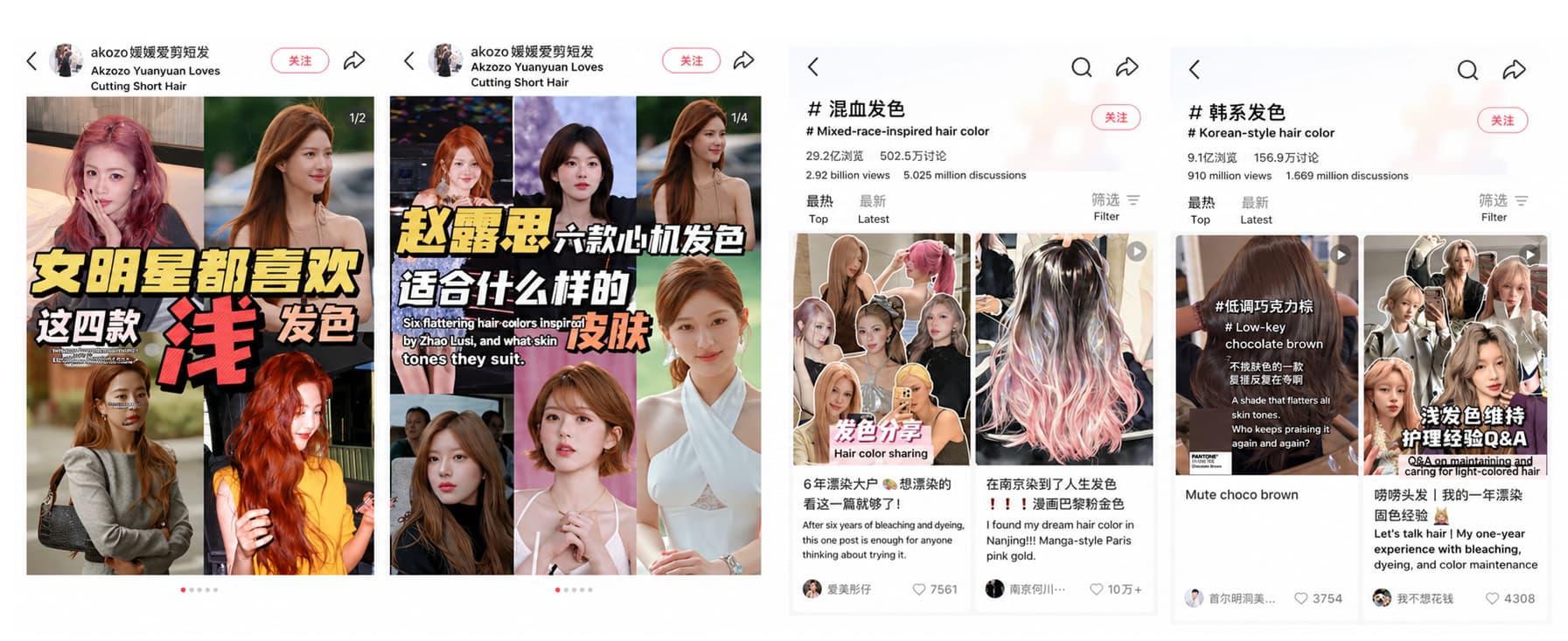
Source: RedNote, designed by Daxue Consulting, Posts under #混血发色 and #韩系发色
Low-commitment techniques are making color experimentation easier
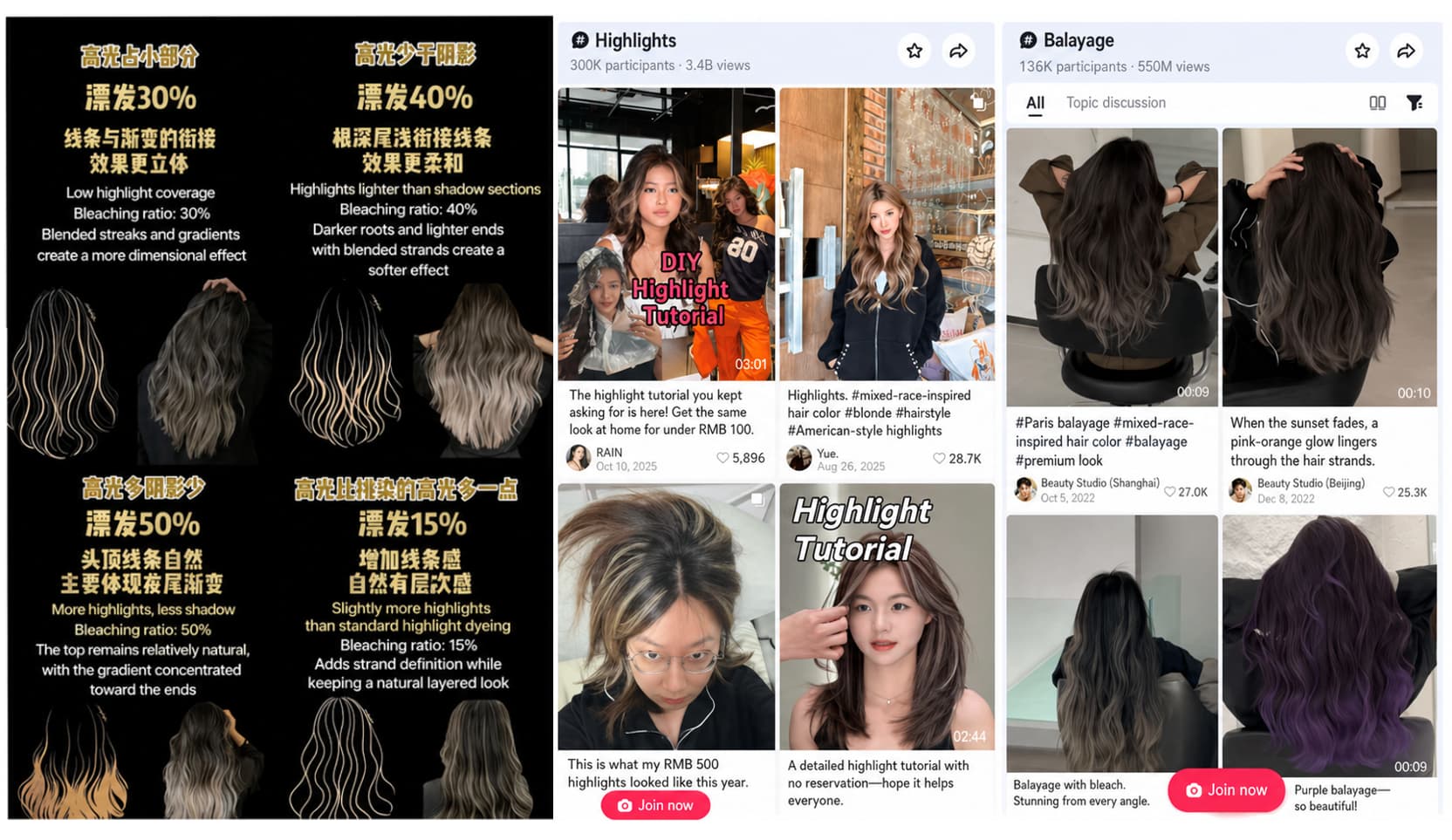
Younger consumers in China remain especially influential in shaping hair-color trends and online visibility. However, although 76.4% of consumers aged 18–30 dye or bleach their hair for fashion-related reasons, this does not necessarily translate into demand for full-head color. Instead, the rise of “挑染” (highlight dyeing) and “画染” (painted dyeing) has made experimentation more wearable and socially acceptable.
Specifically, these techniques allow brighter or more unconventional shades to blend into naturally black or dark hair. Since the overall dark base is preserved, these styles appeal to young consumers as a lower-commitment way to experiment with color without sacrificing wearability.
Content is the key conversion driver
Such visibility is increasingly translating into online sales. In 2025, China’s online hair-dye category grew by 23.2% year on year across its two main e-commerce platforms, but growth was concentrated on Douyin. The platform accounted for 57% of total online market share and recorded 43% annual growth, with its share rising steadily from 2023 to 2025. The surge suggests that China’s hair-coloring market is no longer driven mainly by traditional search-and-shelf e-commerce. Instead, the hair-dyeing category is increasingly shifting toward a content-led model. In which visibility, product demonstration, and trend circulation play a more direct role in conversion.
China’s hair-coloring market is rewarding different brands across different platforms
As content commerce gains importance, platform dynamics are increasingly shaping which brands perform best, creating a more segmented competitive landscape in China’s hair-coloring market.
On Douyin, products that are easy to demonstrate, quick to understand, and affordable to try are better positioned to convert attention into purchases. In 2025, Caixi (彩夕) ranked first on Douyin with RMB 518 million in sales and a 13.9% market share, followed by Dongran (侗 at RMB 407 million and 11.0%, and OKCS at RMB 358 million and 9.6%. This suggests that domestic brands are gaining momentum on Douyin.
Top 3 domestic hair-dye brands on Douyin in Jan–Sep 2025
| Top 3 brands | Caixi | Dongran | OKCS |
| 2025 Douyin sales | RMB 518 million | RMB 407 million | RMB 358 million |
| Market share | 13.9% | 11.0% | 9.6% |
| Core positioning | •“单剂花香染发膏” [single-dose floral hair dye cream], •“天然植物萃取” [natural plant extracts], •“不含双氧及氨水” [free of peroxide and ammonia], •“温和染发” [gentle hair dyeing] | •“侗染非遗单剂染发膏” [Dongran heritage single-dose hair dye cream], •“植萃护染膏” [plant-extract protective dye cream], •“植物洗护染” [plant-based wash-care dye] | •“精细化染护品牌” [precision hair dye and care brand], •“专研中国发质” [developed for Chinese hair types], •“更细微的头发染护场景” [more nuanced hair dye and care scenarios] |
Conversion logic | Converts through low-risk home hair coloring: affordable, easy-to-use products for routine recoloring | Converts through more differentiated home dyeing: plant-based, care-oriented hair coloring with a stronger product story | Converts through beauty-led DIY hair coloring: shade choice, visible transformation, and trend-oriented home dyeing for younger consumers |
Interestingly, Taobao shows a different pattern. In the same period, three of the top hair-dye brands on the platform were all international. Schwarzkopf led with RMB 276 million in sales and a 9.7% market share. Followed by L’Oréal at RMB 157 million and 5.5%, and Les 3 Chênes at RMB 57 million and 2.0%. As such, Taobao continues to favor established brands with stronger trust and premium recognition.
Top 3 international hair-dye brands on Taobao in Jan–Sep 2025
| Top 3 Brands | Schwarzkopf | L’Oréal | Les 3 Chênes |
| 2025 Taobao sales | RMB 276 million | RMB 157 million | RMB 57 million |
| Market share | 9.7% | 5.5% | 2.0% |
| Core positioning | • Professional hair-coloring expertise • Salon-like results and broad shade range • Strong gray coverage and routine recoloring appeal • Premium international hair-care image | • Global brand with strong consumer trust • Fashion-led shades and mass-premium positioning • coloring combined with care-oriented messaging • Broad appeal across both beauty and everyday dyeing needs | • French botanical / natural-oriented brand image • Plant-based and gentler dyeing proposition • Appeals to consumers seeking lower-irritation or herbal-style options |
Conversion logic | Consumers on Taobao are more likely to choose Schwarzkopf for reliable quality, broad product selection, and more premium hair-coloring results | L’Oréal benefits from strong name recognition, mainstream trust, and products that combine color payoff with hair-care reassurance | Les 3 Chênes appeals to Taobao users seeking a more botanical, gentler alternative, especially for lower-risk at-home dyeing |
The trade-off between salon and DIY hair coloring
Salon coloring still plays an important role in bleaching, color correction, and more complex looks in China. On the other hand, at-home dyeing is increasingly becoming the go-to option for lower-risk needs. Consumers now DIY for root touch-ups, partial dyeing, and experimenting with trend colors. One key reason is cost. A box of hair dye can cost about RMB 72, while salon coloring often costs several hundred to a thousand RMB, making DIY a far more affordable choice for consumers who want to recolor more frequently.
In parallel, salons are often criticized for inconsistent service quality and aggressive upselling. This discourages many young consumers from trying new hairstyles in professional settings. In a 2025 survey of nearly 1,000 consumers, more than 70% said they wanted to be deeply involved in hairstyle decisions. However, only 25.3% were willing to leave choices entirely to the stylist. Under this context, DIY hair coloring offers a lower-pressure and more affordable alternative.

Social media has further lowered the barrier to self-coloring by making shades, techniques, and product comparisons easier to understand. By April 2026, #染发教程 (“hair-color tutorials”) had generated 180 million views on RedNote. Meanwhile, #自己染发 (“dyeing your own hair”) had reached 13.4 billion views on Douyin. The popularity of this content reflects a broader shift among younger consumers toward more self-directed beauty decisions.
In sum, these signals suggest that DIY hair coloring is gaining traction not only because it is cheaper, but because digital content is making consumers feel more informed, confident, and selective about when salon expertise is truly necessary.
Key shifts to watch in China’s hair-coloring market
- Hair coloring is becoming mainstream as dyed hair shifts from a fringe statement to part of everyday beauty maintenance.
- Celebrity and global aesthetics are driving inspiration, making hair color more aspirational and trend-led.
- Low-commitment techniques are broadening demand by making color experimentation more wearable.
- Platform dynamics are reshaping competition, with Douyin favoring content-friendly domestic brands and Taobao favoring trusted international names.
- DIY hair coloring is gaining traction as lower prices, tutorial content, and salon frustrations reduce reliance on professional services.