

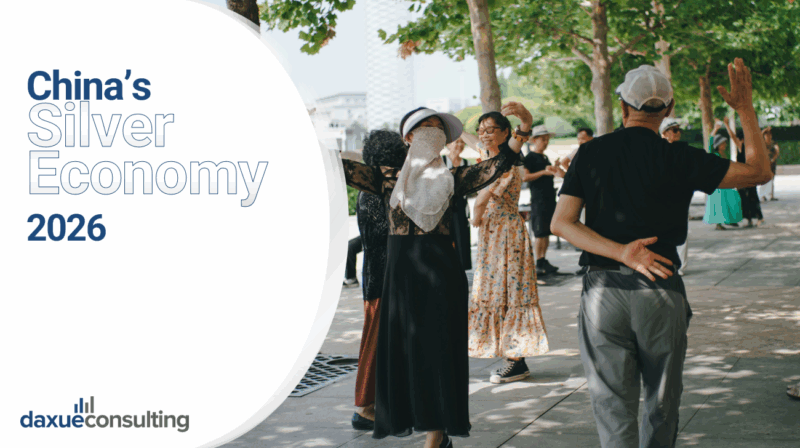
Driven by one of the fastest-aging populations globally, China is entering a demographic turning point that will redefine how businesses, governments, and families think about aging, longevity, and value creation. The silver economy in China has become one of the most structurally important forces reshaping consumption, public policy, and service innovation. Understanding China’s seniors is essential to grasping where the silver economy in China is heading and where opportunities will emerge.
Download our China Silver Economy Report here:
A demographic turning point that is impossible to ignore
As of 2023, around 254 million people in China were aged 60 or above. This accounted for roughly 20% of the population. According to the World Health Organization and the United Nations, this figure is projected to reach 402 million by 2040, or 28% of the population.
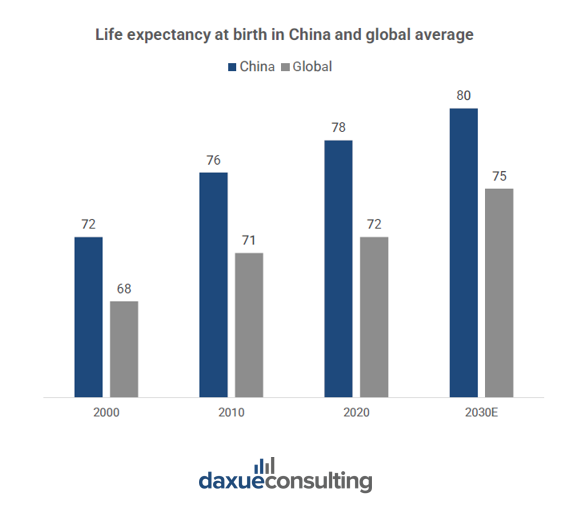
Moreover, for the past two decades, life expectancy in China has climbed steadily and now surpasses the global average. At the same time, persistently low fertility rates mean that population aging is becoming structural. Within just 30 years, the number of people aged 60 and above has more than doubled, and projections indicate it could reach 504 million by 2050. This underscores the urgency for both public and private sectors to adapt.
Aging is uneven: Why geography matters in the silver economy in China
China’s aging process is not uniform across the nation. Significant regional disparities exist due to differences in economic development, internal migration, and historical birth rates. Northeast China, particularly Liaoning, Jilin, and Heilongjiang, has the highest concentration of elderly residents. Seniors account for more than a quarter of the population in several provinces. This is largely the result of youth outmigration following industrial decline. As a result, they left behind aging communities with shrinking workforces.
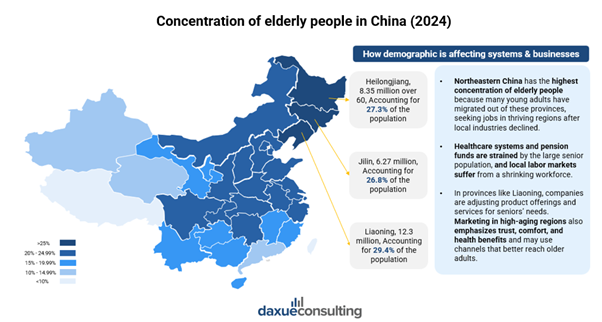
These demographic realities place severe strain on local healthcare systems, pension funds, and labour markets. However, they also act as early testing grounds for the silver economy in China. In high-aging regions, companies are already adjusting product offerings and service models to meet seniors’ needs. Marketing strategies in these provinces tend to emphasise trust, comfort, and tangible health benefits, while distribution relies more heavily on channels that are accessible and familiar to older adults. In many ways, these regions foreshadow what other parts of China will face in the coming decade.
Not one elderly generation, but three
A defining characteristic of the silver economy in China is its generational complexity. Today’s seniors are not a homogeneous group. They span three distinct cohorts shaped by very different historical experiences.
The oldest cohort, born before 1950, has their consumption today primarily driven by caregiving and health maintenance. This is because physical decline becomes more pronounced. This group tends to be cautious, risk-averse, and function-focused in its spending.
The second cohort, born between 1951 and 1963, experienced hardship in early life but also lived through reform and opening-up. Now aged in their 60s and early 70s, they are generally healthier, more adaptable, and still energetic. This group increasingly allocates spending toward leisure, wellness, and social engagement, rather than basic subsistence.
The youngest “silver” cohort, those aged roughly 50 to 60, benefited from better education and exposure to global culture. They value quality of life, are comfortable with change, and exhibit consumption patterns closer to middle-aged consumers than to traditional retirees. As they enter retirement, they are expected to become the primary growth engine of the silver economy in China.

Growth driven by spending power, not just population size
While demographic expansion sets the foundation, the true driver of the silver economy in China is changing spending behaviour. The market size of silver economy in China has grown from RMB 8 trillion in 2020 to an estimated RMB 13.9 trillion in 2024, with projections reaching RMB 17 trillion by 2025. In 2023, it already accounted for around 6% of China’s GDP.
Crucially, today’s seniors are among the wealthiest in China’s history. Many benefited from decades of economic growth, property appreciation, and high household savings rates. As a result, the prevailing stereotype of elderly consumers as overly frugal is becoming outdated. Instead, seniors are demonstrating a clear willingness to spend on products and services that deliver clear value in terms of health, comfort, or quality of life.
How Chinese seniors finance their later years
Despite rising spending, financial behaviour among older Chinese remains shaped by historical uncertainty. Most seniors rely on a mix of government pensions, personal savings, and family support. For elderly individuals living alone, pensions and transfers from children remain the two largest income sources. This structure reflects long-standing cultural norms as well as institutional realities.
China’s household savings rate, around 43% in 2024, far higher than in Europe (15%), also plays a key role. A large share of these savings is earmarked for retirement or intergenerational support, such as children’s education or housing. Meanwhile, the state continues to expand pension coverage and reform healthcare systems to reduce out-of-pocket expenses, gradually easing financial pressure on both seniors and their families.
For businesses, this means that senior consumers are not indiscriminate spenders. They tend to favour high-value, functional products and remain sensitive to pricing, often taking time to compare options. Winning in the silver economy in China requires a balance between perceived quality, trust, and affordability.
From survival to self-image: a shift in senior consumption values
One of the most striking developments is how senior lifestyles and values are evolving. Chinese seniors are spending more on skincare, clothing, haircuts, health examinations, and healthier food. Sometimes at levels comparable to, or even exceeding, those of younger consumers.
Health remains the top priority, with a significant share of disposable income channelled toward preventive care and longevity. However, this is increasingly accompanied by spending aimed at maintaining social presence and self-identity. Many seniors actively invest in “aging gracefully,” challenging traditional notions that equate old age with withdrawal or austerity.

Importantly, this is not reckless consumption. Seniors are strategic buyers: more price-conscious than younger cohorts, yet willing to spend time and effort searching for value. Their growing digital literacy further supports this behaviour, enabling comparison shopping and informed decision-making.
The erosion of traditional family care models
Structural changes in family life are reshaping demand patterns within the silver economy in China. Urbanisation, smaller households, and rural-to-urban migration have led to a sharp rise in so-called “empty-nest” households. Today, nearly 60% of elderly Chinese live either alone or only with their spouse, and around 40 million seniors live entirely alone.
This shift weakens the traditional model of family-based elderly care and raises concerns about access, equity, and social isolation, especially in rural areas. As a result, demand for professional care services, community-based solutions, and technology-enabled support is increasing rapidly. For policymakers, this necessitates government-society collaboration. For businesses, it opens new service categories that were previously marginal or non-existent.
Policy as a market shaper: the “9073” model
Government policy plays a central role in structuring the silver economy in China. Under the “Healthy China 2030” initiative, authorities aim to raise life expectancy to 79 years while building a sustainable elderly care system. A key pillar is the “9073” care model, under which 90% of seniors age at home, 7% rely on community-based care, and only 3% live in institutional facilities such as nursing homes.
This policy direction has profound implications. Rather than prioritising large-scale nursing institutions, the government is actively encouraging at-home care, community services, and public-private partnerships. For companies, alignment with this model, either through home-care services, age-friendly housing solutions, or decentralised healthcare, significantly improves policy compatibility and long-term viability.
Structural opportunity in China’s silver economy
Taken together, the silver economy in China is not a short-term trend driven solely by demographics. It is a structural transformation, rooted in longer lives, generational change, evolving family systems, and supportive public policy.
As seniors become healthier, wealthier, and more self-directed, they are redefining what aging means in China. For businesses and investors, the opportunity lies not in treating the elderly as a single vulnerable group, but in recognising the diversity, influence, and spending power embedded within this rapidly expanding segment. The foundations of the silver economy in China are already in place, and its most transformative phase is only just beginning.
The next frontier: Silver economy in China
- China is aging rapidly, with over 254 million people aged 60+ (20% of the population) in 2023, projected to reach 28% by 2040. This creates a massive, unavoidable market foundation.
- The “senior” group is not monolithic but spans three distinct cohorts with different values and consumption patterns. Driven by historical wealth accumulation, they are becoming a powerful consumer force focused on health, leisure, and quality of life.
- Consumption is evolving beyond basic needs. Seniors are increasingly spending on skincare, fashionable clothing, and wellness to maintain social presence and self-identity, while remaining strategic and value-conscious buyers.
- Urbanization and smaller households have led to nearly 60% of seniors living alone or with only a spouse. This breakdown of traditional family care models is driving demand for professional services, community solutions, and tech-enabled support.
- Government strategy, notably the “9073” model (90% home-based, 7% community, 3% institutional care), actively shapes the economy. This policy prioritizes home- and community-based solutions, creating aligned opportunities in related services and products.