
In 2024, there were 222,412 marriages in South Korea, a 14.8% year-over-year growth, according to Statistics Korea. This is the highest growth rate since 1970, though still 7% below the pre-pandemic 2019 level of 239,159 marriages. Although people are continuing to get married, high cost pressures are driving couples to rethink traditional formats in South Korea’s wedding market. Rather than hosting large, elaborate ceremonies, many, especially the MZ Generation, are opting for smaller, more intimate weddings and reconsidering whether that spending should be allocated elsewhere.
Read our Korea’s MZ Generation report
Wedding service costs vary by region
Gangnam is the most expensive region, followed by the rest of Seoul, Gyeonggi, Incheon, and other regions in Korea. The most affordable region is Gyeongsang.
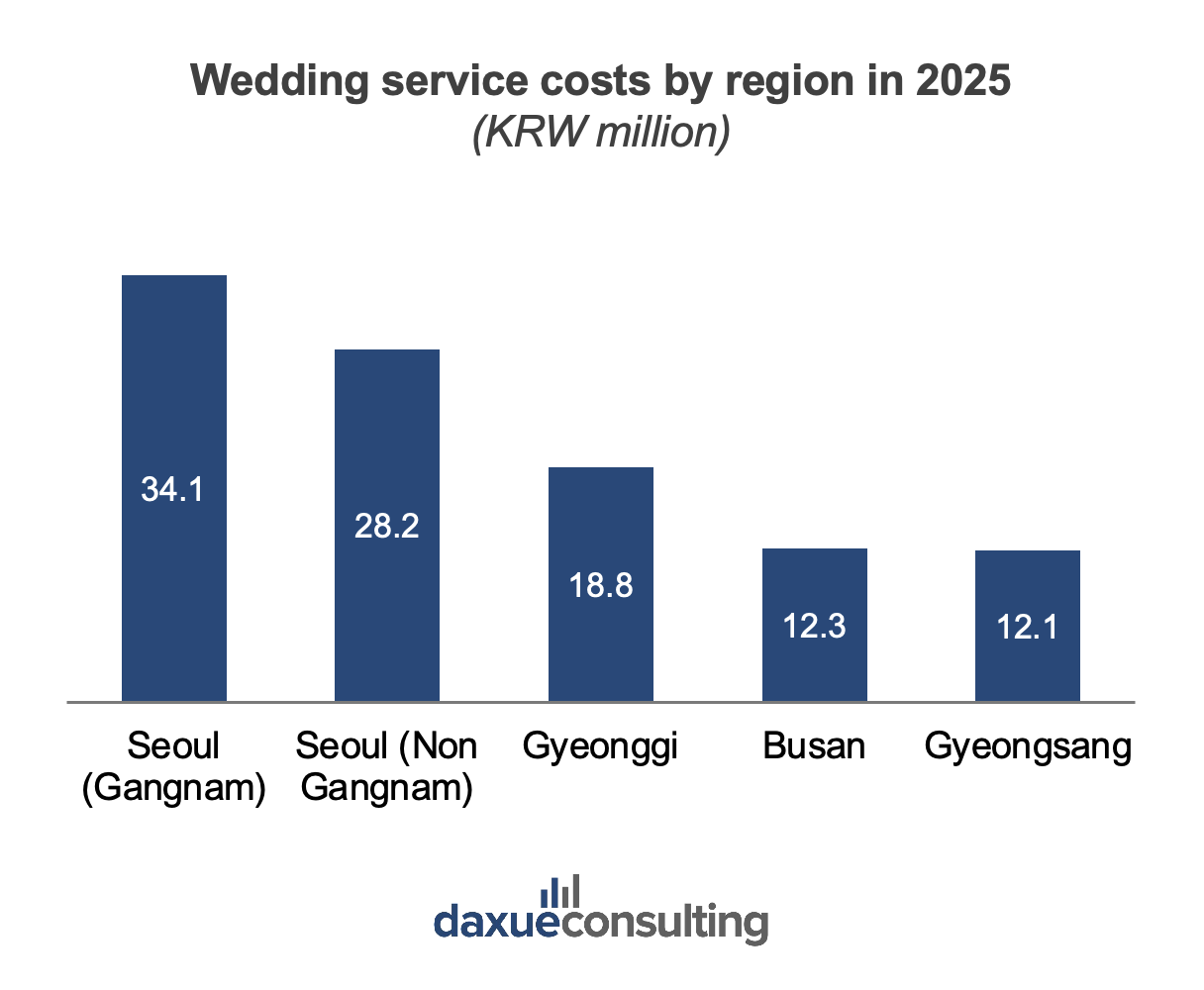
While there is a 280% difference between Gangnam and Gyeongsang, this is due to service composition differences, not just pricing. While Gangnam focuses on premium venues and international brand collaborations, Gyeongsang focuses on traditional wedding halls and local providers.
High wedding costs drive Koreans to rethink traditional weddings
According to Statistics Korea, the average newlywed household annual income in December 2024 was KRW 76.29 million. However, 86.9% carry debt with a median of KRW 179 million. Based on a 20-year repayment at 3.7% interest, monthly payments are approximately KRW 1.07 million.
Based on a 2024 survey of 1,000 newlywed couples published by marriage company Duo, housing costs dominate average marriage-related spending, making up about 94% of total costs. This reflects the widespread adoption of the “jeonse” (전세) system, a housing lease system where tenants pay a large lump-sum deposit instead of monthly rent, even when living in a rental property. Wedding services make up about 7% of spending. While the cost burden remains, weddings are not disappearing but rather diversifying. Koreans are seeking small weddings, house weddings, hotel weddings, or other formats that fit the couple’s budget and style.

Small wedding (스몰웨딩) preferences grow
It is traditional for Korean weddings to take place in a wedding hall with a ceremony and a buffet meal being served at the same venue. The number of guests ranges from 100–300 people as standard.
However, small wedding preferences increased significantly as well. According to a 2025 survey by Embrain among 1,200 single men and women aged 19 to 49 living in the metropolitan area, 56.3% of respondents believed that a small wedding is more meaningful than a lavish, crowded wedding. In fact, 69.7% of respondents said spending money on expensive wedding halls and ceremonies was a waste of money and they would rather than spend that money on travel or buying a home.
However, actual small wedding execution remains a minority. Social network maintenance needs, parental generation expectations, and chukuigeum (축의금) system participation are among the reasons for this. The “chukuigeum” system is a key aspect of weddings in South Korea. Depending on the closeness of the relationship, guests give cash gifts ranging between KRW 50,000 and 500,000. Names are recorded in guestbooks with the expectation of future reciprocation. With the advance of technology, the proportion of digital transfers is also growing. These amounts offset a significant portion of venue costs.

South Korea’s weddings typically require multiple outfits
Typical ceremonies in South Korea’s wedding market require at least four separate outfit purchases. According to the Korea Consumer Agency, the average cost of the main ceremony dress is KRW 1.55 million. Wedding photoshoots are separate from the ceremony, typically a few months ahead. In South Korea’s wedding market, one ceremony dress and three photoshoot dresses are the standard arrangement. Studio photography costs KRW 1.35 million, with makeup adding another KRW 760,000.
While Pyebaek (폐백), a Korean traditional marriage ceremony, shifted from mandatory to optional, traditional hanbok attire usage persists across two channels. Couples maintaining Pyebaek wear hanbok during the family ritual. Those who skip Pyebaek often commission hanbok concept photography separately. In either case, hanbok-related purchases are generated.
There is still a relative lack of development in the groom attire market. Despite the increasing interest and demand in the groom attire market, most services are available as add-ons to bridal shops rather than as a dedicated location.
Transparency demand creates market differentiation
South Korea’s wedding market traditionally displays starting prices, then adds costs during actual service. Some cases report initial quotes of KRW 2 million growing up to KRW 5-10 million at final billing. Additional charges include dress upgrades, accessory packages, rental period extensions, extra photo cuts, original file purchases, and early start fees. Therefore, between 2021 and 2023, consumer complaints increased 63%, according to the Korea Consumer Agency. Online reviews repeatedly cite “unexpected additional costs” as negative keywords.
In response to this, the government and market responded. Starting 2025, wedding halls and studio-dress-makeup packages must disclose their prices, according to the Korea Fair Trade Commission. Some providers in South Korea’s wedding market preemptively adopted transparent all-inclusive pricing before regulations took effect. Online mentions show a positive reception for businesses explicitly stating “no additional costs.”
Honeymoons are getting shorter and more value-driven
The average honeymoon lasts 5-7 days, down from 10-14 days in previous generations. Among the causes are work vacation restrictions and monthly repayment obligations. Cost-efficient destinations are more favored. Through Thailand, Vietnam, and Bali, Southeast Asia offers inexpensive flights and good value. Japan provides proximity and cultural familiarity via Okinawa and Hokkaido. Europe serves as a premium choice for high-income dual-earner couples.
Selection patterns are focused on budgets. Packages that explicitly state “no additional costs” are preferred by consumers. It is becoming more common for travel agencies to offer installment payment plans. It has become standard to offer three to six-month interest-free installments, with some extending up to twelve months.
Combined wedding photoshoot and honeymoon packages appear. Jeju Island has a four-day package deal with two days of shooting plus two days of leisure. Other international cases span five to six days integrating photography with honeymoon activities. Combined pricing delivers cost reduction compared to separate purchases. Travel agencies build photographer networks and photography studios added travel coordination services. Service provider boundaries blur as integrated packages evolve. Transparent pricing composition and payment flexibility are core selection criteria over other factors.

What’s changing in South Korea’s wedding market
- In 2024, there were 222,412 marriages, a 14.8% year-over-year growth. While this is the highest growth rate since 1970, it is still 7% below the pre-pandemic 2019 level.
- In South Korea’s wedding market, high wedding costs are reshaping how couples allocate their budgets. While housing spending remains significant, wedding spending itself is diversifying. Consumers are shifting away from large weddings into other formats like smaller-scale, hotel, or alternative wedding markets.
- A large share of consumers think large, traditional weddings are a waste of money and would rather spend that money elsewhere such as travel or housing.
- Despite this mindset, large weddings remain prevalent due to the chukuigeum (축의금) cash gift system and ongoing family and social expectations.