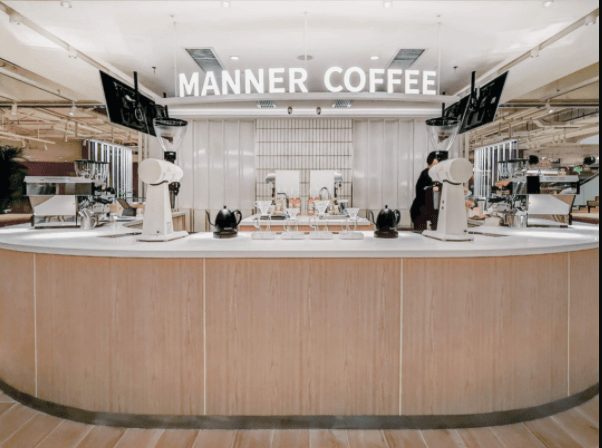

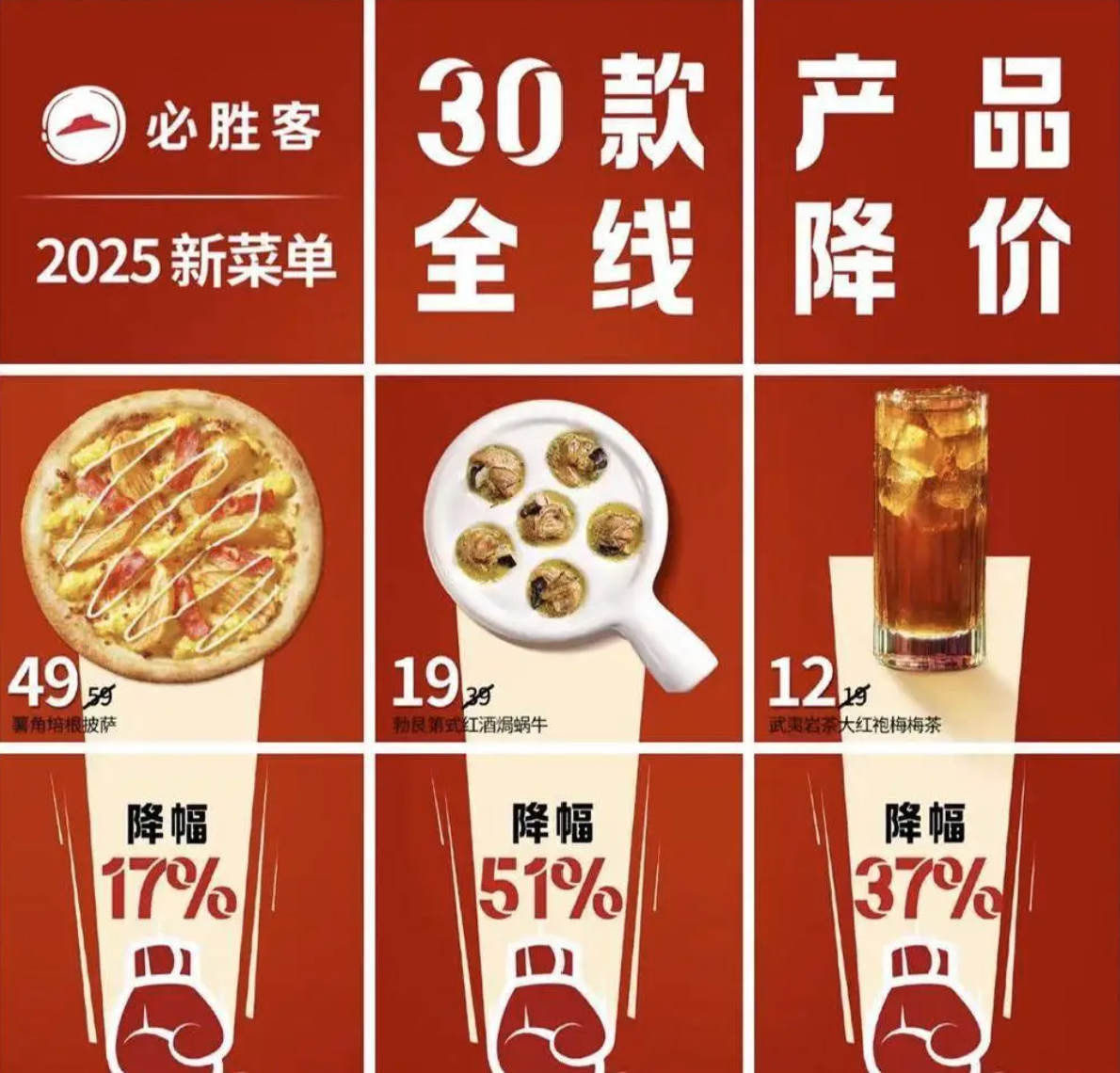
In the last quarter of 2025, Pizza Hut’s restaurants in China served 13% more customers than a year earlier. This marks twelve straight quarters of rising traffic, but earned about 11% less per customer. That was a deliberate trade that reflects a wider trend in the restaurant industry in China. Chinese restaurants fed more people in 2025 than ever before and earned less for doing it. National catering revenue reached RMB 5.79 trillion (USD 857 billion), up just 3.2%. Meanwhile, China’s GDP and per capita disposable income are set to grow by 5% year-on-year. With volume no longer paying, brands now compete to earn a premium from food tied to a place and venues that worth photographing.
Download our China’s F&B industry white paper
The delivery war traded volume for value
When JD.com entered food delivery in 2025, its subsidy war with Meituan and Alibaba pushed daily meal orders from 80-90 million past 200 million. But that peak was a subsidy-driven spike, not a new baseline; it deflated within months as platforms pulled back under regulatory pressure. What lasted was the price reset it forced: discounts that started on the apps in May 2025 had spread into dine-in menus by June, because no restaurant can charge more at the table than on delivery while keeping the walk-in customers.
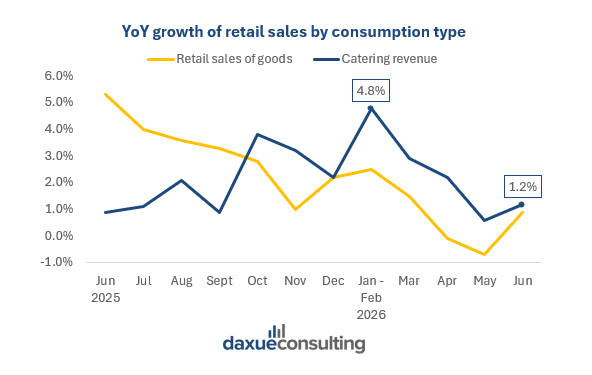
In addition, the slowdown has not stopped since. Catering revenue in the first half of 2026 came to RMB 2.83 trillion, up 2.8%, and growth slowed every month from 4.8% in January and February. Larger operators did even worse, growing only 1.8% during this period.
Brands raised prices before regulators did
Prices recovered from two directions at once. By June 2026 the average ticket was up 6.4% year on year, which the industry association credits partly to enforcement against price-war behavior. But operators had already started moving on their own, once the subsidies covering the gap between menu price and viable price stopped. Cotti Coffee, which started the RMB 9.9 coffee war back in 2023, ended its unlimited RMB 9.9 offer on 31 January 2026, and most of its products went back to RMB 11.9 to 16.9, with some core items rising 30% to 60%. Luckin narrowed its own RMB 9.9 range around the same time and declined to call that an increase, preferring to describe it as widening the price band.
Financial disclosures from Laoxiangji, a homestyle restaurant chain, demonstrate the margin squeeze felt across delivery-heavy chains. Its delivery segment made up 58.1% of revenue in the first eight months of 2025, with platform fees taking 6.3%. The logic is general: the better a brand did on delivery, the worse its margins looked once subsidies went away, which is why the retreat from volume pricing started at the top.
Restaurants are closing faster, but the market is reshuffling, not shrinking
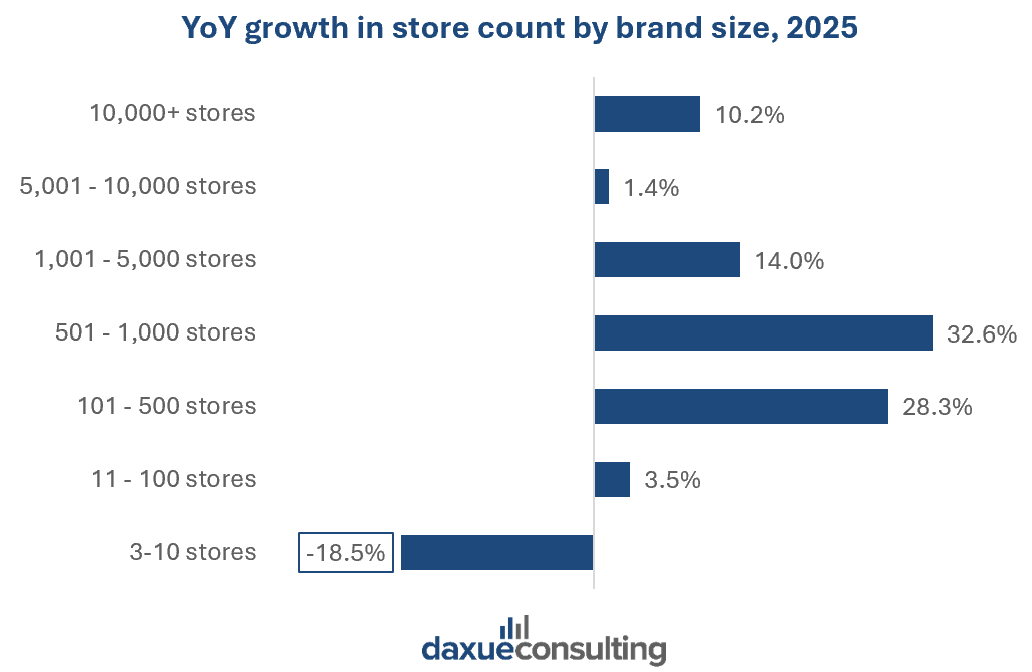
Outlets in operation ended 2025 at 7.47 million, down 0.1%, so the closures were replaced almost one for one. Most importantly, around 65.1% of the merchants that shut in 2025 had opened in 2024 or 2025. This signals that undercapitalized newcomers absorbed most of the damage. Chain penetration climbed to 25% from 21% in 2023, while small brands with three to ten outlets shrank by 18.5%. Getting through a price war takes supply-chain scale that a six-store group simply cannot fund.
Diners still eat out, they just stopped paying for the ordinary
Restaurant footfall kept climbing through the first half of 2026. What changed is what diners will spend on once they are inside.
Hyper-local regional cuisines are outgrowing the market
The eight-cuisine framework that used to organize Chinese dining has broken into smaller pieces, and diners now want to know which part of a province a kitchen comes from. In 2025, Anhui cuisine grew 20.4% by outlet count over the year, Fujian 18.7% and Jiangxi 14.9%, several times what the market managed overall. Specificity gives a restaurant something a generic regional concept no longer has, and it travels better than expected. Xiaojiangxi, a Jiangxi chain founded in June 2024, passed 100 outlets across 25 provinces in under a year.
Restaurants now sell atmosphere as much as food
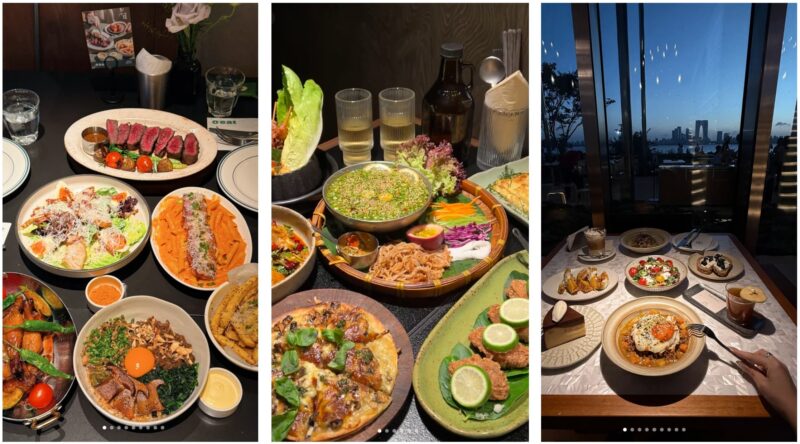
Around 27.6% of consumers say a stylish, photogenic room is a major factor in where they choose to eat. Moreover, 56.3% of young consumers say they will pay more for emotional value. Atmosphere is now a feature with a price attached. This is part of why competition shifted from discounting to interiors and plating. As of now, the 漂亮饭 (translated as aesthetic meal) trend, photogenic meals made to be posted, has drawn 1.92 billion note views and 10.22 million discussions on RedNote.
Riding this wave, Guangxi and Ningbo cuisines, after spending years confined to their home regions, have reached tier-1 cities such as Shanghai and Hangzhou largely on design and presentation. For instance, Ningbo’s Yongjiang Yanhuo passing 20 outlets in six months on butter-baked seafood. Looks are now the main route by which an obscure regional cuisine goes national.
Saturation is pushing chains into county towns and overseas
Tier-3 cities and below now account for more than half of all restaurant outlets in China. Furthermore, tier-5 markets and smaller are the only regions where openings still outnumber closures. The frontier inverted because tier-1 rents and saturation make the unit economics impossible once ticket prices start falling. Foreign brands went the same way. Over half of KFC’s 2025 openings landing in lower-tier markets, marking a structural relocation to the sub-markets where fast-growth is still tangible.
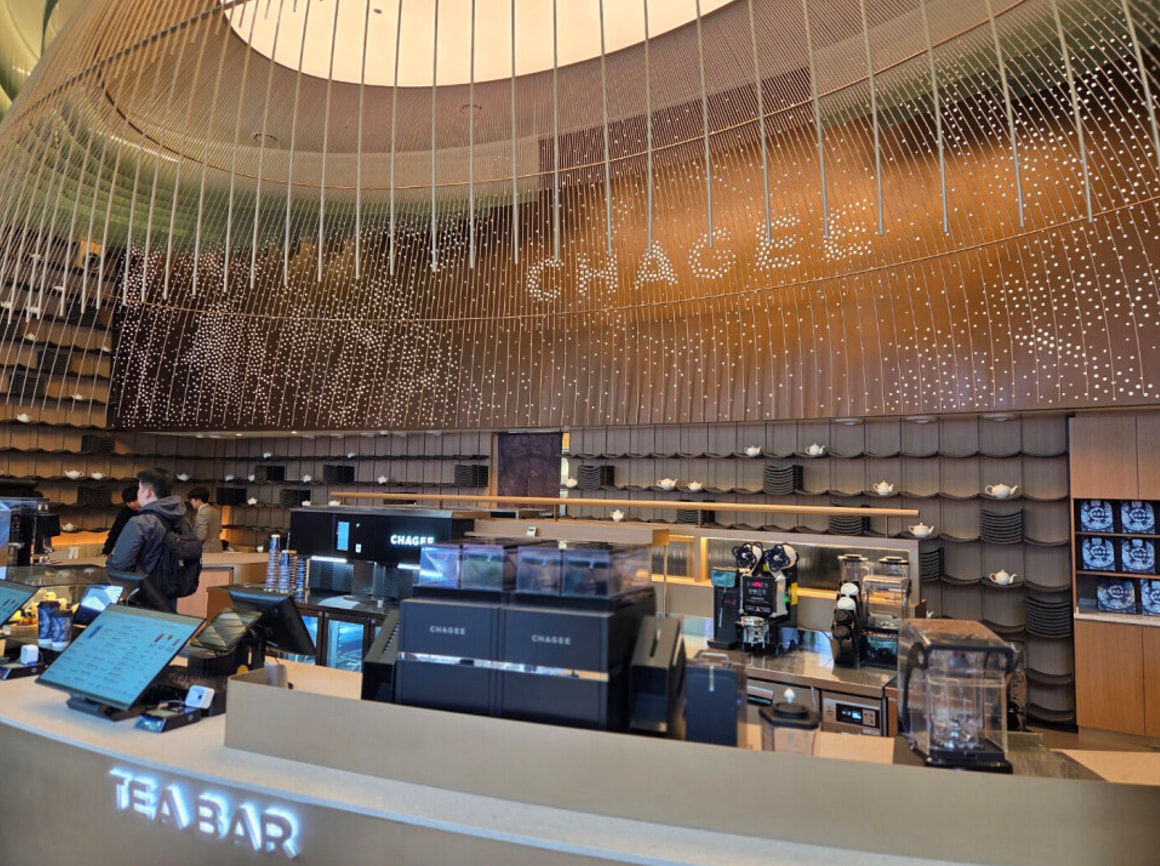
Once the counties fill up, the next market is offshore. Chagee opened three Seoul stores at once on 30 April 2026, anchored by a flagship at Gangnam Station, its eighth overseas market. A premium Chinese tea brand taking on one of the world’s most saturated café markets on experience rather than price is exactly what the aesthetics race at home has trained these companies to do. What crosses the border is the operating model, not the cuisine.
Five things to know about the restaurant industry in China
- Growth no longer does the work. Catering revenue hit RMB 5.8 trillion in 2025 but grew only 3.2%, so market share now has to be taken from competitors.
- The delivery war was won by platforms and consumers. Subsidized competition pushed daily orders past 200 million while dragging menu prices down with them.
- The restaurant industry in China is reshuffling fast. 3.39 million restaurants closed in 2025 and 65.1% of them were under two years old, yet the national total barely moved.
- Diners got pickier, not just poorer. Even as spending per meal fell, footfall kept rising and the premium shifted to specific places and photogenic rooms.
- Growth has relocated down-tier and abroad. Most Chinese restaurants expand in tier-3 cities and below, and Chagee’s Gangnam flagship tests whether the biggest chains can win developed markets on experience.
Authors: Min Chun, edited by Ming Yii Lai, with additional research by Hansel Guo