

Chinese cosmetic brands in 2025 data
- Proya’s 2025 revenue was RMB 10.597 billion, down 1.68%, its first fall in nine years as a listed company, as shown in our Proya case study.
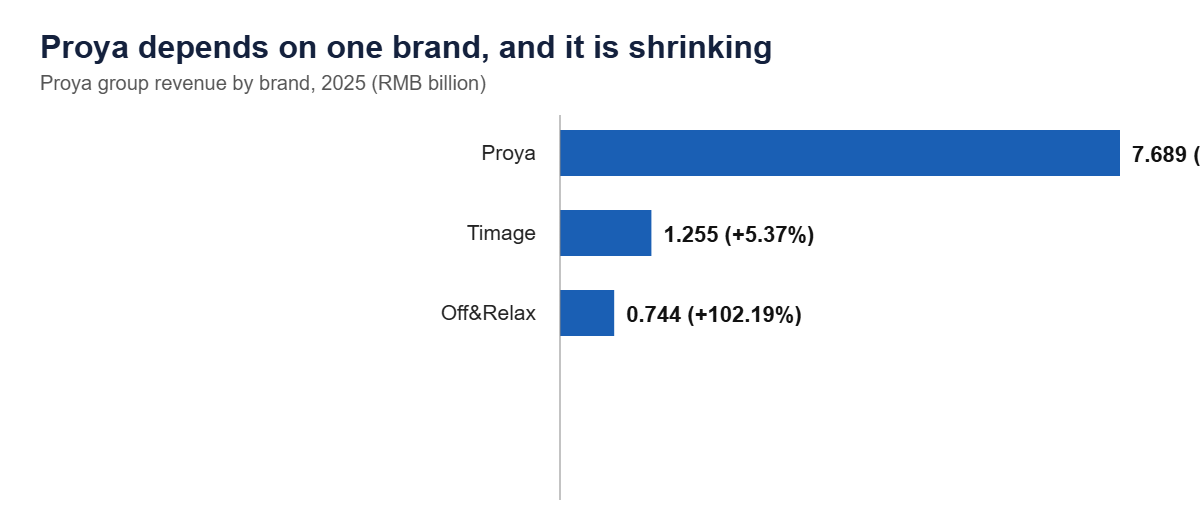
- Its main Proya brand earned RMB 7.689 billion, down 10.39%, and its share of group revenue fell from 79.69% to 72.64%.
- Timage grew 5.37% to RMB 1.255 billion, and Off&Relax doubled, up 102.19% to RMB 744 million.
- Proya’s sales expense ratio rose to 49.63% of revenue, and over 95% of its sales are online.
- Domestic brands hold 57.4% of China’s RMB 1.1 trillion cosmetics market, says Caixin Global, while official retail sales grew 5.1% to RMB 465.3 billion, per Jing Daily.
Leading Chinese brands are strong, but they face the same law as foreign ones: when growth slows, traffic costs eat the profit.
The first generation of local giants
In our first research on cosmetic brands, we looked at the group behind Chando. Jala Group had estimated 2013 beauty sales, of about US$0.79 billion (RMB 5 billion), up 20% year on year. Its main brands covered several price points:
- Chando, for skin care and make-up.
- Chando BB Family, for babies and families.
- Maysu and Aglaia, in skin care.
- Insea, in cosmeceuticals.
The model combined several brands under one group, with research and Distribution shared. That logic is now standard among Chinese beauty groups.
Proya as the case of the decade
Proya grew quickly through online channels and clear product science, with a double-digit growth rate for years (RMB 10.778 billion of revenue in 2024, up 21%). In 2025 the. pattern broke. Net profit fell 3.5%, the sales expense ratio rose from 46.78% to 49.63%, and R&D spending stayed near RMB 216.8 million, only about 2% of revenue.
The group answered with a portfolio. Timage, a color make-up line, kept growing, and Off&Relax, a newer brand, reached 7.03% of revenue after doubling. Gross margin improved to 73.26%, which shows pricing power, but the cost of reaching customers rose faster than that.
What the numbers teach
- Multi-brand matters. Sub-brands made about a quarter of Proya’s revenue already in the first half of 2025.
- Online dependence is a risk. With more than 95% online, any change in platform rules or traffic prices moves profit fast.
- R&D is thin. Spending of RMB 216.8 million, against RMB 5.26 billion of selling cost, shows that marketing still outweighs science.
- Rivals multiply. French, US, Japanese and Korean brands together hold about 38% of the market and keep investing in local factories and digital teams.
The customer side
Most purchases are below RMB 300, so consumers can switch brands easily. They compare ingredients, read reviews and wait for sales events. A strong brand name helps, but repeat purchase depends on visible results. Local brands earn trust when they publish test data and clinical claims, and lose it when a product line looks like a copy of another.
Brand building has also moved from television to creators. A founder who explains a formula in a video, or a dermatologist who tests a serum, brings more credibility than a famous face. This is why many companies now hire scientists as public voices.
Lessons from the first and the second generation
Comparing the 2013 snapshot with the 2025 numbers shows what changed in a decade. Jala-type groups grew by building shelf space in supermarkets, specialty stores and pharmacies. Their strength was distribution depth: thousands of counters, trained sellers and promotions in each province.
The second generation, represented by Proya, grew through data. They tested products on e-commerce platforms, learned from reviews, and adjusted formulas and packaging within weeks. Distribution depth mattered less, and content mattered more.
The next generation will probably need both. Online traffic is expensive and unstable, while offline stores give trust, testing and a place for services. Several brands now open selected stores in shopping centers to serve as showrooms and to collect customer data. For a company planning its next five years, the question is no longer online or offline, but which mix lowers the cost of winning a repeat customer.
Risks that investors should read in the reports
- A falling main brand that hides behind a growing small brand.
- Selling expenses that grow faster than gross profit.
- Reliance on a few platforms and a few creators.
- Claims that regulators may question, which can lead to product recalls and fines.
Daxue Take
We would consider these options, with their limits:
- If the company is a local brand with one hero line, build a second and third brand before the first one slows. This takes years, so start while sales are still strong.
- If the company is a foreign brand, partner with a local group for traffic and speed, but keep control of the formula and the image.
- If the company is a start-up, avoid generic skincare. Pick a specific concern, such as sensitive skin or a regional climate, and build proof around it.
- If the company wants to invest in a brand, examine the sales expense ratio first. Above 45% is a warning sign in a market growing near 5%.
The limit of these cases is data. Annual reports show group totals, not repeat rates, so brand health still needs consumer research.
What to watch next
- Whether Proya’s main brand stabilizes in 2026.
- The growth of Timage and Off&Relax.
- Cost of traffic on Douyin and Tmall around the next festivals.
- Our related reading on the make-up market and bio-cosmetics.
FAQ
Which Chinese cosmetic brands are the biggest?
Proya is among the largest listed groups, with RMB 10.597 billion of revenue in 2025.
Did Proya grow in 2025?
No, revenue fell 1.68%, the first decline since its listing.
What was Jala Group?
The group behind Chando, with estimated 2013 sales of about RMB 5 billion.
How much of the market do local brands hold?
57.4% of transactions in 2025.
What is the biggest risk for these brands?
High traffic cost and dependence on online channels.
About Daxue Consulting
Daxue Consulting is a market research and strategy consulting firm focused on China, founded in Beijing in 2012, with offices in Shanghai, Beijing and Hong Kong. We have delivered more than 800 projects for international brands. To discuss Chinese cosmetic brands, see our market research services or contact our team.