

In China, rapid urbanization and busy city lifestyles have reduced the time available for home cooking, increasing demand for convenient and quick-to-prepare food options. Pasta has become a popular choice for city dwellers who need something convenient to support their urban lifestyle. In 2025, the dry pasta market in China is valued at RMB 10.57 billion (USD 1.5 billion) while the global market is valued at RMB 36.09 billion (USD 5.58 billion), with a CAGR of 5.87%.

Apart from the fast-paced lifestyle, the growing adoption of Western meals is another factor driving the growth of the dry pasta market. The younger generation in China is more familiar with Western meals and is increasingly cooking dry pasta. With a fast-paced lifestyle, ready-to-cook dry pasta has also become a top meal choice for people who want to enjoy an easy Western dish at home.
Download our China F&B White Paper
How are distribution channels effectively reaching consumers across China?
The dry pasta market in China has shown steady growth, supported by the expansion of retail and e-commerce distribution channels. Even though local supply is sufficient, there are some products that China needs to import, especially in the premium dry pasta segment. Customers expect special features in dry pasta products, such as authentic Italian pasta or non-wheat dry pasta.
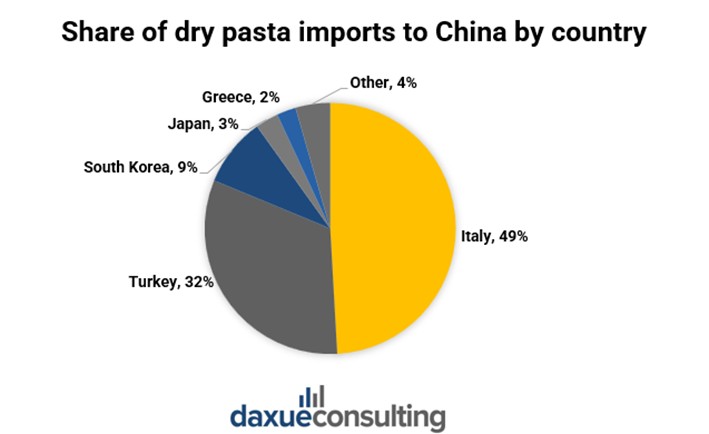
The top exporters of dry pasta to China include Italy, Turkey, South Korea, and Japan. Popular imported products include spaghetti, macaroni, and other pasta shapes. The most popular imported brands in the Chinese market are Barilla and De Cecco, which are widely distributed in retail stores and online platforms. Other European imported pasta brands like Gallo, La Molisana, and Zara’s Pasta are also players in the market, though smaller in scale. All these imported brands represent the premium segment.
There are several distribution channels, with products listed to align with the target customer. Mid- to large-sized dry pasta packs are available in supermarkets for household consumption, while high-end stores offer more premium brands and organic products in smaller pack sizes (250-500g). Convenience stores carry single-serve instant pasta for quick meals.
Another channel is online platforms such as Tmall, JD.com, and Pinduoduo. These platforms offer a variety of both local and imported products, including multi-packs and specialty pasta, such as gluten-free options. Moreover, online dry pasta prices are competitive due to government support for 0% tariffs on cross-border e-commerce (CBEC). This makes it easier for customers to access products and helps minimize stock leftovers at physical stores.
Who’s buying pasta in China?
The main customer group for the dry pasta market in China consists of young urban consumers (ages 20-35) who are interested in convenient meals. Dry pasta brands like “空刻意面 (AIRMETER)” target first-tier cities (Beijing, Shanghai, Guangzhou, and Shenzhen). It focuses on young white-collar workers or sophisticated housewives who care about the details of consumption. Therefore, customers can be grouped into three main categories.
- Young urban consumers seeking convenience who have adopted Western-style dishes and need quick, easy meals.
- The middle-upper class, who are interested in imported and premium pasta.
- Health-conscious consumers who are looking for specialty pasta. For instance, gluten-free and whole-grain foods are in line with global health food trends.
The top players in the Chinese dry pasta market
The dry pasta market in China is growing with increasing demand for both local and imported products. International players like Barilla and De Cecco have a strong presence in the premium market.

Competitive strategies in the dry pasta market include offering product variety, such as different shapes and quick-cook options, which come with innovations in packaged food. Pricing is a key differentiator between imported and local brands. Imported brands are often priced higher than local ones to maintain their premium positioning, while local brands offer more affordable options. Another important strategy for the dry pasta market in China is product localization. For example, many brands emphasize easy-to-cook pasta formats and develop sauce flavors adapted to Chinese tastes, such as mushroom-based, seafood, or mildly spicy profiles. In addition, some Chinese manufacturers focus on health-oriented product innovation, including whole-grain or low-fat pasta options, to meet growing demand for healthier convenience foods. The goal is not only to maintain the taste of the original products but also to adapt to Chinese market preferences.
What does the future hold for China’s dry pasta market?
The dry pasta market in China is growing, yet there are still significant opportunities within this sector. The market landscape reveals competition from both local and imported brands. While challenges exist, they also present opportunities for growth.
There are several challenges:
- Competing with traditional Chinese noodles, which are more price-competitive and familiar in taste.
- Educating customers about how to cook pasta, such as achieving the “al dente” texture. This presents a behavioral barrier.
- Imported products, under general trade, have to follow strict rules and regulations set by the Chinese government.
However, despite these challenges, there are also opportunities:
- The growth of the young consumer base and urbanization is driving demand for convenience and international meals.
- There is a great opportunity in the premium market, as customers are still willing to pay for high-quality and specialty products, offering the chance to gain high margins.
- With the rise of health-conscious eating, there is an opportunity for specialty products to gain popularity and stand out in the market.
- E-commerce and cross-border trade are strong opportunities for international players who want to enter the market, benefiting from tariff exemptions and regulatory support that help this channel grow.
The growth story of dry pasta in China continues to unfold.
- China’s dry pasta market hit RMB 10.57 billion by 2025, driven by a fast-paced urban lifestyle and rising demand for quick meals, positioning pasta as the ultimate “shortcut” meal.
- Younger generations are embracing pasta as a regular meal option, moving beyond its “foreign” novelty and integrating it into weekly meal rotations as an easy-to-prepare home cooking staple.
- Distribution is divided between bulk-buy convenience in local supermarkets and premium imports in high-end boutique grocers. E-commerce is booming, with tariff exemptions making international pasta brands more affordable.
- The market is fragmenting into three key segments. Busy city dwellers and premium buyers are looking for quality. Whilst a growing wellness-conscious group is seeking gluten-free or artisanal pasta alternatives.
- While domestic noodles remain popular due to competitive pricing, the real growth and profit potential lie in the premium sector, where quality and health benefits are increasingly valued over price.