

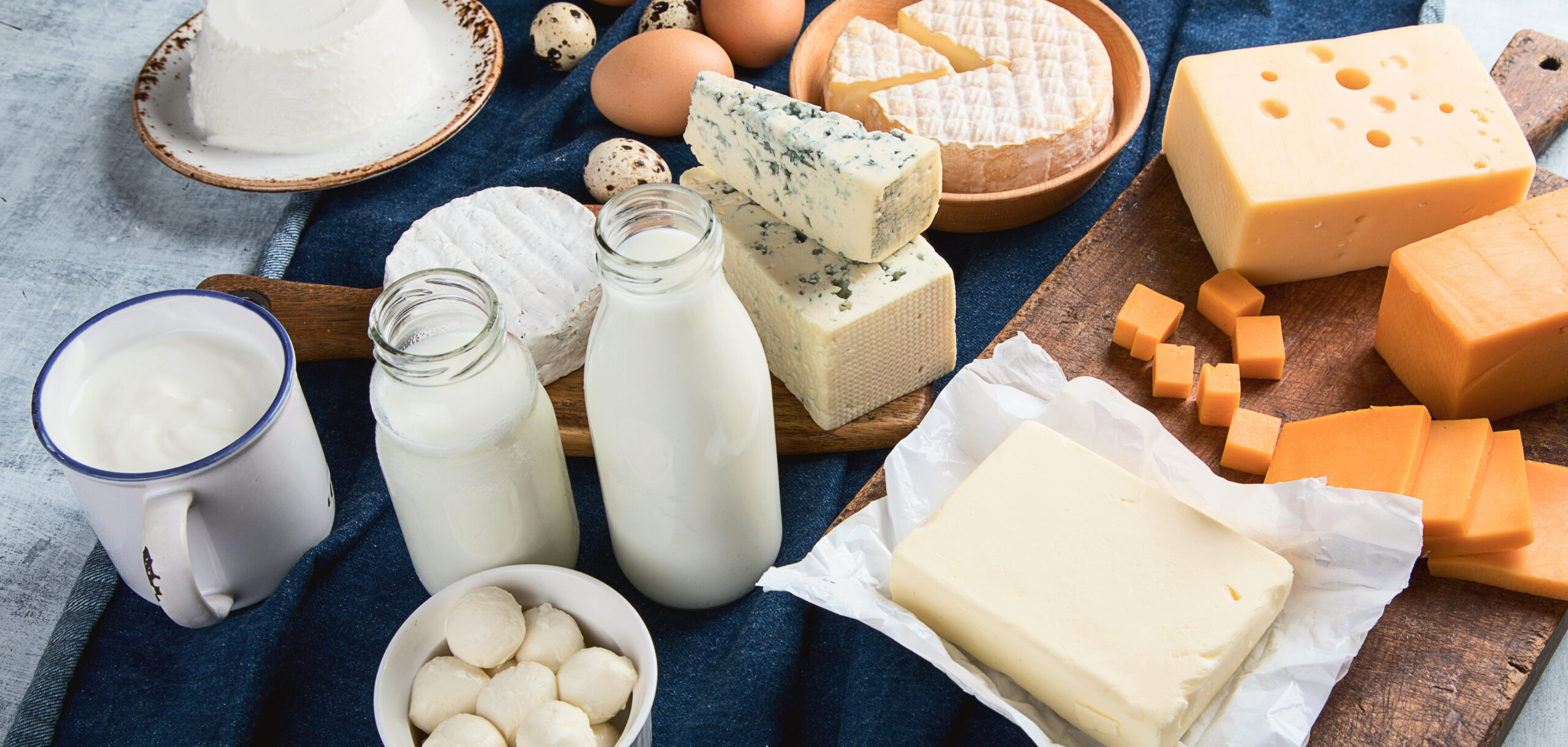
China is one of the world’s largest dairy markets after the US and remains the largest importer of dairy products globally. The market continues to expand in value terms, reaching USD 74.2 billion in 2025 and projected to grow to USD 93.6 billion by 2031, despite broader FMCG stagnation, where total market value grew by just 0.8% in 2024. However, simple volume increases no longer drive profitability. Severe oversupply, along with softer demand, has driven farmgate milk prices to fall by 15% year-over-year. At the same time, traditional ultra-high temperature (UHT) fluid milk demand has slowed. Consumers are price-sensitive and expect greater value for money.
Download our China F&B White Paper
Why is raw milk oversupplied in the dairy market in China?
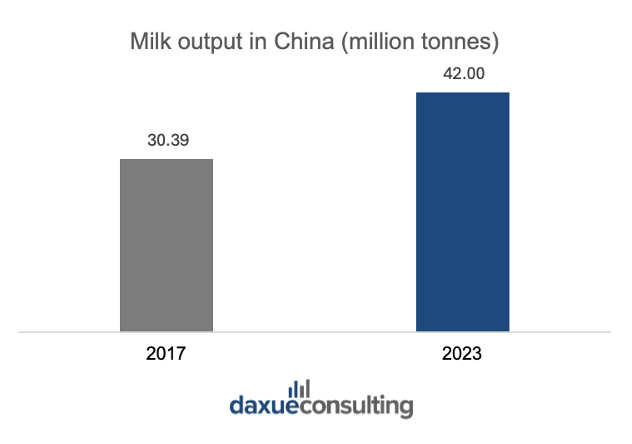
In 2025, domestic milk production reached 40.91 million tons. This represents a 0.3% increase from 40.79 million tons in 2024. However, following several years of rapid expansion combined with stagnant demand, consumer demand for basic fluid milk has plateaued. This supply-demand imbalance has created large domestic stockpiles that processors struggle to absorb into the fluid milk market. Consequently, processors must convert excess raw milk into whole milk powder for storage. This forced conversion occurs even though producing whole milk powder is currently unprofitable. Farmgate milk prices fell by roughly 15% year-over-year, pushing many smaller producers out of the market.
What follows is not simply contraction, but consolidation. Production is increasingly concentrated in large-scale operations. Farms with more than 1,000 cattle account for around 68% of total output by 2025.
These facilities operate with significantly higher efficiency, particularly in feed management and cost control, allowing them to remain viable even in a low-price environment.
Rather than a temporary imbalance, this shift points to a more industrialized dairy system, where scale and operational efficiency define competitiveness.
Where is growth shifting for imported dairy products?
As domestic production strengthens, the role of imports is becoming more specialized. Imported fluid milk is facing increasing pressure, as locally produced pasteurized milk gains consumer trust and logistical advantages. Imports of fluid milk could drop to 660,000 metric tons in 2026. Domestic pasteurized milk is rapidly replacing imported UHT milk. Furthermore, massive domestic stockpiles keep Whole Milk Powder imports stagnant at 420,000 metric tons.
Growth has instead shifted toward categories that are less easily substituted. Cheese demand in China is structurally anchored in foodservice, with over half of total consumption driven by B2B channels.
Notably, growth has shifted toward functional ingredients that are less easily substituted. Cheese imports are increasing aggressively, reaching 129,000 metric tons by August 2025. This demand is structurally anchored in commercial B2B foodservice, where massive demand comes from quick-service pizza chains and new-style tea shops. Similarly, premium western bakeries drive double-digit growth for imported butter. Whey protein imports are also surging, reaching 463,000 metric tons by August 2025. As one of the crucial ingredients, the growth supports the booming sports nutrition and infant formula sectors.

At the same time, shifting geopolitical tariffs are reshaping the import landscape, where the European Union recently faced severe anti-subsidy investigations. On December 23rd, 2025, China imposed 42.7% tariffs on EU cheese. Consequently, Chinese importers are rapidly rerouting their supply chains. New Zealand now dominates the import market. Since January 2024, New Zealand dairy has entered China entirely tariff-free.
How are consumer preferences reshaping dairy demand?
Demand is increasingly defined by function rather than habit. For many consumers, dairy is no longer a default staple, but a product evaluated based on specific health outcomes. Roughly 34% of mainland Chinese consumers prioritize high nutritional value, and another 25% demand verifiable organic certifications.
One structural factor is lactose intolerance, which affects a large portion of the population estimated at around 65% of adults. The dairy alternatives market in China, which is the emerging sector within the broader dairy market ecosystem that addresses demand from consumers with lactose intolerance, will reach USD 19.16 billion by 2033. This has created sustained momentum for plant-based alternatives, including oat and coconut milk, particularly among younger urban consumers seeking low-sugar and easier-to-digest options.
Demographic shifts further segment the market. An aging population is driving demand for specialized milk powders enriched with calcium, probiotics, or collagen, designed to address bone health and overall wellness.
In parallel, the growing pet economy is opening a niche category for dairy alternatives tailored to animals. Pet milk retails between RMB 2.3 and 21 per 100ml. There, safety and digestibility are the key selling points.
Taken together, dairy consumption is moving toward more targeted, need-based purchasing rather than broad, undifferentiated demand.
How does digital discovery influence dairy consumption?
Digital platforms now play a central role in shaping how consumers discover and evaluate dairy products. Traditional advertising has less influence on purchase decisions, especially among younger consumers, who rely more heavily on peer-driven content such as KOC content for authentic product reviews. KOCs post educational carousels that break down complex dairy ingredient lists. They also share highly practical culinary usage guides. For example, KOCs post detailed recipes for imported baking cheese.
Xiaohongshu, in particular, functions as both a search engine and a lifestyle platform. Instead of direct promotion, brands succeed by integrating into everyday scenarios such as breakfast routines or fitness habits through user-generated content. Posts that explain product benefits in simple, practical terms tend to perform well, especially when they focus on ingredients or nutritional value.
Visual aesthetic presentation is crucial for driving consumer conversion. The popularity of trends like the “#YogurtBowl,” which has accumulated over 1.7 billion views, highlights how food products are increasingly positioned as part of a curated lifestyle. Premium brands like Blueglass capitalize heavily on this visual trend. They position low-temperature, collagen-infused yogurt as a luxury lifestyle product. Seasonal campaigns, like cherry-blossom flavored milk, also drive viral momentum.

At the same time, brands must adapt to modern retail logistics, particularly O2O delivery platform logistics. Consumers actively build grocery baskets on Meituan and Ele.me. They constantly hunt for specific cross-promotional dairy coupons. To convert buyers, dairy brands must optimize bulk family packaging.
What does it take to convert consumers in dairy market in China?
- China’s dairy market is projected to grow from USD 74.2 billion in 2025 to USD 93.6 billion by 2031.
- Commercial foodservice has become a primary growth engine in China’s dairy market, with demand for imported cheese and butter increasingly tied to expanding bakery and foodservice chains.
- Widespread lactose intolerance is accelerating demand for plant-based dairy alternatives.
- Adult nutrition is shifting toward functional formulations, with products fortified with calcium, probiotics, and collagen replacing generic milk powders.
- Traditional brand messaging is losing effectiveness in retail conversion, as consumers increasingly rely on Xiaohongshu KOCs for practical, experience-based education.
- O2O delivery platforms are reshaping purchasing behavior, with consumers favoring bulk and family-sized formats that align with at-home consumption and rapid delivery models.