

Meituan has left community group buying, and Pinduoduo’s Duoduo Maicai now runs it almost alone. Fourteen years after China’s group-buying website war, the idea survives inside three apps, each with its own economics.
Updated on 2 September 2026. First published in July 2012. By the Daxue Consulting team.
Meituan Youxuan, the community group-buying arm of China’s largest local services platform, stopped taking orders in Fujian, Hubei, Sichuan, Jiangsu and Beijing on 23 June 2025, Yicai reported. In December it left its last regions, according to Jiemian.
The space went to Pinduoduo. Its Duoduo Maicai (多多买菜) service reached a GMV close to RMB 300 billion by late November 2025, LatePost data quoted by Jiemian show, with more than 2 million pickup points. That is more than Duoduo Maicai and Meituan Youxuan sold together the year before.
How community group buying works, and why it stopped paying
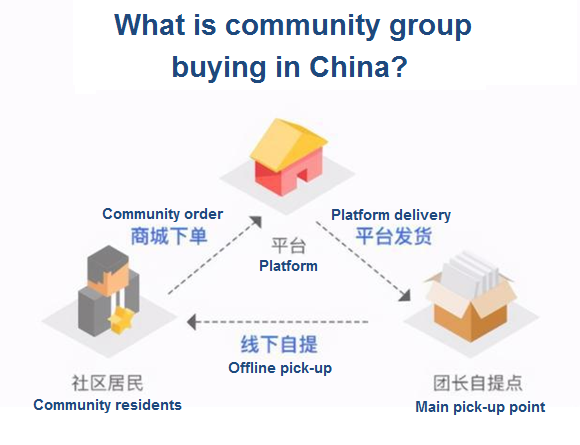
The model is simple. A group leader (团长), often the owner of a small shop in a housing compound, posts the day’s deals in a WeChat group. Neighbours order before midnight. The next day, the platform delivers everything to the shop and residents come to collect.
For the shopper, it is cheap. For the platform, each basket of eggs and cabbage carries warehouse, truck and commission costs on a margin of a few yuan. Meituan tried to keep the model in its stronger regions in mid-2025. Six months later, suppliers received shutdown notices.
Duoduo Maicai went the other way. It cut commissions nationwide in September 2025 and took over former Meituan suppliers and warehouses. By late 2025 its pickup points reached about 70% of China’s administrative villages, according to Jiemian. That is where the model still works: villages and small towns, far from 30-minute delivery.
Vouchers moved to Douyin, speed moved to Meituan
The Groupon-style voucher of 2012 did not disappear. It moved to short video. Douyin’s local services business grew total transactions by 59% in 2025, with more than 15 million stores selling on it, according to its annual review cited by the 21st Century Business Herald.
Not every voucher turns into a visit. Huxiu wrote in March 2026 that under half of Douyin’s hotel and travel vouchers were actually used, against about 90% on Trip.com.
Meituan bet on speed instead. On 5 July 2025, its instant retail orders hit a record 120 million in one day, National Business Daily reported. The price war with JD and Alibaba was costly: Meituan lost RMB 23.4 billion in 2025 on revenue of RMB 364.9 billion, Caixin Global reported. We cover that shift in our analysis of quick commerce in China.
The group-buying websites of 2012 are gone. The idea itself moved inside Pinduoduo, Douyin and Meituan.
At Daxue Consulting, we run a news watch on China’s consumer market to keep professionals informed. Our team follows platform results, regulation and consumer habits, and we publish what matters in our weekly China market newsletter and on this site. This article is part of that work: our July 2012 piece on group-buying websites, updated with the 2026 numbers.
From the 2012 group-buying war to three giants
Group buying reached China in 2010, two years after Groupon was founded in the United States. Hundreds of copycat sites appeared. In July 2012 we reviewed four of them. Meituan led, with monthly sales of RMB 0.4 billion and a founder, Wang Xing, known for cost control. Lashou had raised money fast and spent it fast on advertising; its IPO filing stalled and it later withdrew it, then was sold to Sanpower, TMTPost wrote. Nuomi belonged to Renren and was later absorbed by Baidu.
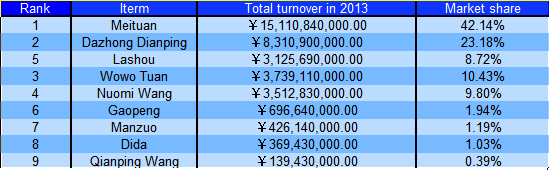
The race was decided fast. By 2013 Meituan held 42% of group-buying turnover and Dianping 23%. The two merged in October 2015, Caixin Global reported, and Meituan listed in Hong Kong in 2018. What we did not see in 2012 was that the real winners would be apps that did not exist yet: Pinduoduo, founded in 2015, and Douyin, launched in 2016.
What it means for brands
We see three channels with three different jobs. Next-day pickup on Duoduo Maicai suits fast-moving goods for lower-tier towns. Douyin vouchers bring first visits to restaurants, gyms and hotels. Instant retail on Meituan serves what people need today: drinks, snacks, beauty basics.
Price is the risk. The same product often shows three prices in three channels, and shoppers compare them in seconds. We would set the pricing architecture before the first listing, and track voucher redemption, not only GMV. Our article on route-to-market in China explains how to split roles between channels. For more on lower-tier shoppers, see our work on Pinduoduo’s consumers and on Meituan’s strategy.
FAQ
Which is the biggest group-buying platform in China in 2026?
For community group buying, Pinduoduo’s Duoduo Maicai is the last national player, with a GMV near RMB 300 billion by late November 2025 and more than 2 million pickup points. For restaurant and service vouchers, Meituan leads and Douyin grows fastest (+59% in transactions in 2025). See our guide to community group buying in China.
Why did Meituan close Meituan Youxuan?
Next-day group buying lost money on small baskets of fresh food. Meituan stopped Youxuan in five provinces on 23 June 2025 and left its last regions in December 2025, to focus on 30-minute instant retail.
What happened to the 2012 group-buying websites?
Most closed or were absorbed. Lashou withdrew its IPO in 2012 and was sold to Sanpower, Nuomi went to Baidu, and Meituan merged with Dianping in 2015 before listing in Hong Kong in 2018.
About Daxue Consulting
Daxue Consulting is a market research and strategy consulting firm focused on China, founded in Beijing in 2012, with offices in Shanghai, Beijing and Hong Kong. We have delivered more than 800 projects for international brands. To discuss your channel strategy in China, see our consumer understanding services or contact our team.