

Kailas is part of a rapidly growing Chinese outdoor and sports market that has been expanding since 2016. Government support and long-term targets have helped expand the sector and, along the way, reduced the automatic prestige and trust advantage international brands once had in many categories. Local companies now have a clearer path into performance-focused segments of the outdoor sports and technical apparel market, if they can prove the quality of their products.
Founded in 2003, the company’s core focus has always been on technical, premium outdoor gear. It gained significant attention after 2016, both locally and internationally, as climbing and trail running became more popular. Consumers began demanding gear that performs in real-world conditions, not just “gorpcore fashion” products. Kailas adapted to this shift, aligning perfectly with the market’s evolving needs, leading to greater success.
The rise of Kailas in China
Kailas stays in the performance-focused segments of the outdoor sports and technical apparel market. It concentrates on climbing, mountaineering, and trail running equipment and apparel. The brand emphasizes function over form. Products feature lighter builds, dependable grip, rain protection without trapping heat, and durable materials that withstand repeated use.
That focus tends to attract serious buyers, people who care about safety, performance, and technical credibility more than low prices or lifestyle branding. It also fits the market’s main participation groups. The China Outdoor Sports Industry Development Report puts the post-80s and post-90s cohorts at 32.5% and 36.1%, respectively (68.6% combined). These demographics, having grown up with digital connectivity, are particularly adept at this evidence-based shopping: they read reviews, compare specs, and trust firsthand user experience.
Growth drivers behind Kailas in China
Kailas grew by building a simple but disciplined system: product credibility first, then targeted visibility, and then community-driven retention. In technical categories, reliability is the brand. Kailas treats product performance as its core asset and improves designs through feedback loops with serious users who can quickly tell what works and what fails.
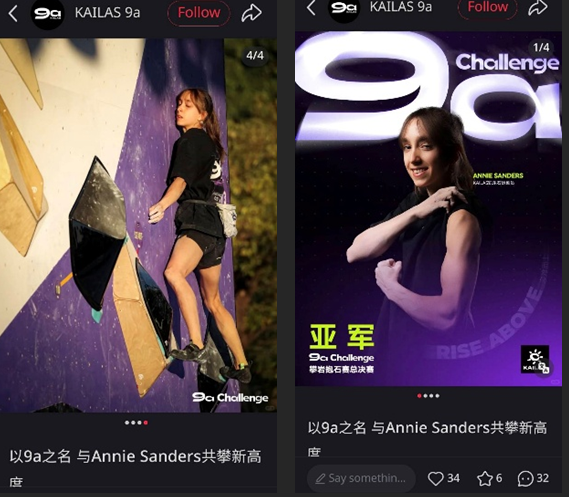
Rather than leaning on glossy lifestyle storytelling, Kailas puts its weight behind evidence. User-generated content plays a central role because it shows the gear performing in real settings. For instance, routes, trails, and rough weather, instead of controlled, studio-like scenes. When customers share climbing or trail-running experiences, the brand benefits from a level of credibility that paid media often struggles to create.
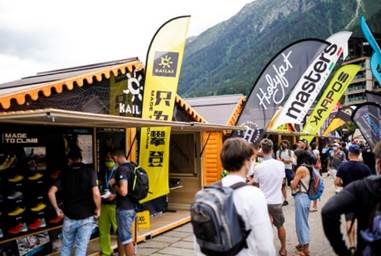
Kailas also uses event marketing in a focused way. Sponsorship and activation at endurance and trail-running events, including UTMB (The Ultra-Trail du Mont-Blanc)-related races. This helps the brand reach its exact target audience while creating natural moments for new product launches.
Because fit and confidence are critical in technical apparel, Kailas uses an O2O (Online-to-Offline) strategy to bridge the gap between online interest and offline purchase. Its stores in Tier 1 cities such as Beijing and Shanghai, as well as key tourist and outdoor hubs, are designed as meeting points, not just shop floors. With classes, events, and group activities, the store becomes a place where customers can test products, pick up skills, and build trust, which matters most in premium footwear and technical apparel where fit and confidence drive the purchasing decision.
Challenges in competing with global outdoor incumbents
Kailas’ growth has required overcoming challenges that are structural for premium technical brands in China. The first is credibility under real conditions. In climbing and mountaineering, a product failure is not a minor issue; it can quickly damage trust across tightly connected communities. Maintaining consistent quality as the brand scales is, therefore, a constant pressure.
The second challenge is consumer perception around pricing. Many buyers still assume a local brand should be cheaper than Western competitors, even when the product is positioned as premium. That means Kailas must continually defend its price through performance proof, not brand storytelling alone.
A third challenge is the high cost and slow payoff of innovation. Improving technical products means steady investment in materials, R&D, and testing, but results do not always translate into fast commercial wins. Some development efforts simply will not land. Competition adds another layer: Kailas is up against global incumbents such as The North Face, Salomon, and HOKA, which are backed by decades of credibility, bigger budgets, and deeper distribution. The real risk is dilution, where expanding too widely could blur the technical identity that earned the brand its trust in the first place.
Brand building beyond sales: how Kailas in China strengthens loyalty and credibility
Kailas is a useful role model because it shows a way to compete without mimicking the global giants. The brand keeps its message tightly aligned with product reality, which helps avoid the gap that often appears when marketing outpaces performance.
The company also builds legitimacy through collaboration with expert communities and professional channels, including connections to competitive climbing and national teams. In technical categories, these relationships work less as endorsements and more as competence signals to serious users.

Beyond partnerships, Kailas invests in outdoor culture and participation, not just sales campaigns. Initiatives such as the “Unclimbed Peak Project” reinforce the idea that the brand is part of the sport rather than merely a label selling into it.
On social media, Kailas benefits from KOC (Key Opinion Consumer) dynamics who are credible everyday users sharing genuine experiences. This type of advocacy tends to be more persuasive than high-gloss influencer content for performance buyers, and it helps build loyalty that is harder for competitors to buy.
This foundation also supports broader expansion. Kailas has moved beyond being only “Kailas in China.” The brand grew into markets such as the United States, Canada, Spain, Japan, and Singapore. This exports credibility built through performance and community reputation.
Implications for other businesses: Key lessons from the Kailas in China case
Kailas offers several lessons for brands trying to compete against established global players. The first is that proof scales better than persuasion. Field testing, athlete validation, and real-use evidence reduce purchase risk more effectively than broad claims.
The second is the advantage of sharp positioning. Kailas anchored itself in a clear technical identity rather than trying to serve everyone, which made it easier to earn trust, defend pricing, and stay credible with demanding users.
Third, capability must come before communication. Strong brands in technical categories are built from the inside out where R&D, materials choices, design execution, and quality control come first. Marketing works best when it is explaining real advantages, not trying to cover for missing ones.
Fourth, a community can function as a moat. Events, training programs, and user-generated content help turn customers into repeat users and advocates, while also reducing long-term reliance on paid media.
Finally, credibility matters in sustainability too. Repair, reuse, and durability programs are more convincing than generic “green” messaging because they align with product performance and can be experienced directly.
Kails demonstrates that a domestic brand can compete with global leaders by staying rigorous: earn trust through performance, stay technical, and build loyalty by showing up consistently in the communities that use the product. Kailas in China is proof that a local brand can take share from global names without trying to outspend them or borrow their playbook. It didn’t win on noise or novelty; it won by earning trust through performance, backing its claims with real-world use, and building relationships that last beyond a single purchase.
Raising the bar in outdoor gear: How Kailas is competing with global brands in China
- China’s outdoor and sports market has expanded swiftly since 2016 and is projected to reach 3 trillion RMB by 2025, supported by government policy and rising participation, creating space for strong local performance brands.
- Kailas found its footing by riding the wave of China’s climbing and trail running craze. But they didn’t just follow the crowd into the “outdoor fashion” scene. They doubled down on technical gear instead. The brand designs equipment that actually survives the elements and doesn’t quit on you after a couple of rugged trips.
- Their main crowd is mostly post-80s and post-90s outdoor enthusiasts who aren’t interested in cheap deals or flashy logos. These folks take their hobbies seriously. For them, a product’s safety track record and actual performance carry a lot more weight than “lifestyle” marketing or a low-price tag; they want to see real-world proof before they pull the trigger.
- The whole growth engine at Kailas is built on one thing: being believable. They let real user reviews and niche event sponsorships do the talking, then back it up with an O2O (online-to-offline) retail setup. It works because it lets people actually get their hands on the gear to test it out before making a purchase.
- Despite competing with global incumbents, Kailas defends premium pricing through performance proof, community engagement, and sustained investment in R&D, while avoiding dilution of its technical identity.