

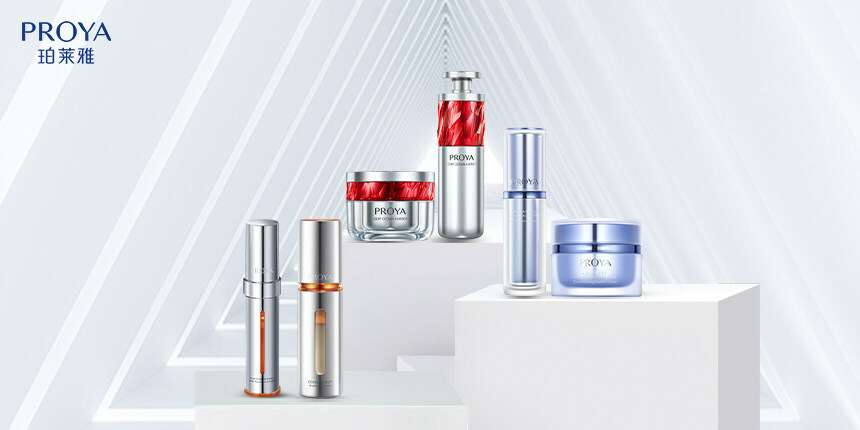
In 2024, Proya became the first domestic beauty brand in China to record RMB 10.778 billion in annual revenue. More significant than the number was how it got there. Chinese skincare consumers had spent several years shifting from brand prestige to ingredient literacy. Proya built its product strategy entirely around that shift while international incumbents were still optimizing for the brand-led model that had worked in China for decades.
As a result, L’Oréal’s own management team acknowledged it was losing share in mass beauty to domestic brands, and in June 2024, Proya’s Tmall (天猫) store overtook L’Oréal, and topped the beauty rankings for the first time, displacing the French giant. Revenue grew 21% and net profit 30%. It looked less like a company catching up and more like one pulling away.
| Platform / Metric | 2024 Result | 2025 Result |
| Tmall Beauty GMV Ranking | No.1 ↑70%+ YoY | No.1 (Full cycle) |
| Douyin Beauty GMV Ranking | No.1 ↑110%+ YoY | No.2 |
| JD Domestic Beauty GMV Ranking | No.1 ↑80%+ YoY | No.1 |
| Vipshop Domestic Beauty GMV Ranking | No.1 ↑30%+ YoY | No.1 |
| Pinduoduo Beauty GMV Ranking | No.1 ↑60%+ YoY | No.1 |
However, the narrative shifted in 2025. Full-year revenue came in at RMB 10.597 billion, down 1.68%, with net profit falling 3.5%. Both were the first declines in Proya’s nine years as a listed company. The context matters more than the headline: China’s cosmetics retail market grew 5.1% that year. Proya did not decline because the market turned; rather, it declined while the broader market continued to grow. The more telling figure is the sales expense ratio, which rose to 49.63% of revenue in 2025, up from 46.78% the year before, even as revenue contracted. When a brand spends a growing share of shrinking revenue on marketing and still loses ground, the problem is not the campaign. The main Proya brand contracted 10.39% in 2025 and absorbed most of the cost of a transition the company had not yet figured out how to complete.
Why did this strategy stop functioning in 2025?
The sales expense ratio of Proya rose to 49.63% of revenue in 2025, up from 46.78% the year before, while revenue fell 1.68%. Marketing spends increased in absolute terms. Revenue fell. That combination tells you something specific: Proya is spending more to find customers and finding fewer of them. Over 95% of its revenue comes from online channels, and the brand is already present on every major platform. There is no new channel to enter and no cheaper audience available.
What makes this harder to explain away is the gross margin: Proya’s rose to 73.26% in 2025, up 1.87 percentage points year-on-year. The product itself is generating more value per unit than it did a year ago. Proya’s problem is not that its products stopped working. It is that the consumers most likely to respond to ingredient-led skincare messaging have largely already been reached, and the ones who have not been choosing differently. In a market that grew 5.1%, Proya declined, and this is not due to sector problem.
In contrast, it is a specific audience exhaustion, and more marketing spend cannot solve it because it just finds the same people who already said no. Moreover, in Q1 2026, revenue fell a further 2.29% and net profit contracted 6.05%. The main Proya brand was down 10.39% for the full year. The numbers do not describe a difficult year. They describe a model that has exhausted its addressable audience on the channels it was built for.
Proya expense breakdown (2024-2025)
| Expense Item | 2025 (RMB) | 2024 (RMB) | Growth Rate (%) |
| Selling Expenses | 5,259,412,498 | 5,161,012,045 | +1.91% |
| Administrative Expenses | 403,543,630 | 365,856,440 | +10.30% |
| R&D Expenses | 216,843,241 | 210,385,991 | +3.07% |
| Finance Costs | −28,600,472 | −35,821,940 | N/A |
The clinical ingredient approach from another brand ran into the same wall
KOMFYMED(可复美)’s experience offers a warning from a different angle. The brand reached RMB 4.54 billion in revenue in 2024 by concentrating entirely on one ingredient: recombinant collagen, delivered through Human-like Recombinant Collagen Restoration Single-Use Essence (胶原). In addition, the effect was measurable: Komfymed’s second-half 2025 sales fell RMB 540 million year-on-year, Double 11 GMV dropped approximately 30%, and the parent company recorded its first revenue and profit decline since listing in 2022.
The ingredient controversy landed in an already difficult market: injectable collagen-stimulating treatments saw dramatic price collapses in 2025, with procedures that once cost tens of thousands of renminbi falling to a fraction of that. When the clinical alternative becomes affordable, the consumer’s case for premium topical products weakens alongside it. Proya does not carry Komfymed’s degree of single-product concentration. Yet, both brands built their identity on consumers trusting an ingredient story, and that trust is harder to sustain in a market where the injectable version is becoming cheaper by the quarter.
| Metric | 2025 | 2024 | Change (YoY) |
| Revenue | 5,518.5 | 5,538.8 | −0.4% |
| Gross Profit | 4,433.4 | 4,546.9 | −2.5% |
| Profit Before Tax | 2,350.3 | 2,457.8 | −4.4% |
| Net profit | 1,914.7 | 2,061.7 | −7.1% |
| Profit Attributable to Owners of the Parent | 1,914.8 | 2,062.3 | −7.2% |
| Adjusted Net Profit (Non-IFRS) | 1,959.9 | 2,151.5 | −8.9% |
| Basic Earnings Per Share (RMB) | 1.83 | 2.10 | −12.9% |
| Diluted Earnings Per Share (RMB) | 1.81 | 2.06 | −12.1% |
The brand that overtook Proya did not heavily market on formulas
KANS(韩束) ranked first on Douyin beauty throughout most of 2024, with full-year brand revenue reaching RMB 5.591 billion, up 80.9%. Its method was short dramas with the influencer 姜十七, whose six branded series accumulated over 5.2 billion views by mid-2024. The storylines were built around romance and personal identity, not product formulations. Proya held second place on Douyin in the first half of 2025, behind a brand whose entire playbook was built on emotional content.
The gap matters because Douyin now determines which brands reach consumers who have not yet formed a product loyalty, and the brand in first place was not competing on formulation at all. By 2025, KANS’s brand revenue had grown to RMB 7.36 billion, but the growth rate had fallen to 31.6% from 80.9% the year before, and its most recent drama collaboration accumulated only 240 million views compared to over a billion for its earlier individual series. Drama-driven content reaches a natural audience ceiling, much like ingredient-driven content before it. Proya has not yet found a new playbook. Ultimately, KANS at least proved its old one worked for a time. Both are now looking for what comes next.
Proya’s sub-brands are growing, but not fast enough
The growth rates attached to Proya’s sub-brands read well in isolation. Off&Relax grew 102% to RMB 744 million, INSBAHA(原色波塔) grew 125%, and Awaken Seeds(惊时) grew 442%. Each percentage looks like an early chapter of a growth story. However, in absolute terms, they share the same constraint: the bases are too small to move the group-level numbers. Together, Proya’s sub-brands added approximately RMB 710 million in new revenue in 2025. The main Proya brand lost RMB 892 million over the same period, on a base that was RMB 8.581 billion the year before. Sub-brand share of total revenue reached 25.73% in the first half of 2025, the highest it has been. That still means three quarters of the business depends on a brand that is contracting.
TIMAGE (彩棠) is the one sub-brand with the revenue base to change that arithmetic. At RMB 1.255 billion, it operates in color cosmetics, a category structurally separate from the skincare channel where the main brand is facing headwinds. Its growth rate fell to 5.37% in 2025, from 19% in 2024, continuing a deceleration that began when it grew 103% in 2021. Whether this reflects natural market maturation in color cosmetics or a broader portfolio dynamic is a question the next few years will clarify.
Off&Relax presents a different picture, growing at 102% in haircare, a category with meaningful whitespace and a distinct consumer base. At RMB 744 million, it is still building scale, but the growth rate suggests real market demand. Proya’s multi-brand strategy is structurally sound and positions the company to diversify its revenue base over time. How quickly the sub-brands can reach the scale needed to rebalance the portfolio is the central question for the next two to three years.
Proya Cosmetics Co., Ltd. — Core Business Revenue by Brand (2025)
| Brand | Amount (RMB 100mn) | 2025 YoY (%) | 2024 YoY (%) | 2023 YoY (%) | 2025 Share (%) | 2024 Share (%) | 2023 Share (%) |
| Proya (珀莱雅) | 76.89 | −10.39 | 19.55 | 36.36 | 72.64 | 79.69 | 80.73 |
| Timage (彩棠) | 12.55 | 5.37 | 19.04 | 11.86 | 11.07 | 11.26 | |
| OR (Off&Relax) | 7.44 | 102.19 | 71.14 | 71.17 | 7.03 | 3.42 | 2.42 |
| Youfumei (悦芙媣) | 3.71 | 11.80 | 9.41 | 61.82 | 3.50 | 3.08 | 3.41 |
| (原色波塔) Awaken | 2.56 | 125.38 | 138.36 | — | 2.42 | 1.06 | — |
| Seeds (惊时) | 0.96 | 441.66 | — | — | 0.91 | — | — |
| Other Brands | 1.74 | 6.77 | 23.18 | 18.86 | 1.64 | 1.68 | 2.18 |
| Total | 105.85 | −1.67 | 21.09 | 40.86 | 100.00 | 100.00 | 100.00 |
Key takeaways on the rise of Proya
- The main Proya brand contracted 10.39% in 2025 while China’s cosmetics retail market grew 5.1%. Sales expenses rose to 49.63% of revenue even as revenue fell, which means the brand is spending more to reach fewer new customers.
- The competitor that took Douyin from Proya was not selling ingredients. KANS(韩束)held the top Douyin beauty ranking for most of 2024, growing revenue 80.9%, by producing short dramas with emotional storylines rather than formulation content. Proya ranked second on Douyin in the first half of 2025.
- Sub-brands are growing fast but from bases too small to matter at group level. Off&Relax grew 102% and Awaken Seeds(惊时) grew 442% in 2025, but together the sub-brands added roughly RMB 710 million while the main brand lost RMB 892 million. TIMAGE(彩棠), the only sub-brand at meaningful scale, grew just 5.37%.
- Q1 2026 shows no reversal: revenue fell a further 2.29% and net profit contracted 6.05%. The multi-brand strategy is directionally right. Whether it scales fast enough to offset the main brand’s decline is the question the next two years will answer.