

China advanced agriculture in 2025 data
- Grain output reached a record 714.88 million tonnes in 2025, up 1.2%, according to Miller Magazine.
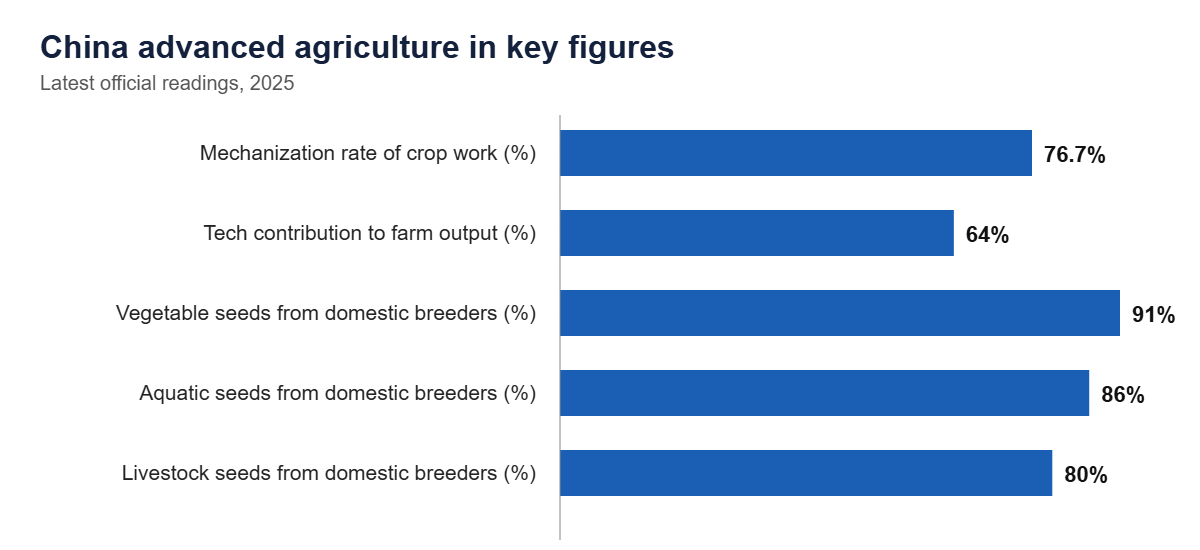
- Mechanization of cultivation, planting and harvesting hit 76.7%, and technology now explains more than 64% of farm output, per the ministry data reported by Global Agriculture.
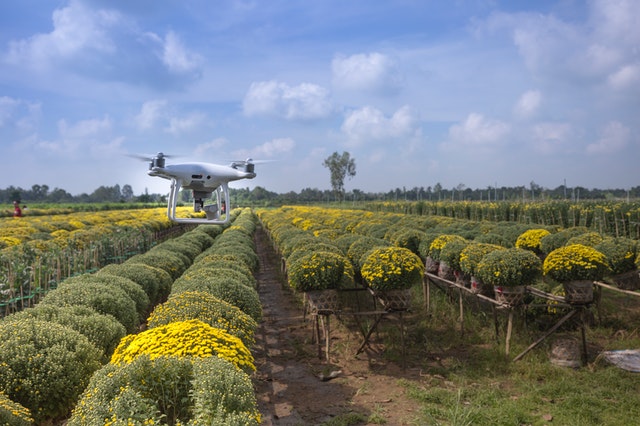
- More than 300,000 agricultural drones now fly over about 460 million mu a year, roughly 30.7 million hectares.
- Rural disposable income reached RMB 24,456 per person, up 6% in real terms, says CGTN.
Advanced agriculture in China is no longer a pilot topic. It is the way the country keeps 1.4 billion people fed with less labor and less land.
Why China keeps pushing advanced agriculture
The logic of our first research has not changed. China abandons the traditional farming methods step by step, and applies more technology throughout the country. Precision agriculture and, expert systems help to use resources better. Automation machines free part of the agricultural labor force. Vertical farming was introduced to feed the growing urban population.
What changed is the scale. The pressure points are the same:
- Farmland is limited, and part of it is lost every year to disasters and poor land management.
- The rural labor force is aging, while cities keep absorbing young workers.
- Food demand moves up in quality, not only in volume.
- Imports are large, which makes food security a political topic.
On that last point, China was the world’s second-largest agricultural importer in 2025, with imports of US$207.4 billion, And soybean imports hit a record 111.83 million tonnes. So the state wants more output from the same land.
What the latest policy document asks for
The 2026 No. 1 central document sets a grain goal of about 700 million tonnes, as Miller Magazine reports. The priorities are concrete:
- High-end intelligent machinery, especially for hilly and mountainous terrain.
- AI applied to farming, with more drones, IoT sensors and robots.
- Faster seed development and industrial biological breeding.
- Strict protection of arable land and more high-standard farmland.
- More oilseeds (rapeseed, peanuts, oil tea) and forage such as silage corn and alfalfa.
High-standard farmland is the quiet engine. China built or renovated 75.68 million mu in 2025 alone, and the total passed 1. billion mu. That land is flat, irrigated and ready for machines, so every drone and tractor works better on it.
Drones, seeds and machines
Drones. The number above is huge for one country. A fleet of 300,000 units means spraying, seeding and mapping are now routine services, often sold per mu by local cooperatives. DJI and XAG lead this market, and farmers with small plots rent the service instead of buying.
Seeds. Domestic breeders now supply over 80% of livestock and poultry seeds, 86% of aquatic seeds and 91% of vegetable seeds. Seeds are the part of the chain Beijing wants to control first, and the document asks to industrialize biological breeding.
Machines. A 76.7% mechanization rate hides a gap. Plains reach very high levels, while hills and mountains in the south-west stay low. This is why the 2026 document names hilly-terrain machinery directly.
From our earlier research on premium produce
Our first article noticed that premium plants raised by advanced agriculture were welcomed, especially by middle- and high-income customers. Imported fruits were seen as safer and of higher quality. Ole, a high-end supermarket, opened more than 40 stores in over 20 cities in just 11 years, and its transactions grew every year.
That human insight still holds. The difference today is that domestic producers want this premium shelf too. Traceability codes, greenhouse brands and cooperative labels compete directly with imported fruit.
Daxue Take
For a foreign company, the opportunity is real, but it depends on where it sits in the chain. We would consider these options:
- If the product is hardware (sensors, irrigation, greenhouse systems), partner with a local integrator. Selling alone to farms is slow, and the buyer is often a cooperative or a state-linked platform.
- If the product is genetics or inputs, expect the strongest limits. Seeds are a strategic sector, and foreign access is tight.
- If the product is premium food, the channel is the story. Cross-border and high-end retail still pay, but only with a clear origin and a traceable label.
- If the product is software or data, check the data rules first, because farm data can fall under local storage requirements.
None of these routes is easy, and each one needs a local partner. The limit is that official figures describe the national average, and a single province can look very different.
What to watch next
- Whether the mechanization rate in hilly areas starts to close the gap.
- The number of drones and their yearly coverage, the cleanest signal of real adoption.
- How seed rules open or close for foreign players.
- Food-demand shifts, also visible in our work on the baby food market in China, the elderly care market and the industry 4.0 wave in China.
FAQ
How much grain does China produce?
A record 714.88 million tonnes in 2025, up 1.2% from the year before.
How mechanized is Chinese farming?
The rate for cultivation, planting and harvesting is 76.7%, with large differences between plains and mountains.
How many agricultural drones does China use?
More than 300,000, covering around 460 million mu each year.
Can foreign companies enter this market?
Yes for equipment, premium food and services, usually with a local partner. Seeds and data are far more restricted.
What is the main goal of policy?
Stable grain near 700 million tonnes, less import dependence and higher productivity through technology.
About Daxue Consulting
Daxue Consulting is a market research and strategy consulting firm focused on China, founded in Beijing in 2012, with offices in Shanghai, Beijing and Hong Kong. We have delivered more than 800 projects for international brands. To discuss advanced agriculture and food markets in China, see our market research services or contact our team.