
Updated on 19 August 2026
Births have halved in a decade, yet baby hygiene sales still grow as nearly every baby now wears disposables, Japanese brands have lost their lead and Chinese brand Babycare has entered the top three.
By Daxue Consulting
Baby hygiene products, mostly diapers, reached RMB 32.89 billion of sales in China in 2025, up 3.7% YoY, and 89% of babies now use disposable diapers, up from 84.8%. Total absorbent hygiene products reached RMB 133.0 billion, up 1.3% (Gelonghui (格隆汇), China Disposable Hygiene Products Association data, June 2026). This growth comes despite 7.92 million births in 2025, about half the level of the early 2010s.
The brand ranking has changed. Japanese brands such as Merries and MamyPoko, once the “safe” choice of Chinese parents, have lost most of their share. Chinese brand Babycare rose to third place in early 2026, and P&G’s Pampers is first again. China’s ageing population is also opening a second market in adult care. This analysis of diapers in China examines demand, brands and channels, and what they imply for international hygiene brands.
| Daxue Overview |
|---|
| Births: 7.92 million in 2025, about half the level of the early 2010s. |
| Market: baby hygiene RMB 32.89 billion in 2025 (+3.7% YoY); total absorbent hygiene RMB 133.0 billion (+1.3% YoY). |
| Penetration: 89% of babies use disposable diapers (2025), up from 84.8%. |
| Brands: Pampers no. 1; Babycare no. 3 in Jan-May 2026; Merries and MamyPoko down sharply. |
| Next market: adult incontinence products for 323 million people aged 60 and over. |
Diapers in China: key figures
Exhibit 1: Value grows as users decline
| Indicator | Figure | Period | Source |
|---|---|---|---|
| Baby hygiene products sales | RMB 32.89 billion, +3.7% YoY | 2025 | China Disposable Hygiene Products Association via Gelonghui |
| Women’s hygiene products sales | RMB 84.62 billion, -2.4% YoY | 2025 | Same |
| Total absorbent hygiene products | RMB 133.0 billion, +1.3% YoY | 2025 | Same |
| Baby diaper penetration | 84.8% to 89% | 2024 to 2025 | Same |
| Average offline price per diaper | RMB 1.45 to 1.65 | Mid-2024 to mid-2026 | Same |
| Merries market share | 8.6% to 2.7% | Over recent years | Ma Shang Ying (马上赢) via Gelonghui |
| MamyPoko market share | 7.4% to 2.5% | Over recent years | Same |
| Births | 7.92 million | 2025 | NBS |
Source: compiled by Daxue Consulting.
Higher penetration and longer use offset fewer births
With 7.92 million births in 2025, against 9.54 million in 2024, the number of users falls each year. Three forces keep the value growing:
- Penetration. 89% of babies used disposable diapers in 2025, up 4.2 points in one year, as the last families using cloth or split pants (开裆裤) switch.
- Spending per child. With one child in many families, parents choose premium ranges.
- Longer use. Pull-up pants, night diapers and training pants extend the period each child uses diapers.
Baby hygiene sales grew 3.7% in 2025 while women’s hygiene products fell 2.4% (Gelonghui).
Japanese brands declined, Chinese brands rose, Pampers returned
Japanese brands. Kao’s Merries and Unicharm’s MamyPoko were often bought abroad or through cross-border e-commerce for their “imported quality”. Merries’ share fell from 8.6% to 2.7%, and MamyPoko’s from 7.4% to 2.5% (Gelonghui).
Chinese brands. Half of the top 10 diaper brands in 2025 were Chinese. Babycare, a Hangzhou brand born online, ranked seventh in 2025 and third in January to May 2026, with sales up nearly 200%; it has led mother-and-baby product sales for three years (Ma Shang Ying data via Gelonghui). Annil (安儿乐) ranked second in early 2026.
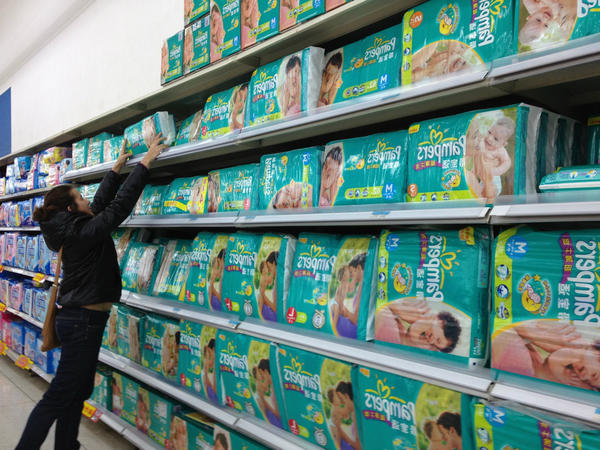
Pampers. Pampers ranked first in 2025. P&G reports double-digit growth for six quarters in a row and nearly five points of share gained, helped by premium ranges such as 黑金帮 (National Business Daily (每日经济新闻), August 2026; see P&G in China). Kimberly-Clark’s Huggies, fourth in 2025, lost share in early 2026.
Exhibit 2: Leading diaper brands in China
| Brand | Origin | Position | Strength | Trend |
|---|---|---|---|---|
| Pampers (帮宝适) | P&G, United States | No. 1 in 2025 | Premium ranges, scale | Up |
| Annil (安儿乐) | China | No. 2 in Jan-May 2026 | Value, distribution | Strong ranking |
| Babycare | China (Hangzhou) | No. 3 in Jan-May 2026 | Online, design, full baby range | Strong growth |
| Huggies (好奇) | Kimberly-Clark, United States | No. 4 in 2025 | Brand, range | Share down in 2026 |
| Merries (妙而舒) | Kao, Japan | 2.7% share | Japanese quality image | Down |
| MamyPoko (妈咪宝贝) | Unicharm, Japan | 2.5% share | Japanese quality image | Down |
Sources: Gelonghui, National Business Daily; compiled by Daxue Consulting.
Adult care is the next diaper market
China had 323.38 million people aged 60 and over at the end of 2025 (NBS). Adult incontinence products remain small compared with baby diapers and face a cultural barrier: many seniors are embarrassed to buy them, and families often buy for them. For hygiene brands, adult care uses the same factories and materials, has a growing number of users and rewards comfort, skin care and discretion. The wider context is covered in the China Silver Economy Report 2026 and retirement in China.
Chinese parents choose diapers through detailed reviews
Diapers are among the most reviewed products on Chinese social media. On Xiaohongshu, parents post detailed tests of absorption, softness, leaks, rashes and fit by weight. On Douyin, brands sell large family packs in livestreams. On Tmall and JD, repeat purchases depend on reviews and membership programmes. Babycare’s growth comes from this ecosystem: a brand built online, with design, fast launches and a full range of baby products. Maternity and early-childhood purchases are covered in maternity clothes in China.
How China’s diaper market has changed over the past decade
Exhibit 3: From a growing birth base to a premium, shrinking user base
| Early 2010s | Today | |
|---|---|---|
| Births | About 16 million a year | 7.92 million (2025) |
| Penetration | Growing, many cloth diapers and split pants | 89% of babies use disposables |
| Leaders | P&G, Kimberly-Clark, Kao, Unicharm | Pampers, Annil, Babycare, Huggies |
| Japanese brands | Strong, imported and “safe” | Sharply reduced shares |
| Chinese brands | Small, low price | Half of the top 10 |
| Adult products | Very small | A growing second market |
Daxue Take: implications for hygiene brands
Diapers show clearly how demography reshapes a category: half as many babies as a decade ago, yet a growing market because each parent spends more and almost every baby uses disposables. The winners are not those that led ten years ago: Japanese brands lost when their “imported quality” advantage disappeared, Babycare grew because it was built for Chinese parents online, and Pampers returned through premium ranges designed for China.
- For baby hygiene brands, growth comes from premium products and longer use rather than more users. Plans based on volume growth are unlikely to hold.
- For global brands, Pampers’ return suggests that premium, China-specific ranges can win back share from Chinese challengers.
- For brands relying on “imported” positioning, the decline of Merries and MamyPoko shows that origin alone no longer justifies a premium once local brands match quality.
- For brands building their channel mix, Babycare’s rise came from e-commerce and content; speed on Tmall, Douyin and Xiaohongshu is likely to matter as much as offline presence.
- For manufacturers with baby diaper capacity, adult care is a long-term extension where trust and discretion matter. Early investment in consumer understanding may pay off as the population ages.
Questions for leadership teams: What share of growth comes from premium ranges? How fast can the brand launch a new product online? Is adult care part of the long-term plan?
What to watch next
- Birth figures for 2026, due in January 2027.
- Babycare’s ranking through the rest of 2026.
- Pampers’ share gains and Huggies’ response.
- Growth and destigmatisation of adult incontinence products.
FAQ about diapers in China
How big is the diaper market in China? Baby hygiene products, mostly diapers, reached RMB 32.89 billion in 2025, up 3.7%, according to the China Disposable Hygiene Products Association. Euromonitor estimates the baby diaper market at more than RMB 65 billion with a wider scope.
What is the most popular diaper brand in China? Pampers was first in 2025. In early 2026, the top three were Pampers, Annil and Babycare.
Are Chinese diaper brands popular? Yes. Half of the top 10 brands in 2025 were Chinese, and Babycare’s sales grew nearly 200% in early 2026.
Why are Japanese diaper brands losing share in China? Chinese brands now match their quality at lower prices, and global brands such as Pampers have launched premium ranges. Merries fell from 8.6% to 2.7% of the market.
Is there a market for adult diapers in China? Yes, and it is growing with China’s 323 million people aged 60 and over, although it remains small compared with baby diapers.
About Daxue Consulting
Daxue Consulting is a market research and strategy consulting firm focused on China. For baby and adult hygiene brands, Daxue Consulting tests products with parents and caregivers, analyses reviews and conversations on Xiaohongshu, Douyin and Tmall, benchmarks Chinese competitors such as Babycare, and studies new segments such as adult care. Learn more about our consumer research and China market research services, or contact our team.
Author: Daxue Consulting