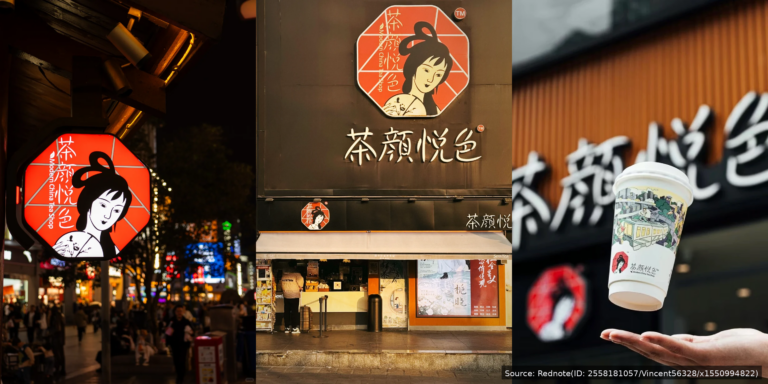


The Chinese modern tea sector has matured significantly since 2020, completing a transition from a volume-driven expansion model to a quality-focused era. In terms of growth, we can see this reflected in the shift from an average growth rate of 24.9% CAGR between 2017 and 2022 to a growth rate of 6.4% in 2024. The market is now saturated in first-tier cities, pushing brands to compete on per-store profitability rather than sheer outlet count.
Market trends today are shaped by new challenges: intensified competition among brands, health-centric innovation, and the pursuit of global expansion.
Download our China’s F&B industry white paper
The end of reckless expansion in the Chinese modern tea sector
The end of reckless expansion in China’s modern tea sector
Next-generation teas and coffees are now the two favorite beverage categories among the new generation of consumers. In particular, the next-generation tea market reached approximately 278.2 billion RMB in 2025. However, the current bubble tea sector in China is facing challenges. The first one is increased competition among different companies.
There is a fluctuation in the number of stores. Recent data (May, 2026) indicates that over an 11-month period, 174,000 new stores opened, but a staggering 137,000 closed. This slow growth indicates that the market is saturated.
There was also a reduction in the number of independent operators. This pushes the industry from a single-store battle toward a brand vs brand competition. The market is dominated by large chains that have better access to capital, land, and supply chains. The sector’s chain store rate has jumped from 57% to 66%, with chain stores now numbering approximately 206,000 (more than 68% of tea and bubble tea shops are part of larger chains).
Overview of the distribution strategy for tea brands in China

Prices range from 4 RMB (Mixue) to sometimes over 20 RMB (HeyTea). The Chinese bubble tea market can be structured around three distinct strategic tiers: volume leadership, premium differentiation, and an increasingly squeezed middle tier.
At the volume-driven tier, Mixue dominates through a low-cost model (products around 6 to 8 RMB) and exceptional scalability. This is supported not only by operational efficiency but also by strong emotional branding. Mixue brand is heavily tied to its viral Snow King mascot and its jingle that spurs user-generated content. This combination of affective marketing and aggressive expansion has enabled the brand to surpass other competitors and to have 30,000 global outlets.
The volume-driven vs premium quality debate
At the opposite end, premium specialists like Chagee have successfully carved out a defensible niche. Chagee avoids sugary toppings and instead focuses on pure tea lattes and a healthier beverage narrative. With 6,000 stores, its strategy demonstrates that premium positioning can be broad-based and accessible, and that the strategy is not necessarily limited to high price points or exclusivity. Chagee has successfully carved out an “affordable premium” niche. The brand offers quality tea and a refined store experience without the luxury price tag. This strategy allows the brand to attract middle-class consumers who want authenticity and a pleasant environment, but at a more accessible price point than top-tier premium brands.

How legacy chains adapt?
Between these two poles lies a heterogeneous middle tier, where brands face growing strategic pressure. Legacy premium chains such as Heytea and Naixue (once defined by fresh fruit, high price points, and third-place experiences) are now forced to lower prices and expand into lower-tier cities as value-consciousness rises. ChaPanda operates slightly below them with a large franchise network and balanced pricing, maintaining volume without competing at Mixue’s ultra-low level.
Regional players add further complexity. A-Shui Tea holds loyal mid-range ground in northern and eastern China, while Modern China Tea Shop rejects national scale to preserve a cult-like, premium aura, remaining geographically concentrated in Hunan province.
The importance of health trends in the Chinese modern tea sector
In 2026, the health trends in the Chinese modern tea beverage sector are an important requirement that the industry has to deal with. It is not a niche option anymore but a regulatory necessity. There is a genuine demand for healthier products in this sector. In fact, 78.3% of consumers look for “real fruit” and “low sugar” labels on the new tea beverages they buy.
Consumers are calling for greater transparency and for companies to better control the amount of sugar added to beverages. A viral social media sentiment, “难怪现在奶茶三分糖都很甜” (“No wonder even 30%-sugar milk tea is still so sweet”), has captured consumer skepticism. “Reduced sugar” labels are highly unreliable. Some “30% sugar” drinks contained more sugar than competitors’ “70% sugar” options.
Sweetness as a main decision factor
In response, brands (such as Chagee, Happy Lemon, Heytea, Naixue, and Tealive) are recalibrating their sweetness benchmarks. The industry has shifted standards so that what used to be “50% sugar” is now labeled “70% sugar” to manage customer expectations. At the same time, they have also launched “low‑calorie” series that substitute artificial or natural alternative sweeteners for part of the sucrose load. Take Chagee and HeyTea, for example: their WeChat Mini-App displays the glycemic index and calorie content of their drinks.

More broadly, this cultural shift goes beyond simply reducing sugar intake. It must be understood within the context of a new economic landscape in the weight-loss industry that has emerged in recent years.
Young office workers report replacing daily milk tea purchases with healthier alternatives like protein shakes, a direct threat to habitual consumption. The strategy for these brands, then, is to adapt to these new demands rather than risk being left behind. But this trend is not the only one shaping the industry.
Product innovation strategies in China’s tea market: from tea+ models to brand differentiation
Beyond positioning battles between volume and premium tiers, or their positioning on the health trend, competition in China’s tea market increasingly plays out through product innovation.
The nature of innovation has matured, rather than relying on superficial additions like cheese caps or Oreos (which are easily replicated and offer no sustainable differentiation), brands now compete on “Tea+ (茶+)” models: hybrid offerings that fuse beverage consumption with cultural identity, seasonal rituals, or lifestyle experiences.
Various innovation strategies have emerged to stay relevant
The goal is always to ensure that the brand stands out from the competition.
Take Heytea, for example, which has successfully blended seasonal traditions with modern taste preferences. A case in point is the “Longjing Green Rice Ball Milk Tea” (龙井青团奶茶). 3 million units of this variety were sold in a single month. This product demonstrates that cultural relevance can drive viral growth even for a premium brand. In this case, the inclusion of familiar festival traditions stems from the fact that green rice balls are eaten during the Qingming festival in China. For context, Qingming is a major traditional Chinese festival for honoring ancestors by visiting their graves. Here, heritage-based innovation reduces perceived risk for consumers: a familiar cultural cue makes an unfamiliar product more approachable.
Another example is Molly Tea. While Mixue focuses on volume and price and Chagee on its accessible premium offerings, Molly Tea has built its identity around expertise in a single ingredient: jasmine. Strategically, Molly Tea illustrates a different innovation path: vertical specialization rather than seasonal variety. This mono-ingredient focus creates two competitive advantages. First, it generates a perception of superior quality (consumers assume that a brand specializing in jasmine sources the best leaves). Second, it solves the memorability problem: in a crowded market of hundreds of tea brands, being “the jasmine tea brand” makes it much easier for consumers to recall and recommend. The 14 million units sold of their Jasmine Milk tea in one year (2025) confirms that narrow specialization, when executed consistently, can achieve scale comparable to generalist players.
The winners are not those who add more toppings. Those who win embed their products in narratives that resonate across the various Chinese regions and demographics.
But the new tea beverage sector also faces challenges and risks
Persistent homogeneity of products and the risk of consumer fatigue
Despite the innovations it tries to introduce in terms of flavor, the industry remains trapped in a cycle of undifferentiated competition. Data (2025, N = 1,434) shows that consumers widely recognize “recipe homogeneity” (46.5%) and “co-branding fatigue” (61.1%) as major sector problems.
The response of many brands has been cross-category expansion. 70% of top tea brands now sell coffee, and nearly all sell bakery items. This leads to even greater standardization among stores. The danger is that brands with weak core flavor identities become generic drinking stations rather than destinations. This fragmentation of category identity dilutes consumer memory. In turn, it is harder for any single brand to command lasting loyalty or pricing power.
Risk of low brand loyalty
The 2025 food delivery price war caused external damage, exposing how brands with fragile value propositions can be swiftly destabilized. Chagee suffered the most dramatic setback. Its principled refusal to join the platform subsidy wars backfired catastrophically. The initial intent was to protect the brand’s high-end image and franchisee margins. While competitors saw delivery volumes explode, Chagee’s store traffic was sharply diverted, leading same-store GMV to decline for eight consecutive quarters. But the price war alone does not explain Chagee’s struggles. Another factor to consider is market saturation, that intensified competition for every customer. Chagee is no longer the only brand in this niche.
Chagee’s predicament reveals a market reality where brand loyalty is thin. Consumers in major cities exhibit low switching costs and will abandon a preferred brand for a better-subsidized rival. This suggests that, for all their marketing efforts, many brands have failed to build a genuine relationship with consumers that protects them from price-based competition.
A reason for this failure lies in a long-standing over-reliance on transactional marketing tactics that generate noise but not loyalty. For years, the sector chased traffic peaks through high-frequency IP co-branding and novelty-driven limited-time offerings. While these campaigns generated immediate visibility, they conditioned consumers to seek constant stimulation. When consumers are trained to hop between brands for the next novel flavor or theme, they develop a relationship with the new tea beverages, not with the brand.
The sector’s primary weaknesses are not on the demand side. Rather, they are competitive and structural crises.
New tea beverage market: from growth to strategic maturity
- The Chinese new tea beverage market has entered a maturity phase. With growth slowing sharply, this signals the end of expansion and a shift toward increased competition between brands and difficulties for the smaller ones
- The industry is structurally segmented into three tiers: low-cost volume leaders, premium differentiators, and a pressured middle segment trying to balance price and brand positioning
- Health has become a core strategic requirement rather than a trend. Strong consumer demand for low-sugar, transparent, and functional products forced brands to reformulate offerings and improve disclosure
- Sustainable differentiation now depends on meaningful innovation, while persistent product homogeneity and low brand loyalty remain critical structural risks