
Even though China’s fragrance market is growing rapidly – faster than the global average – what is worth more attention is how Chinese consumers now understand, select, and experience perfume. In 2025, the market for perfumes in China totaled around RMB 30 billion, a 20% year-over-year growth. By 2029, it is projected to exceed RMB 50 billion, meaning it could grow by more than two-thirds in just four years. Despite this momentum, perfumes remain smaller than other mainstream categories like color cosmetics, haircare, and personal care products.
Light formats win: EDT leads consumer choice
In China, Eau de Toilette (EDT) is the top choice. According to iMedia Research’s 2026 survey on 1,186 fragrance respondents, 63.1% chose EDT as one of their most preferred types of perfumes. This was followed by 48.6% who chose Eau de Parfum (EDP) as a secondary preference. EDT’s light, versatile character suits commuting, office wear, dates, and casual social occasions, matching the understated self-presentation many perfume buyers in China favor.
This is not simply a matter of price or convenience. Heavier concentrations are more likely to feel overwhelming in daily rotation. A perfume that lingers for eight hours and announces itself across a room sits awkwardly against a broader cultural preference for understatement in everyday self-presentation, which is why EDT’s lighter footprint keeps winning over even as overall spending on fragrance rises.
Floral, fruity, and woody: A market in transition
Women, particularly those under 30 years old and in first- and second-tier cities, still account for around 60% of the Chinese perfume market. However, male consumers are growing as an emerging segment, with their share rising from 37% in 2023 to 40% in 2024.
Floral scents, often linked with softness and natural elegance, resonate strongly given the market’s female-dominated base, and that association is part of why floral has kept its lead even as male buyers enter the category with different scent instincts. According to a report by iMedia among 1,186 respondents, floral was the most preferred family at 37%, pairing naturally with the light-intensity formats.
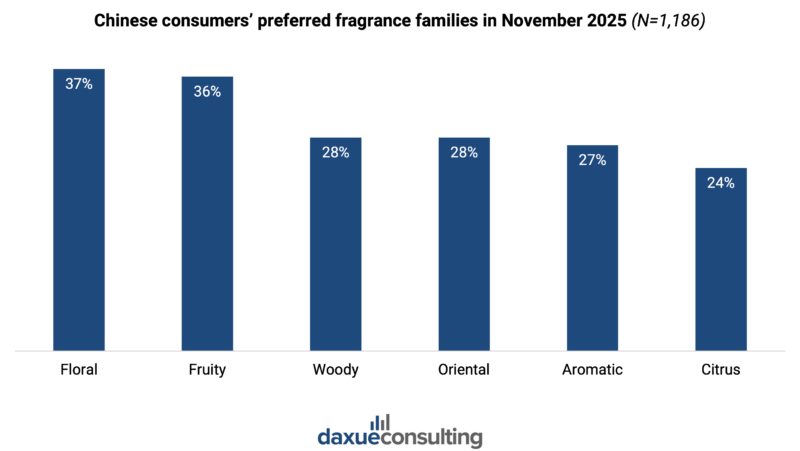
Demand is fragmenting into niche, trend-driven segments – fruity, floral-fruity, and woody-floral among them – rather than consolidating around one dominant note, which has real implications for how brands should be building out their fragrance lines.
Floral scents hold the largest share of China’s fragrance market at 26%, but are growing just 6%, a mature, stable core rather than a growth engine. Fruity and floral-fruity scents each grew 26%, making them the most dynamic families, while oriental scents shrank 19%.
That combination, broad floral dominance paired with sluggish floral growth, is the more revealing signal. It confirms that heavier, traditional profiles are losing ground to lighter, fresher preferences, but it also means floral’s popularity is no longer translating into concentrated purchasing momentum.


Usage by city tier: The geography of everyday habit
Usage frequency reinforces the everyday-use story, and it is not a new trend. Over 40% of consumers wear perfume one to three times a week. Annual spending most commonly lands between RMB 501 and 1,000, a mid-tier price point rather than a luxury price.
That habit is not evenly spread across the country. An industry tracker, Cosmetics Observer (August 2025), found that in higher-tier cities more than a third of consumers apply perfume once a day and nearly 12% apply it multiple times a day, while in lower-tier cities almost a third of consumers report no fixed usage habit at all. A separate 2026 industry report puts the split at 44% using perfume one to three times a week, 26.7% four to six times a week, and 9.5% daily, with only 6.1% reserving it for special occasions. Together, these frame perfume less as an occasional indulgence and more as a small, recurring act of self-care that higher-tier city consumers in particular have built into their lives.
Emotion drives purchase: Storytelling outsells scent
More than 40% of consumers choose perfumes in China based on a specific mood or occasion. PHLUR, relaunched in 2022 under Chriselle Lim, built “Missing Person” around her post-divorce experience, and now projects USD 175 million in 2026 global retail sales. To Summer’s Douyin following grew 2,400% year-on-year — proof that in China, content drives purchase before scent ever does.

Samples as business: From trial to standalone category
Because online shoppers cannot test scent before buying, two practices have emerged. Brands manage expectations directly through scent cards, order samples, pop-up testing events, and subscription models such as Scentbird which mail 8 ml samples so consumers can try.
Samples have also become a standalone product category in their own right. On Tmall, perfume gift sets grew 83%, and scent-testing sets grew 26% in 2025, outpacing the 16% growth of the perfume category overall. The scent-testing segment remains small, at roughly RMB 56 million, so the signal here is less about current scale than about where growth in perfumes in China may come from next, and whether “try before you buy” becomes a durable category of its own or stays a marketing line item.
Eastern aesthetic: Beyond oriental scent profiles
To Summer (观夏) takes a different approach, building a full lifestyle brand around Eastern aesthetics rather than competing on scent alone. It uses local ingredients carrying shared cultural memory such as osmanthus and Pu’er tea.

The brand also wraps products in literary naming such as “Cedarwood” 昆仑煮雪, which folds in Kunlun Mountain geography and classical tea culture, as well as extending the story into physical space at its September 2025 Hong Kong flagship, themed around 1960s “Made in Hong Kong” manufacturing and built around a customizable gifting ritual.

The distinction matters because weak growth in oriental-family scents does not mean Eastern-inspired brands are losing ground in the Chinese perfume market. Oriental fragrances don’t match current demand for light and refreshing formats. To Summer’s 2025 launch, “Watery,” reflects that shift: aquatic, floral and musky rather than classically oriental, proof that a brand can keep its cultural identity while abandoning the scent profile that identity is traditionally associated with.
Fit over fragrance: Why scent became a lifestyle
- Emotional value and lifestyle fit, more than ingredients alone, are driving purchase decisions in China’s fragrance market.
- Light formats win: EDT leads, while floral and fruity notes dominate everyday use, reflecting a broader preference for restraint over rejection.
- Floral holds the largest share, but fruity and floral-fruity segments are growing fastest, showing that demand is fragmenting rather than consolidating.
- Storytelling and samples matter more as online shopping grows since consumers often buy before they can smell the product.
- Weak growth in oriental-style scents does not signal declining interest in Eastern aesthetics; brands such as To Summer are thriving by framing culture as a lifestyle, not just a fragrance family.
Authors: Sory Park and Ming Yii Lai, with additional research by Zhien and Merry