
The global pickleball market is projected to rise from USD 2.2 billion in 2024 to USD 9.1 billion by 2034, a 15.3% CAGR. But China’s trajectory stands apart. While the sport has been widely associated with retirees in the US and club‑driven growth in Europe, China’s adoption pattern is younger, faster, and shaped by a different set of structural drivers.
The Asia‑Pacific region is the fastest‑growing pickleball equipment market globally, and China holds the largest share within the region at 22.1% in 2025. In the same year, China’s total pickleball market (equipment and services) reached RMB 1.8 billion (~USD 260 million), growing at a projected 47% compound annual rate, more than five times the equipment-only CAGR of 8.1%.
This growth rests on two pre‑existing conditions. China has one of the world’s deepest racket sport participant pools. According to China’s 2023 National Fitness Status Report, badminton is the country’s most participated sport, with 250 million amateur players, representing roughly 65% of the global active badminton population of 384 million in 2024. Table tennis, as China’s national sport, is equally embedded in daily life. Such immense familiarity with racket sports reduces the learning curve for pickleball to near zero for millions of potential players. At the same time, the national government, through the Chinese Tennis Association, has also actively standardized rules for pickleball in China, certified coaches and referees, and built a national tournament circuit.
Where the growth is happening
Pickleball’s expansion in China is not uniform. Venue growth is concentrated in two patterns: first‑tier cities as density hubs, and smaller cities as renovation hotspots. In Shanghai alone, 42 pickleball courts were added in the first half of 2025. During a similar period, in Dandong, Liaoning, local authorities converted over 270 recreational spaces for pickleball use, reaching more than 20,000 residents. This renovation‑led model keeps construction costs low and accelerates access, particularly in lower‑tier cities where tighter budgets make conversions of existing spaces a practical tool for promoting sports.
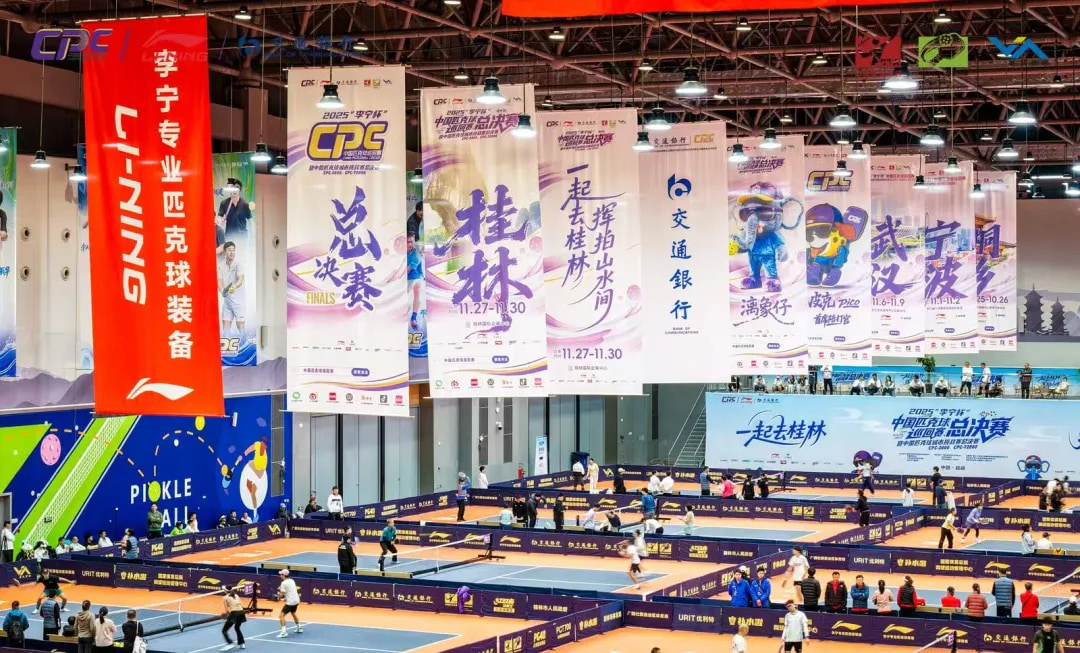
The tournament infrastructure is scaling even faster for pickleball in China. The national tournament circuit grew from 80 events in 2024 to over 600 scheduled for 2026. Referee certification, however, has not kept pace. With 2,300 referees trained in 2025, the average is fewer than four officials per event. Multi‑court tournaments can require ten or more referees daily, creating a bottleneck. How China resolves this, whether by training more referees, consolidating events, or accepting quality trade‑offs, will determine whether the sport prioritizes mass participation or competitive integrity.
Who plays pickleball in China: Age and what it means
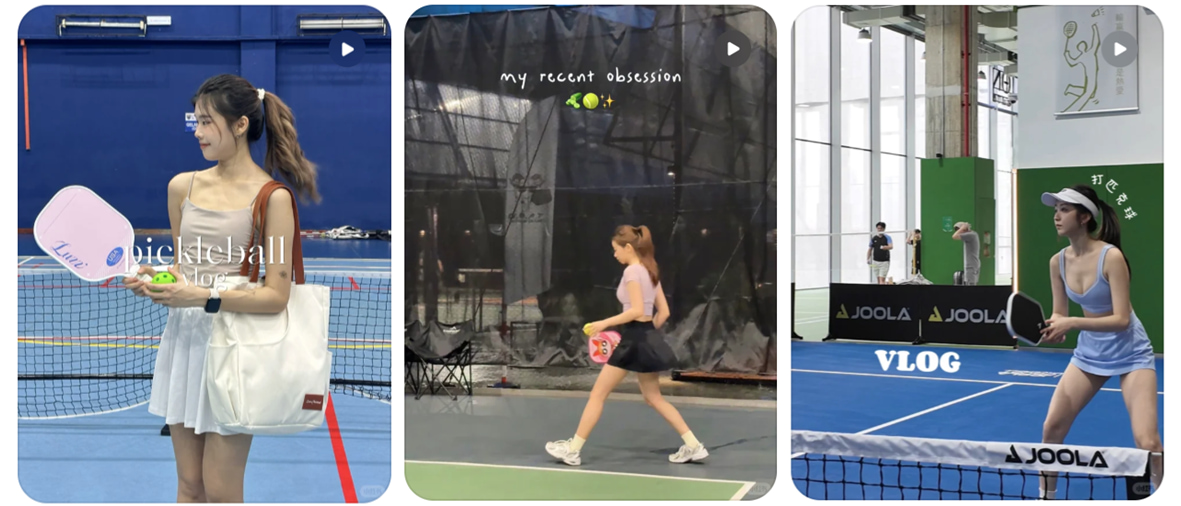
China’s pickleball participants are notably younger than the sport’s US stereotype. Among regular players, 35% are under 30, 40% are between 30 and 50, and 25% are 50 or older. That means three‑quarters of active players are below 50, with more than a third under 30. In the US, pickleball has long been associated with retirees, though that image is slowly shifting.
This skew towards China’s youth reflects a distinct emerging sports market. Younger players drive peer recruitment through social outings and workplace teams, creating organic daily marketing. Their higher lifetime value justifies greater brand acquisition spending, while advertising shifts toward RedNote (小红书) and Douyin (抖音) rather than senior‑focused channels. As of now, the hashtag #匹克球 has generated nearly 1.5 million user‑generated notes on RedNote alone, a clear signal of grassroots enthusiasm among young Chinese consumers. Consequently, brand partnerships naturally tilt toward fashion, beverage, and tech categories, aligned with young urban professionals, over health or retirement products.
Three structural differences: China has its own way with pickleball
Renovation as the scaling mechanism
In contrast to most Western markets, China builds courts primarily by repurposing existing spaces rather than constructing new facilities. This represents a structural difference, as China’s model decouples venue growth from real estate cycles. In markets where new construction depends on commercial investment, expansion slows during downturns. China’s renovation‑led approach, enabled by abundant underutilized badminton courts and community spaces, allows the sport to scale even when capital is tight. For foreign brands, this means that market penetration is less dependent on their own investment in facilities; local governments and community centers are already doing the heavy lifting.
The identity dilemma: why familiarity is also a threat for pickleball in China
In a nation with 250 million badminton players and a dominant national table tennis culture, pickleball has an extremely low learning barrier. Although this helps grow the sport initially, the unstated risk is that pickleball may remain a secondary activity. Something people play when badminton courts are full or when they want an easier workout. To become a primary sport, pickleball must institutionalize its unique rules and culture within the next few years. Fortunately, China’s top‑down governance of pickleball actually helps here, as the Chinese Tennis Association can mandate distinct rule sets and tournament formats. The threat is not that pickleball fails, but that it succeeds only as a casual substitute, capturing participation without brand loyalty or premium spending.
A two‑tiered supply side where domestic innovation meets premium entry
China already manufactures 70–85% of global pickleball paddles. Domestic brands are now investing in advanced production: Geili Sports (给力体育) put RMB 12 million into 3D printing and smart manufacturing in 2025, boosting efficiency by 400%, and improving energy transfer by 30%. This technological upgrading coincides with premium international brands such as Gearbox entering the market via exclusive distribution and association partnerships.
As a result, domestic brands compete on cost and innovation for the mass market, while international brands claim premium positioning. Unlike most emerging sport markets where premium brands lead and lower‑cost copies follow later, China’s domestic upgrading is happening in parallel. The technology gap is narrowing fast, and tension may emerge as domestic brands move upmarket. In this environment, international brands differentiate through brand equity, partnership networks, and service bundling, areas where local manufacturers currently have less presence.

The unwritten rules of China’s pickleball boom
- The market is shifting from one‑time paddle sales to recurring spending on training and tournaments. For participants, this means more structured play and coaching. For brands, the growth opportunity lies in services, not hardware.
- The referee shortage forces a strategic trade‑off: mass participation (spreading officials thin) versus competitive integrity (fewer, higher‑quality events).
- Pickleball in China is a young person’s game. Marketing happens on RedNote and Douyin, not senior channels. Thus, targeting peer recruitment and lifestyle branding is crucial.
- China scales venues by repurposing existing facilities, not building from scratch. This separates growth from real estate cycles and allows expansion without heavy capital inflow. For local governments, it’s a low‑cost public health tool.
- Domestic manufacturers are upgrading production alongside premium international entries. As the technology gap closes, brand equity, partnerships, and service bundling become the primary differentiators.
Author: Ming Yii Lai, with additional research by Hansel Guo