
Ultraviolet (UV) protection alone is not enough in the sunscreen market in China. Sunscreen is becoming more deeply integrated into daily skincare routines, outdoor lifestyles, and beauty regimens. This is raising the standards of sunscreen among Chinese consumers. According to Qingyan Intelligence, the sunscreen market in China was valued at RMB 27.5 billion in 2025, down 7.8% year-over-year. This decline is less driven by weakening sunscreen use and more by consumers seeking affordable sunscreen and the rise of physical protection apparel. The decline partly reflects consumers adopting broader sun protection in China, including facekinis, hats, and arm sleeves.
Even so, competition among brands continues to intensify as consumers seek sunscreen beyond just UV protection. Chinese consumers are applying sunscreen daily and seeking benefits such as moisturizing, anti-aging, and barrier repair. This is driving brands to invest in technology that allows them to differentiate themselves and win through scientific innovation and product performance rather than marketing alone. Competition is also playing out different across platforms, with Douyin growing rapidly.
Sunscreen is becoming part of daily skincare
Topical sunscreen cosmetics are becoming part of everyday skincare in China. Frequent use and high reapplication awareness show that consumers are treating SPF as a routine product rather than occasional protection. More than 70% of consumers use sunscreen either daily or two to three times per week, and 87% already understand the need to reapply it.
Protection, safety, and texture shape purchase decisions
Even though Chinese consumers value sun protection, product safety, and skin feel in sunscreen, they believe that there is a lack of products that can deliver them effectively.
Protection remains the strongest purchase driver for sunscreen cosmetics in China, with 84% of consumers naming protection effect, including SPF and PA values, as a key factor. Safety follows it very closely at 82%, followed by texture and skin feel at 70%. However, according to a Xinhua News Agency survey of 1,811 respondents, 83% believe the market still lacks a product that balances all three.
This explains why strong SPF claims are not enough to secure repeat use: products that feel heavy, cause discomfort, or fail to sit well on the skin can weaken consumer trust even when their protection looks credible. As sunscreen becomes part of daily skincare, sensory comfort is becoming part of how consumers judge whether protection is actually usable.
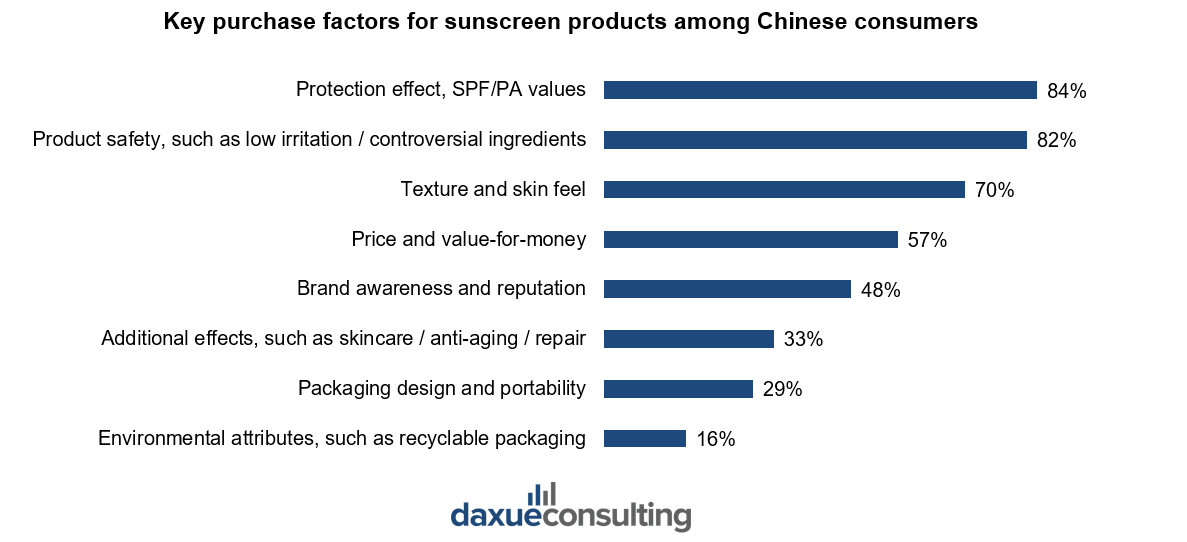
Additionally, amid China’s skincare market, consumers are becoming more ingredient-literate and discerning when evaluating sunscreen. They evaluate SPF protection together with formulation, daily-use comfort, and skin compatibility, looking for products that feel light, non-irritating, and suitable for different conditions and makeup routines. They are focusing more on how a product works rather than merely trusting what the product claims to do.
“Sunscreen+” is changing product expectations
As effective UV protection becomes the baseline and consumers expect more than just sun protection, sunscreen brands are trying to differentiate themselves through “sunscreen+” (防晒+) offerings. They are offering sunscreen products that also function as skincare or makeup or designed for different scenarios like sports, travel, and daily commute.
According to February 2026 Taotian data, basic sunscreen remained the largest claim category with a 49% share, but declined 6% year-on-year, while smaller categories such as repair, soothing, complexion correction, and primer/isolation recorded much faster growth. While the data does not directly measure consumer demand, it shows how sunscreen products on Taobao and Tmall are increasingly being framed around added skincare value and makeup compatibility.
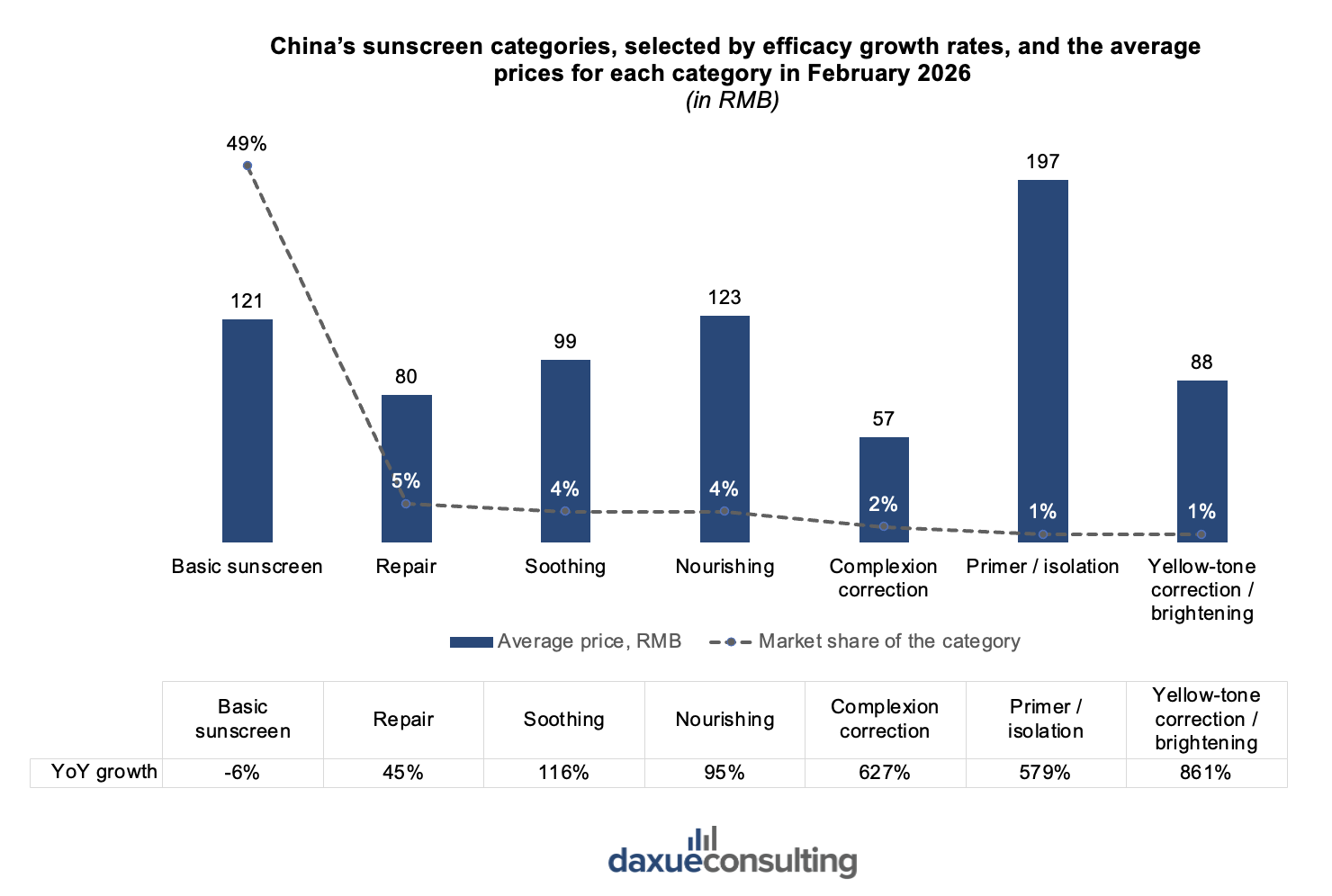
Data source: Taotian, designed by Daxue Consulting, selected sunscreen product claims by year-on-year growth, with data on average price and category share
Sunscreen is therefore moving closer to hybrid skincare. Repair and soothing claims are especially relevant for consumers who want protection without discomfort. Tone-up sunscreen, primer-like sunscreen, and makeup-compatible sunscreen also show how the category is entering complexion management.
Scenario-based use is making sunscreen more segmented
Scenario-based use is making sunscreen cosmetics in China more segmented, as consumers now expect one product to match a specific routine rather than serve every sun-exposure situation. A lightweight sunscreen for commuting is judged by comfort and ease of reapplication, while outdoor use puts more pressure on durability, sweat resistance, and stronger protection.
Consumers still buy topical sunscreen, but they now compare products within a use case rather than across the whole category. More portable formats are gaining relevance in outdoor and on-the-go settings, while tone-up and SPF base products are becoming better aligned with makeup routines. Across these use cases, the key shift is that sunscreen formats are increasingly judged by how naturally they fit into the consumer’s day, rather than by protection claims alone.
Douyin is reshaping sunscreen formats
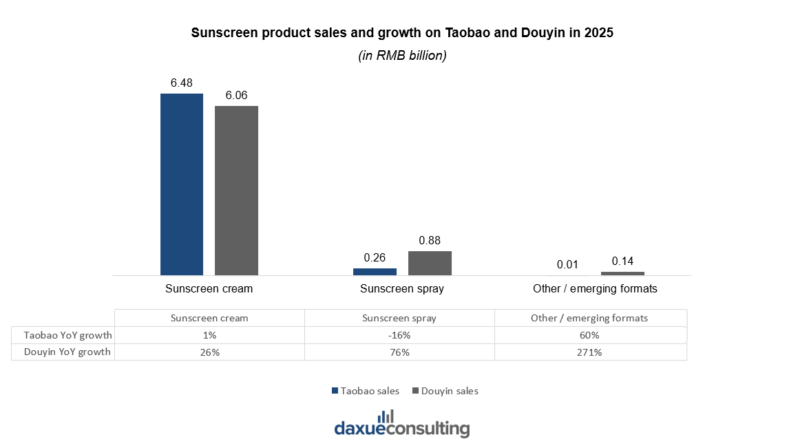
Sunscreen cream remains the core product format, but channel dynamics differ sharply. On Taobao in 2025, the sunscreen category declined by 0.2%. Sunscreen cream reached RMB 6.49 billion and grew only 1%, while sunscreen spray declined by 16%. This suggests that Taobao is a more mature channel for sunscreen cosmetics, where established formats still dominate, and growth is more limited.
Douyin shows a different pattern. In 2025, Douyin’s sunscreen category grew 32.5%. Sunscreen cream reached RMB 6.06 billion and grew 26%, while sunscreen spray reached RMB 877 million and grew 76%. Other emerging sunscreen formats remained smaller, but their rapid growth shows how short-video platforms can make new textures, application methods, and demonstration-friendly products more visible.
Competition is becoming more concentrated and more technical
China’s sunscreen cosmetics market is becoming more competitive. In 2025, the top five brands accounted for 36.51% of sales, while the top twenty accounted for 63.75%. Mistine, Anessa, and Winona remain highly visible across channels, but platform differences shape how brands compete. Taobao favors more established beauty brands, while Douyin gives emerging sunscreen brands more room to scale through content, education, and product demonstrations.
The shift is also raising the bar for product credibility. Seasonal campaigns and high SPF numbers are less powerful when consumers compare texture, ingredients, claims, and real-use reviews. The rise of “sunscreen+” broadens the product field, while regulatory pressure makes product claims more disciplined. As a result, consumers are looking for sunscreen products whose formulas, test results, and claims feel clear and trustworthy.
Regulation is becoming part of brand trust
Sunscreen cosmetics are special cosmetics in China and require registration management. In 2025, new draft technical guidelines for sunscreen cosmetics research and quality-control standards strengthened the role of mechanism research, safety, and claims. SPF and PA claims require supporting efficacy tests, while product instructions are expected to explain application amount, timing, and reapplication frequency.
This regulatory direction fits the broader consumer shift toward safety and proof. Buyers are paying more attention to irritation risk and real-use performance. As a result, compliance is becoming part of market trust. For sunscreen cosmetics in China, scientific credibility now appears across the whole product journey, from formula design and testing to label claims, content education, and consumer reviews.
What to know about China’s sunscreen shift
- China’s sunscreen cosmetics market totaled RMB 27.5 billion in 2025, down 7.8% year-over-year. This decline is less about weakening sunscreen use and more about seeking affordable sunscreen and a greater demand for sun protection products like facekinis, hats, and sleeves.
- Sun protection remains the top purchase driver (84%), followed by safety and texture.
- Sunscreen is becoming a daily skincare step. Chinese consumers demand benefits beyond just sun protection, including anti-photoaging, pigmentation prevention, and long-term skin health.
- “Sunscreen+” is pushing the category toward repair, soothing, tone-up, primer-like, and makeup-compatible products.
- Protection remains the baseline, while differentiation increasingly comes from how well products combine protection with comfort, skincare value, and a natural finish.
- Douyin is accelerating growth in sunscreen creams, sprays, and emerging formats, while Taobao shows a more mature channel structure.
- Scenario-based sunscreen remains focused on topical cosmetics, including commuting, outdoor sports, sensitive skin, body use, and makeup compatibility.
- Regulation is raising the importance of SPF/PA evidence, safety testing, quality control, labeling, and compliant claims.
Author: Sory Park, with additional research by Kate
Download our white paper on China’s beauty industry