
For most consumers in China, brushing teeth has long been a routine done without much thought. It used to be quick, habitual, and largely functional. Yet this everyday behavior is beginning to change. What used to be a low-cost necessity is now gradually taking on new meaning. Chinese consumers pay more attention to how products feel, what they contain, and even how they fit into a broader sense of self-care. This shift, while subtle, reflects a deeper transformation in how health, lifestyle, and consumption are increasingly intertwined in China.
A growing market with a persistent value gap
The oral care market in China is expanding steadily, growing from USD 7.21 billion in 2025 to a projected USD 10.45 billion by 2031 at a CAGR of 6.38%. This was driven by rising health awareness and consumption upgrading. At the same time, underlying oral health conditions remain severe and under-treated. The dental caries rate in 2026 among 5-year-old children in China is as high as 71.9%. There is an average of 4.24 decayed teeth per child, while 12-year-olds show a 38.5% prevalence rate. However, fewer than 30% of affected children receive standardized treatment, and misconceptions such as “baby teeth do not require treatment” remain widespread.
This contrast between rapid market expansion and persistently low treatment and awareness levels highlights a significant gap in preventive care and professional intervention. This points to substantial untapped potential across both mass oral hygiene products and higher-value, function-oriented solutions in China’s oral care market.
Policy-driven awareness is accelerating structural demand in the Chinese oral care market
Government policy has played a significant role in shaping the development of the Chinese oral care market. This elevates oral health as part of a broader national health agenda. China’s economic priorities shift toward improving the quality of life, public health, and especially preventive care. Initiatives such as Healthy China 2030 explicitly include oral health as a key focus area. It promotes nationwide adoption of healthier lifestyles and targets full regional coverage of health interventions, including oral hygiene.
This policy direction is particularly evident in the strong emphasis on children’s oral health. The government has introduced specific targets, such as controlling the dental caries rate among 12-year-old children to below 25%. This signals a move toward early intervention and long-term habit formation. At the same time, regulatory frameworks such as the Cosmetics Supervision and Administration Regulation (CSAR) and the updated toothpaste filing regulations have raised safety and labeling standards for children’s products. By clearly defining “children’s toothpaste” and tightening compliance requirements, these policies are not only improving product safety but also accelerating industry standardization.

As a result, policy support is translating into structural market opportunities. While the adult segment still dominates the market, accounting for 85.62% of the total share in 2025, the children’s segment is emerging as the fastest-growing category, with a projected CAGR of 7.38% through 2031. This growth reflects not only demographic factors. It is also the combined effect of policy-driven awareness, parental education, and increased willingness to invest in preventive care from an early age.
A shifting competitive landscape and market ecosystem
The oral care market in China is characterized by a diverse product landscape, ranging from water flossers and mouthwash to breath fresheners and dental floss. However, toothpaste remains the dominant category, accounting for 63% of total sales and continuing to serve as the core entry point for daily oral care consumption. As a high-frequency, necessity-driven product, toothpaste has historically anchored the market’s growth and remains central to both brand competition and consumer engagement.
Within this core category, pricing dynamics already reflect a structural shift in competition. The RMB 20–60 price range now contributes over half of total sales, with the RMB 40–60 segment alone accounting for 28.02%, indicating that demand is increasingly concentrated in mid-range segments. This shift is closely tied to rising health awareness. There is also a growing demand for specialized oral care solutions such as whitening and sensitivity relief, which are driving consumers to prioritize efficacy over price. As a result, the market is gradually moving away from purely low-price competition toward value-based differentiation. Therefore, the mid-price segment is becoming the key battleground.

The rise of local brands
In this context, domestic brands have grown rapidly, taking 7 out of the top 10 positions. Their growth is no longer driven by low prices, but by function-focused products. These products offer functions such as sensitivity relief, gum care, and whitening. Local brands are also faster in responding to local consumer needs. These strengthened their position in the mid-range segment.
However, competition remains differentiated across price tiers. While domestic brands are gaining share in the mid-range, foreign brands continue to hold a stronger position in the high-end segment (above RMB 80). Sensodyne and Colgate each account for over 30% of this segment, with Sensodyne reaching 40.4%, reflecting its strong clinical positioning. This suggests that although domestic brands are expanding overall. The premium segment remains more competitive and is still shaped by brands with stronger technological credibility.
At the same time, distribution channels are undergoing rapid transformation, further reshaping market competition. Online retail has become a key growth driver, with total online sales reaching RMB 25.3 billion and continuing to expand. Traditional e-commerce platforms such as Tmall remain dominant, accounting for 34.7% of online retail value. Emerging content-driven platforms like Douyin have quickly risen to capture 26.7% of the market. This shift highlights the growing importance of content, branding, and consumer education in driving purchasing decisions, particularly for higher-value and function-oriented products.
Premiumization and emotional value are reshaping the oral care market in China
Two key trends are redefining the Chinese oral care market: premiumization and the growing importance of emotional value. The shift toward premiumization reflects rising disposable income and a broader upgrade in living standards, as consumers increasingly seek higher-quality, function-driven products that align with a more health-conscious lifestyle. At the same time, the rising role of emotional value is linked to increasing stress levels and the expansion of emotion-driven consumption in China, where even everyday products like oral care are becoming vehicles for comfort, self-expression, and small moments of indulgence.
Premiumization is becoming the primary growth driver
The oral care market in China is increasingly transitioning from volume-driven to value-driven growth. In 2024, the industry experienced a “volume growth, price decline” dynamic, with sales volume increasing by 19.87% while total revenue grew by only 4.68%, reflecting intense price competition. However, this trend reversed in 2025. From January to October, sales volume growth slowed to 6.12%, while revenue surged by 19.05%. This indicates that higher average selling prices have become the main driver of market expansion.
This premiumization trend is also reflected in changing product demand. While toothpaste remains the dominant category, accounting for 68.27% of total e-commerce sales. Other oral care segments collectively make up a relatively small share. This includes toothbrushes and cleaning tools (14.29%), mouthwash (5.8%), dental floss (3.71%), and oral sprays and other niche products, each below 3%.
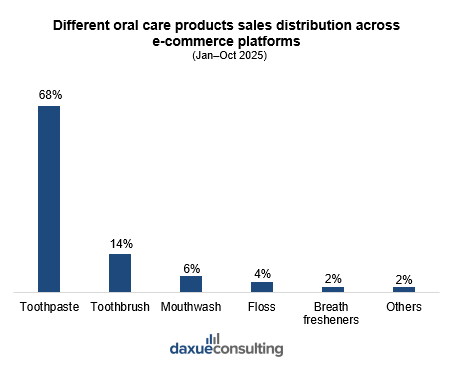
Despite their smaller base, these emerging categories are growing significantly faster. For example, categories such as antibacterial oral sprays (up 58.33%), dental serums (up 31.62%), and breath fresheners (up 27.65%) are outpacing traditional products. This divergence suggests that while the market is still anchored by toothpaste. Yet, incremental growth is increasingly driven by higher-value, function-oriented solutions. This reflects a shift from basic cleaning toward more targeted and specialized oral care needs.
At the same time, ingredient transparency and formulation are becoming key differentiators. Conventional products still dominate with an 89.45% market share in 2025. However, natural and organic variants are expected to grow at a CAGR of 6.88% through 2031. This reflects a broader consumer preference for perceived safety, quality, and “clean-label” products, further supporting premium positioning.
Emotional value is emerging as a new layer of differentiation
Beyond functional benefits, the rise of “emotional value” in oral care is closely linked to increasing stress levels and the growing demand for small, everyday moments of self-care. In a fast-paced lifestyle, even routine activities like brushing teeth are being redefined as opportunities for relaxation and personal indulgence, rather than purely functional tasks.
Social media data show that discussions around the “emotional value” of toothpaste have surged by over 400% year-on-year. Brands such as Haolai, Crest, and MARVIS are generating the strongest engagement. In this context, product design and sensory experience matter not just for differentiation, but for how they reshape the brushing experience. For example, Xiaojudan’s pump-style packaging, MARVIS’s floral-inspired Garden Collection, and Colgate’s limited editions help turn a routine into something more engaging and shareable.

Scent plays a particularly important role in this shift. Products like MARVIS are often described as “perfume for the mouth.” While seasonal releases introduce a sense of novelty and ritual, it transforms oral care into a brief but meaningful moment of comfort within daily life.
The Chinese oral care market is shifting from basic hygiene to premium, experience-driven consumption
- The oral care market in China is expanding steadily, but a gap remains between rising awareness and actual daily habits. This indicates significant room to convert knowledge into consistent usage and higher spending.
- Toothpaste continues to anchor the category as the core daily-use product. Meanwhile, other segments remain smaller in size but are gradually gaining relevance.
- Growth is increasingly driven by premiumization. Consumers are showing a stronger willingness to pay for products that offer clearer functional benefits and differentiated value.
- Emerging categories such as oral sprays, dental serums, and breath fresheners are growing rapidly. This reflects a shift toward more targeted and specialized oral care solutions beyond basic cleaning.
- At the same time, emotional value is becoming an important driver. Oral care evolves into a more sensory and experience-led routine tied to self-care and lifestyle expression.