
The soft drinks market in China encompasses ready-to-drink, non-alcoholic beverages (including concentrates) with 0.5% or less of ethanol. It includes bottled water, fruit and vegetable juices, protein beverages, carbonated beverages (sodas), and others, for a total of 11 major categories. The industry is undergoing a fundamental transformation: growth is shifting from volume to value and category leadership is rotating toward tea and functional beverages.
China’s soft drink market grows steadily but some categories benefiting more than others
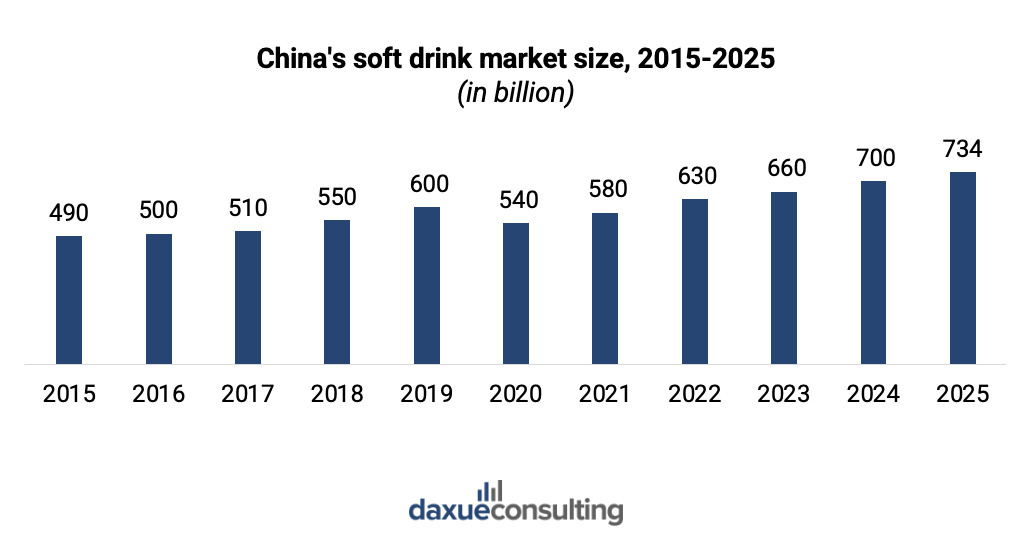
In 2025, China’s soft drink market reached RMB 734.1 billion, a 4.9 year-over-year increase. This broadly aligns with the CAGR of 4.2% from 2015 to 2025, showing that the market is experiencing steady long-term growth. However, traditional sugar-sweetened categories are losing their appeal as health awareness in China grows. During the first half of 2026, sugar-free carbonated drinks made up 41% of the total carbonated-drink sales volume, an increase of 7 percentage points.
Category leadership changes from carbonated drinks to tea beverages
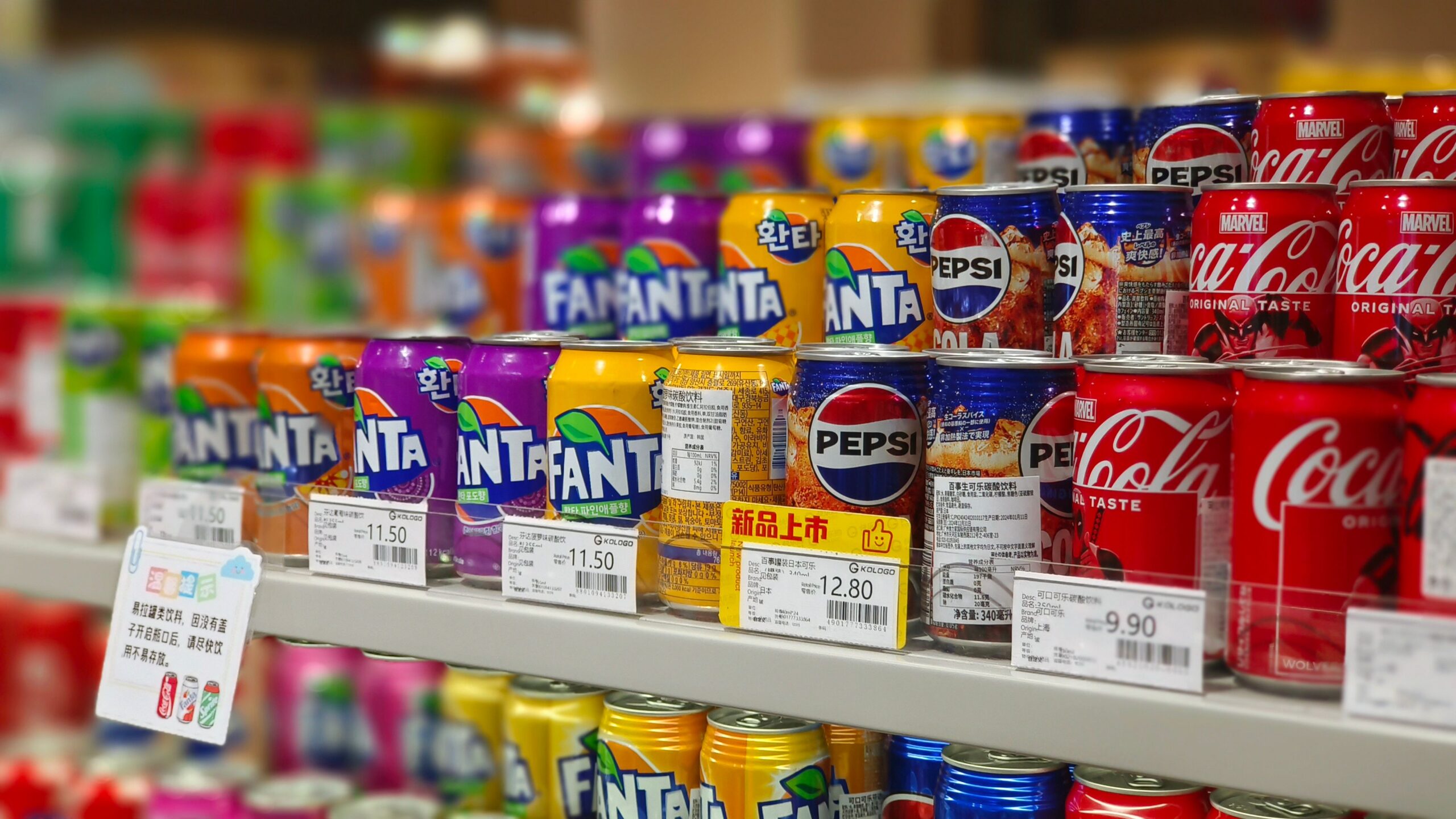
The soft drinks industry in China is undergoing a profound restructuring. The share of carbonated beverage sales fell from 18.4% in 2019 to 16.5% in 2025, while RTD tea rose sharply from 17.6% to 23.3%, officially surpassing carbonated beverages to become the largest category. Within the RTD tea market, the penetration rate of sugar-free tea continues to rise, reaching 35.1%. The diversification of product categories indicates that the industry is moving from a period of sugar-free frenzy into a new phase of rational competition.
The beverage distribution channel enters an era of fragmentation
The soft drinks channel landscape is rapidly diversifying. In 2025, offline channels remained the key driver of the market, accounting for 55% of sales. Large-scale traditional retail stores and supermarket chains are losing traffic to more flexible, consumer-friendly specialty retail channels, such as gas stations and smart vending machines.
Emerging offline channels such as warehouse membership stores, snack retail chains, and discount stores are expanding rapidly, driven by consumer preferences toward a combination of value for money, convenience, and experience. At the same time, traditional retail channels themselves are evolving toward smaller store formats, a greater focus on fresh produce, and discount-oriented models, as consumers shift from casual browsing to purposeful shopping, quick decision-making, and buy-and-go transactions.
Health and functionality become the industry standard
Health has become one of the most important factors for Chinese consumers. According to a 2025 Nielsen survey, 71% of consumers thoroughly research a product’s ingredients, origin, and nutritional benefits when purchasing food and beverages. 78.7% pay attention to the sugar content of beverages and try to choose sugar-free or low-sugar options. More than half choose sugar-free or low-sugar beverages, while only 5.4% prefer high-sugar beverages.
Reducing sugar content has become a basic requirement across the entire industry, while functionality is the key competitive advantage. Nearly all major beverage brands, including Master Kong, Uni-President, Coca-Cola, Wahaha, and Genki Forest, have launched sugar-free tea or sugar-free sparkling water product lines.
The beverage and cold drink industry is entering a new stage of function-oriented daily consumption. Diverse functional needs such as electrolytes, energy supplements, and probiotics are rapidly rising.
GLP-1 impacts early adopters in China
The Chinese GLP-1 market remains small, accounting for only about 3% of the global market. While consumer acceptance of GLP-1 remains limited by factors such as concerns about side effects, cost, and accessibility, early Chinese GLP-1 users are experiencing dietary perception and behavioral changes.
GLP-1 medications can significantly reduce the desire to consume high-calorie, ultra-processed foods, including carbonated and sugary beverages, so users typically reduce their calorie intake and instead turn to low-calorie, high-protein, and individually packaged functional foods. This means that “low-sugar” or “sugar-free” labels might not be enough. Instead, protein content, micronutrient density, and satiation, attributes that align with GLP-1 users’ nutritional priorities, could become more important.
Soft drinks satisfy needs beyond quenching thirst
Beverages are consumed to satisfy a wider range of needs, including socializing, exercise, beauty, and energy boosts. Nearly 70% of consumers have made beverages a part of their daily spending, with 31% of young people purchasing packaged beverages several times a week and another 37% drinking them once or more each day. In other words, beverages are becoming more deeply integrated into their daily routines.
Social settings and the “third space” are opening up new avenues of growth. In scenarios such as group entertainment, social gatherings, and dining with others, consumers value the sharing aspect and the atmosphere that fosters connection.
At the same time, new-style Chinese teahouses are becoming a new “third space” option for young people, following coffee shops. Brands such as BASAO, Kaiji Teahouse, and tea’stone have revolutionized the traditional take-out model of tea shops, transforming them into immersive experiences centered on lingering. Tea brands are shifting from a “quick-service model” to an immersive experience centered on lingering, transforming “drinking tea” from a fleeting consumption act into a moment to savor and share.
Key learning points in the soft drinks market in China
- Sugar-free adoption in the soft drinks market is rapidly growing. Sugar-free carbonated drinks made up 41% of carbonated volume in H1 2026, while sugar-free tea penetration hit 35% within the RTD tea market. This shows that health-conscious positioning is becoming more mainstream, not a differentiator.
- RTD tea has surpassed carbonated beverages, becoming the largest segment in the soft drinks market.
- Retail channels are becoming more fragmented. Offline still dominates, although traditional supermarkets are losing traffic to gas stations, vending machines, membership clubs, and discount stores. Traditional retailers are responding with smaller formats and discount models.
- The rise of GLP-1 users signals nutritional priorities beyond low sugar. They seek low-calorie, high-protein beverages.
Authors: Sory Park and Stéphane Badel, with additional research by Zhixin