

Every luxury brand in Shanghai now has a café, which is why the café concept no longer says as much as it could have said about your brand. At Daxue Consulting, we’ve identified that the next frontier is brand education – to build an educational system to teach how to “live” the brand promise. The impact is much more sizable, distinctive, and creates an additional layer of desirability.
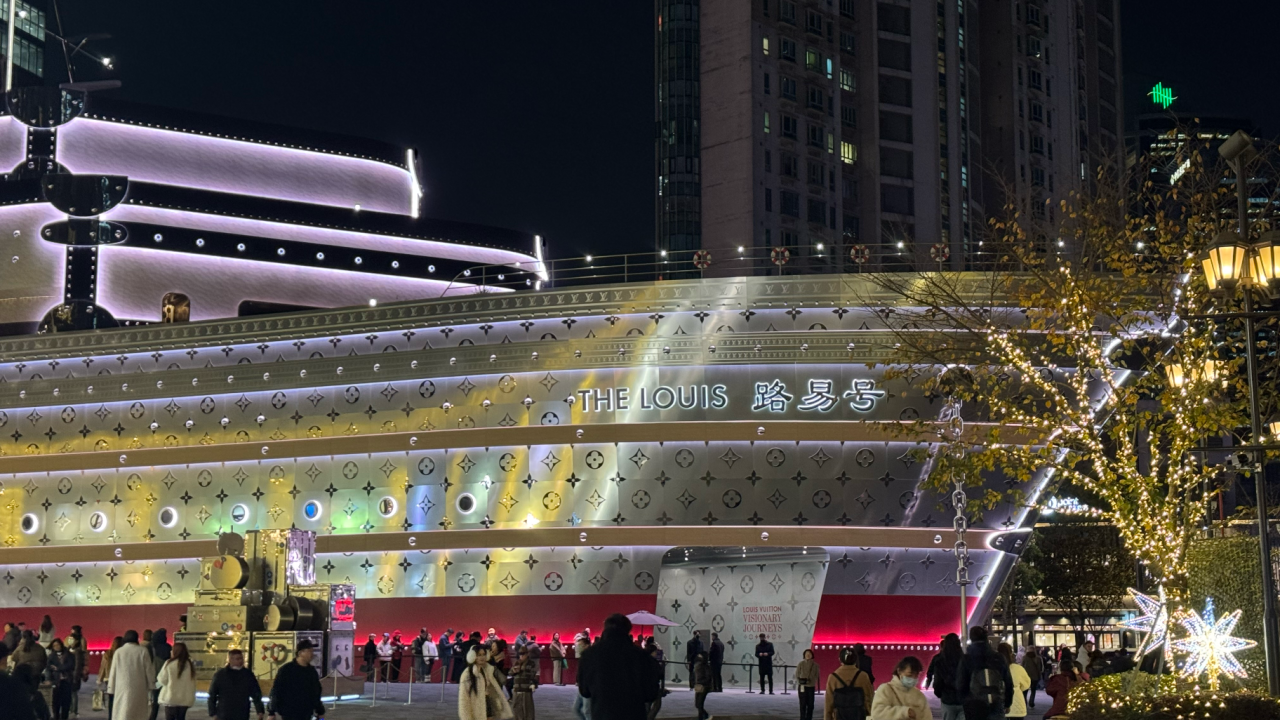
The story we’ve all heard is that brands are moving from selling products to selling experiences, and the proof is the café, the immersive exhibition, or the success of The Louis (Louis Vuitton in China‘s ship-shaped venue on Nanjing West Road at Taikoo Hui, opened June 2025). But the experience is just the entry ticket and the real retention proxy will most probably play a role of “inspirational educator” in order to lock in the relationship and empower clients to embody the brand’s attitude and soul.
Why playing the role of educator is more important in China than elsewhere
Even though the trend might be global, the move toward “education” might be more critical in China than in other countries. Indeed, most Chinese wealth is only one generation old (built since the 1980s with the opening of China). Therefore, in 2026, the buyers exist, and the money is there. But the inherited codes that come with old money in Europe, knowing how to wear it, read it, talk about it, were never passed down, because there was no previous generation to pass them.
A brand that teaches those codes is positioning itself as an institution of taste or knowledge. Take the French children’s wear brand Petit Bateau for instance. In France, from one generation to the next, clients would buy Petit Bateau for their children, then grandchildren and talk about the brand identity to their children and pass over. Petit Bateau could legitimately claim a territory in education: a child’s creativity, their freedom to be mischievous (espièglerie), their critical mind. And that’s a territory that could be played in China if in line with the segments Petit Bateau is touching.
Where brand education works better
Of course, this only holds for categories where knowledge turns into a behaviour, skill, code or statement. Outdoor, wine, watches, jewellery, beauty rituals, food, art, wellness, fashion, apparel. It will be harder for a shower gel to develop an environment of “inspirational education”.
The lasting value of brand education in China
But we should not take brand education in China as simply the stage “after experience”. It is much more an “experience with something left over” (so still an experience per se), a skill or a code the customer keeps. Pine and Gilmore, who named the “experience economy”, called that leftover transformation. The customer comes out able to do something they could not do before or to behave in a way that they could not behave before or even someone they could become that they could not be before.
How brands in China are educating their consumers
The brands currently growing fastest in China are the brands that accompany their community through knowledge sharing:
- Van Cleef & Arpels backs L’ÉCOLE, School of Jewellery Arts, with a permanent campus in Shanghai: workshops, lectures, sessions for children. Ten years ago, a jewellery house running an actual school would have read as an eccentricity.
- Lululemon has called its in-store staff “educators”. This one is partly retail language, and I would not lean on it as hard as the first two, but a company does not keep a word like that around by accident. It tells you how they think about what a store is for.
- Arc’teryx Equipment runs academies, several days with mountain guides and pro athletes, including a Climbing Academy in Yangshuo. You leave the act of buying with a skill developed and transferred by the brand. Arc’teryx crossed 2 billion USD in annual sales for the first time in 2024, and at its September 2025 Investor Day the brand set a 5-billion target by 2030. And there might be a reason teaching sports in China works so well specifically.
“Most Chinese millennials and Gen Z had their P.E. lessons cut at school, given up to exam pressure. Now, this generation is taking up new sports as adults, with the income to pay, but nobody ever showed them how. A brand that steps into that gap does something the school system never did, and effectively grows the pie for sports consumers”
– Allison Malmsten, Sports and leisure strategy consultant at Daxue Consulting
How knowledge can build lasting loyalty
A customer who has learned to read a leather, a watch complication or a fracture line in granite holds knowledge that only pays off with your brand. A product gets copied. A store concept gets copied faster, a Chinese mall can clone a format. What someone has trained their own eye to see is far harder to lift, which counts in a market where buying a dupe is an easier choice for younger shoppers.
This reminds me of Bourdieu’s analysis of cultural capital. As Bourdieu was pointing out, taste is learned, it takes time to acquire, and whoever teaches it holds a position that is hard to attack. But cultural capital is worth having only while it stays scarce. Teach the codes to everyone and they stop setting anyone apart, so a brand educating at full scale spends down the thing it charges for. Most of these academies are less a way to reach the masses than a moat around the top clients, a sophisticated loyalty program for the 5% a maison cannot lose – the VICs or the “VII” (Very Important Influencers).
That said, we should not take the word “education” wrong. It is not about lecturing customers. Most customers hate being lectured and even more in China. It is about accompanying customers on how to live the brand identity beyond the “logo” – in other words, to live the brand with an attitude and a knowledge.
Why providing immersive educational experiences is a good investment for brands in China
This transformation does not have to weigh on your balance sheet. Commercial real estate operators looking for cultural activation to draw an audience are a natural partner for a brand investing in “education”. They bring the space, you bring the reason to visit. The content and the authority, meanwhile, are best built with existing educational and cultural institutions seeking to diversify their own revenues. These partnerships pay twice: they lighten the cost, and they lend the brand a legitimacy it cannot credibly grant itself.
Turning this into an executable strategy that lands in your P&L is the hard part. It is what we work through with clients at Daxue Consulting: what a brand can honestly teach, and where the line runs before craft slides into lecturing people on taste.
Author: Matthieu David, edited by Allison Malmsten