


China’s OTC market has matured around traditional symptom-relief and household medicine categories. However, growth is increasingly coming from more specialized self-care needs, while changes in consumer lifestyles, treatment priorities, and purchasing channels are reshaping which products gain prominence.
China’s OTC market is mature, but growth is shifting between categories
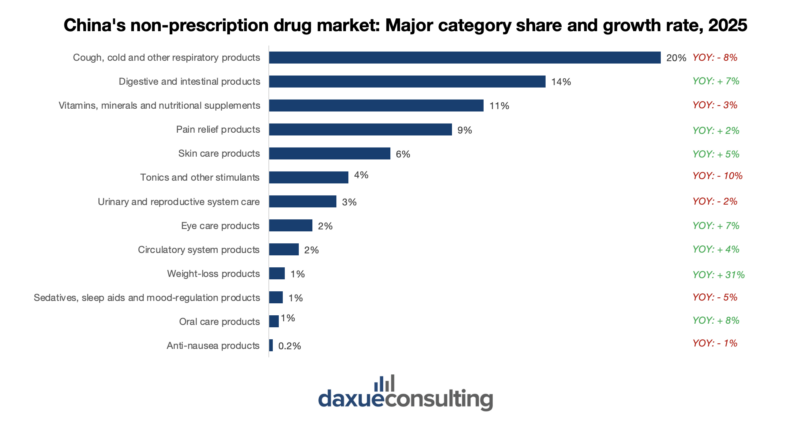
China’s OTC market remained at approximately RMB 300 billion in 2025, with a CAGR of 1.6% from 2018 to 2025. Respiratory products remain the largest category at 19.7% of sales but declined 7.8%, while vitamins and supplements also contracted. By contrast, smaller self-care categories grew faster, led by weight management at +30.6%, followed by oral care, eye care and skin care.
Scale and growth are diverging. Large categories remain commercially essential, but smaller categories can become strategically important long before reaching comparable scale.
OTC demand varies by life stage and city tier
OTC purchasing varies significantly across life stages as priorities, lifestyles, and perceptions change. Younger consumers increasingly use social commerce for familiar acute conditions, while parents place greater weight on pharmacists, doctors, and recognized brands when buying for children. Older consumers are more self-directed, while middle-aged consumers increasingly purchase across multiple generations of the same household. Life stage influences both the target user and perceived purchase risk, making the purchase occasion and decision-maker more effective segmentation variables than age alone.
Geographically, first-tier city consumers have wider brand choice and stronger loyalty, while efficacy and safety carry greater weight. They also supplement hospital and pharmacy advice with online information and personal experience. From second-tier cities downward, consumers rely more on doctors and offline pharmacies and often consider familiar domestic products sufficient for common illnesses. The difference goes beyond purchasing power. First-tier consumers face a more complex brand environment, making differentiation more valuable, while perceived product similarity makes lower-tier consumers less willing to pay a premium.
Domestic brands dominate China’s OTC market
China’s Top 20 OTC Companies: 2025 CNMA Statistical Ranking
Ranked by declared OTC drug market value (factory price, tax included)
| Rank | Company | English name |
| 1 | 华润三九医药股份有限公司 | China Resources Sanjiu Medical & Pharmaceutical Co., Ltd. |
| 2 | 太极集团有限公司 | Taiji Group Co., Ltd. |
| 3 | 赫力昂(中国)有限公司 | Haleon (China) Co., Ltd. |
| 4 | 修正药业集团股份有限公司 | Xiuzheng Pharmaceutical Group Co., Ltd. |
| 5 | 科赴中国 | Kenvue China |
| 6 | 云南白药集团股份有限公司 | Yunnan Baiyao Group Co., Ltd. |
| 7 | 东阿阿胶股份有限公司 | Dong-E-E-Jiao Co., Ltd. |
| 8 | 仁和(集团)发展有限公司 | Renhe (Group) Development Co., Ltd. |
| 9 | 国药控股星鲨制药(厦门)有限公司 | Sinopharm Xingsha Pharmaceuticals (Xiamen) Co., Ltd. |
| 10 | 江中药业股份有限公司 | Jiangzhong Pharmaceutical Co., Ltd. |
| 11 | 拜耳医药保健有限公司 | Bayer HealthCare Co., Ltd. |
| 12 | 浙江康恩贝制药股份有限公司 | Zhejiang CONBA Pharmaceutical Co., Ltd. |
| 13 | 葵花药业集团股份有限公司 | Sunflower Pharmaceutical Group Co., Ltd. |
| 14 | 青岛百洋医药股份有限公司 | Qingdao Baheal Medical Inc. |
| 15 | 贵州百灵企业集团制药股份有限公司 | Guizhou Bailing Group Pharmaceutical Co., Ltd. |
| 16 | 杭州中美华东制药有限公司 | Hangzhou Zhongmei Huadong Pharmaceutical Co., Ltd. |
| 17 | 山东达因海洋生物制药股份有限公司 | Shandong Dyne Marine Organism Pharmaceutical Co., Ltd. |
| 18 | 马应龙药业集团股份有限公司 | Mayinglong Pharmaceutical Group Co., Ltd. |
| 19 | 河南羚锐制药股份有限公司 | Henan Lingrui Pharmaceutical Co., Ltd. |
| 20 | 仲景宛西制药股份有限公司 | Zhongjing Wanxi Pharmaceutical Co., Ltd. |
In 2025, 17 of the top 20 companies in the CNMA OTC rankings by market value were Chinese, led by China Resources Sanjiu and Taiji Group. National Chinese brands also account for 82% to 95% of consumer choices across city tiers.
China’s medical insurance system reinforces this preference, where eligible OTC medicines can be purchased through personal medical insurance accounts, and inclusion in the National Medical Insurance Drug Catalog provides reimbursement benefits. Class A OTCs can receive full reimbursement under applicable national or provincial healthcare schemes, while eligible Class B medicines may receive partial coverage.
Combined with familiarity, perceived effectiveness, accessibility and affordability, this creates a trusted-value advantage for domestic brands. International or premium branding may therefore offer little advantage where consumers perceive limited differences in effectiveness.
How China’s leading OTC products are changing
1. Respiratory medicines remain leading OTC products
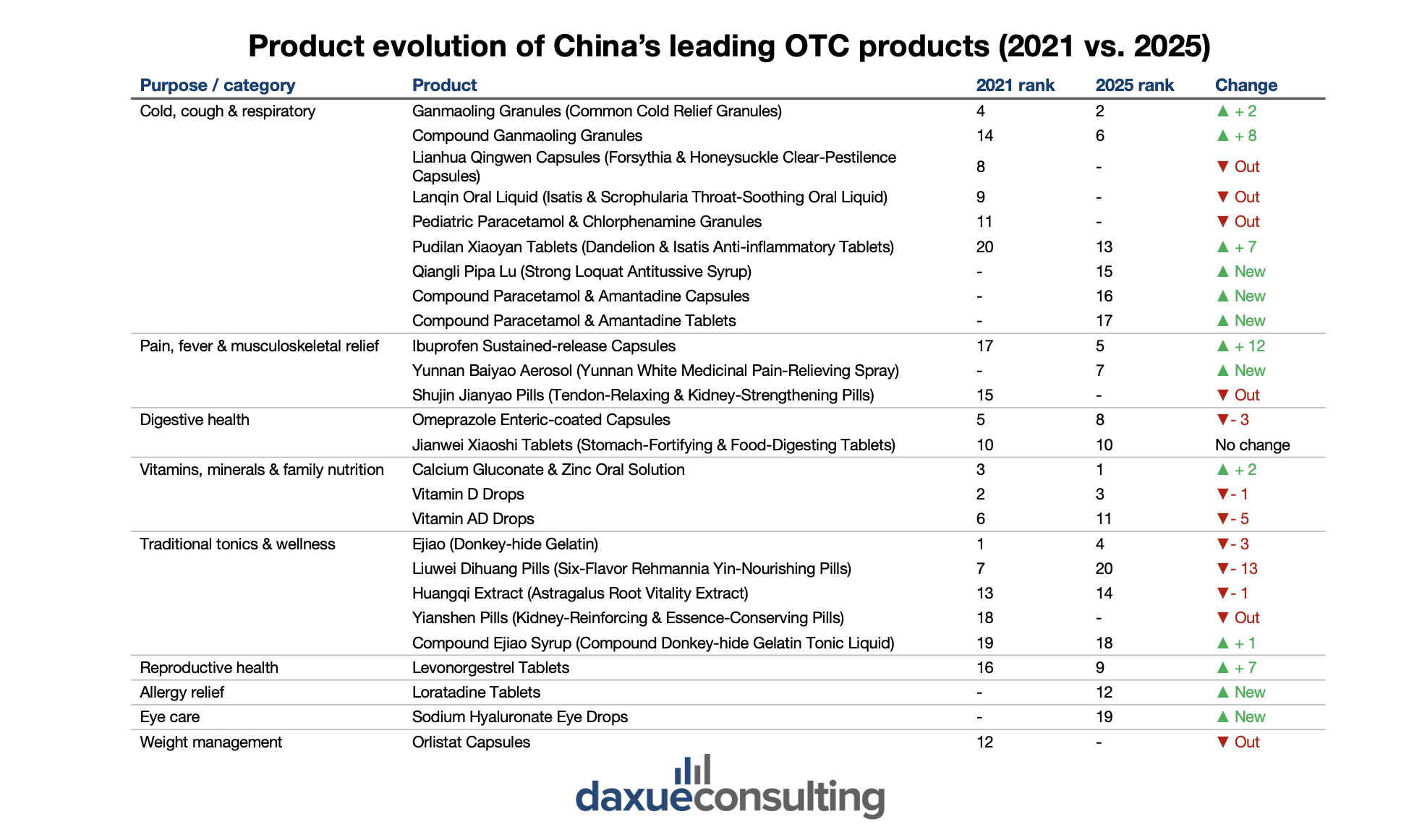
While respiratory medicines remain prominent, the category declined 7.8% in 2025, yet several major products improved their rankings: Ganmaoling Granules (common cold relief granules) and Compound Ganmaoling. A contracting category can therefore still produce winners if demand consolidates around stronger or better-known products.
2. Family nutrition remains prominent
Calcium Gluconate and Zinc Oral Solution, together with Vitamin D Drops, remain among China’s leading OTC products. Nutrition-related OTC products sit between treatment and preventive family health, allowing them to serve recurring rather than purely episodic needs. This makes them particularly relevant to parents and multi-generational households, reinforcing the importance of life-stage segmentation.
3. Pain and fever relief gained prominence
Ibuprofen rose from #17 in 2021 to #5 in 2025, while Yunnan Baiyao Aerosol (Yunnan White Medicinal Pain-Relieving Spray) entered at #7 after sales reportedly increased from RMB1.0 billion to RMB1.2 billion. Seasonal respiratory illness may drive short-term demand, but the scale of Ibuprofen’s ranking shift suggests a broader trend, with established pain relief and fever medicines taking a more prominent role in household self-medication.
4. Digestive medicines remain a stable core category
Jianwei Xiaoshi Tablets (Stomach-Fortifying & Food-Digesting Tablets) stayed at #10 between 2021 and 2025, reflecting its integration into everyday food and indulgence occasions rather than illness alone. Omeprazole remained in the top 10 but lost position. Together, these movements suggest digestive health remains structurally resilient even without the rapid growth seen in newer specialist categories.
5. Traditional tonic products lose ground as wellness preferences change
Ejiao (Donkey-hide Gelatin) fell from #1 in 2021 to #4 in 2025, while Liuwei Dihuang Pills (Six-Flavor Rehmannia Yin-Nourishing Pills) dropped from #7 to #20. Traditional tonics face pressure not only from price but from a changing definition of wellness. While Ejiao remains culturally established among older consumers, younger consumers have cheaper and more accessible alternatives, including protein powders and modern supplements aligned with contemporary fitness and wellness lifestyles.
6. Allergy and eye-care products are emerging more clearly
Loratadine entered the top 20 at #12, while anti-allergy medicine sales rose 60.4% week on week in early 2026. Rising prevalence and familiarity with antihistamines suggest allergy treatment is becoming a more routine self-care purchase.
Sodium Hyaluronate Eye Drops also entered the top 20. Screen-intensive lifestyles are creating recurring demand around dryness, fatigue, and eye strain, giving eye care a lifestyle-related demand pattern distinct from OTC categories driven mainly by episodic illness.
7. Weight-management category growth does not guarantee individual product growth
Orlistat fell from #12 in 2021 to outside the top 20 in 2025 despite weight management being one of the fastest-growing OTC categories. Competition from prescription GLP-1 medicines is redistributing demand, while obesity prevalence and China’s Weight Management Year Campaign support broader category growth. The divergence demonstrates why category growth cannot be treated as a proxy for incumbent-product growth. As demand expands, the category is also becoming more fragmented.
Fragmentation, not expansion, is the opportunity
China’s OTC market is not expanding uniformly. Demand is fragmenting by condition, life stage, city tier, treatment philosophy, and price point. A stable RMB 300 billion market can therefore contain rapidly growing niches, declining legacy segments, and changing product leaders.
The 225 new product registrations in 2025, up 27%, reinforce this shift toward narrower opportunities for innovation and differentiation. The opportunity is not simply to enter China’s OTC market, but to identify which consumer, condition, treatment occasion, and value proposition remain underserved.
Five takeaways for OTC companies
- China’s OTC market is mature, but not static. Overall growth is limited, while category and product performance are diverging sharply.
- The biggest categories are not necessarily the biggest growth opportunities, as smaller self-care segments are becoming strategically important before they reach comparable scale.
- OTC purchase context shapes consumer behavior, with life stage, intended user, and city tier often more important than age alone.
- Domestic brands compete through trusted value, not just low prices, where familiarity, perceived efficacy, availability, and reimbursement strengthen their position.
- Fragmentation presents both opportunities and risks: even fast-growing categories can contain underperforming products, making product positioning more important than the category itself.
Author: Ming Yii Lai, with additional research by Kyle Gumangan