
Tencent runs one of China’s largest digital ecosystems, spanning consumer communications, digital content, payments, gaming, cloud services, software, and AI agents. By the end of 2025, Weixin and WeChat together had about 1.4 billion monthly active users. This reach gives Tencent AI in China a distribution edge over other AI firms within its consumer and enterprise networks. The connection to enterprise adoption runs through shared infrastructure: businesses already use WeCom for customer engagement, Tencent Meeting for collaboration, and Tencent Cloud for operations. Each touchpoint represents an existing entry point for AI deployment.
Its competitive advantage lies in leveraging its Hunyuan foundation-model family alongside Tencent Cloud, workplace tools and established digital platforms, giving the company multiple routes to embed AI directly into existing business workflows. However, whether this consumer reach translates into sustained enterprise adoption remains an open question, as enterprise buying decisions hinge on performance, compliance, and measurable ROI rather than platform familiarity alone.
China’s AI industry and digital economy enterprise deployment
In 2025, China’s core AI industry was valued at over RMB 1.2 trillion, with more than 6,200 domestic AI companies. Adoption is swiftly shifting from experimentation to industrial deployment. By the end of 2025, over 30% of manufacturing firms with annual revenues of at least RMB 20 million had integrated AI technologies.
China’s consumer digital foundation is equally large, with 1.125 billion internet users by the end of 2025, representing an 80.1% penetration rate. Generative-AI users, on the other hand, reached 602 million, equivalent to a national adoption rate of 42.8%, up 25.2% year on year.
China’s AI industry spans computing infrastructure, foundation models, development platforms, and applications. Enterprise AI is the commercial deployment layer where these technologies are integrated into organizational processes, data systems, products, and industry workflows.
China’s AI industry is expanding beyond models into applications
China’s generative‑AI sector first expanded by building foundation models and consumer‑oriented chatbot products. Now, industry momentum is shifting towards real-world commercial deployment, driven by AI agents, multimodal capabilities, and vertical, industry-specific applications.
Tencent recorded 79.2 billion in total capital expenditure in 2025, covering IT and AI infrastructure, including computing equipment, software and data centers, as well as land-use rights, office premises and intellectual property. Alibaba deployed approximately RMB 120 billion in capital expenditure over four quarters to advance AI and cloud infrastructure, while Huawei invested RMB 192.3 billion in total R&D in 2025 across strategic areas including computing, cloud, AI and security.
As domestic demand for Chinese-language and sector-specific AI grows, cloud and intelligent infrastructure, backed by government policies, offer vital technical support, accelerating AI innovation and deployment in China.
China’s 2025 AI+ Initiative targets AI integration across the economy, with intelligent terminals and AI-agent penetration expected to exceed 70% by 2027. By the end of 2025, China had also built 42 intelligent-computing clusters, each with at least 10,000 GPUs.
Mapping China’s AI landscape
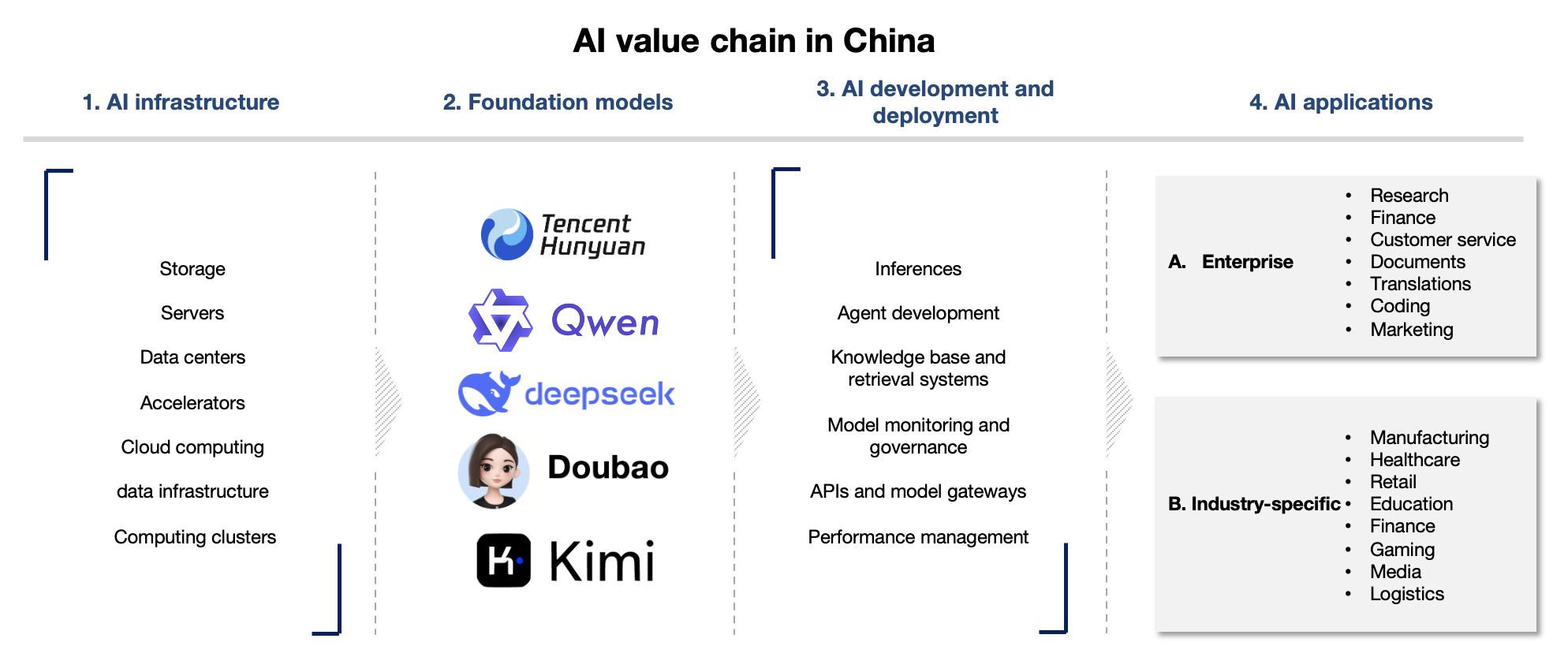
China’s AI value chain can be divided into four layers: infrastructure, foundation models, development platforms, and applications. Infrastructure supplies computing, cloud, and data capacity required to train and operate models。 oundation models such as Hunyuan, Qwen, DeepSeek, Doubao, and Kimi provide core multimodal capabilities; development platforms turn those models into governable enterprise systems; and the application layer converts them into productivity, industry, and creative tools.
Tencent spans several layers of China’s AI value chain: Tencent Cloud provides infrastructure and deployment capabilities; Hunyuan provides foundation-model capabilities; and WeChat, WeCom, WorkBuddy, and CodeBuddy provide routes into consumer and enterprise applications.
How Tencent AI is building a multi-model AI infrastructure
Tencent has expanded Hunyuan beyond language models into a multimodal family spanning text, image, video, 3D, and translation. Hunyuan Translation supports 33 languages and serves business needs, including document translation, legal contracts, negotiations, and cross-border e-commerce. Hunyuan 3D connects Tencent’s AI development with its gaming and digital content expertise, producing assets that can be exported to Unity, Unreal Engine, and Blender.
Tencent is also moving from conversational AI toward workplace agents such as WorkBuddy. WorkBuddy can analyze data, create content and execute multi-step tasks, while CodeBuddy provides evidence of adoption at scale: it is used by more than 95% of Tencent’s engineers and has reduced coding time by 40% and improved R&D efficiency by 16%. While these figures reflect internal deployment rather than external market validation, they demonstrate the tools’ capability under real production conditions. The Office AI Agent Suite connects WorkBuddy with Tencent Docs and LearnShare, embedding agents within existing workplace tools.
Tencent LearnShare, a knowledge-base tool that collects and surfaces information within an enterprise, was used by more than 300,000 enterprises in 2025, achieving 92% response accuracy.
At the platform level, TokenHub combines Hunyuan with selected third-party models and routes requests based on factors such as cost, performance, and task requirements. Tencent’s strategy is moving towards orchestrating multiple AI capabilities around business workflows rather than relying on a single foundation model.
Ecosystem integration, industry applications and competition
Tencent’s main structural advantage is distribution through an ecosystem businesses already use. Weixin and WeChat provide customer reach; WeCom, Tencent Docs and Tencent Meeting provide workplace touchpoints; Mini Programs and payments connect businesses with customers; Tencent Cloud supplies the deployment layer; and its gaming and content businesses provide additional environments for multimodal AI. Together, these assets allow Tencent AI to integrate into existing workflows rather than requiring enterprises to adopt entirely new platforms.
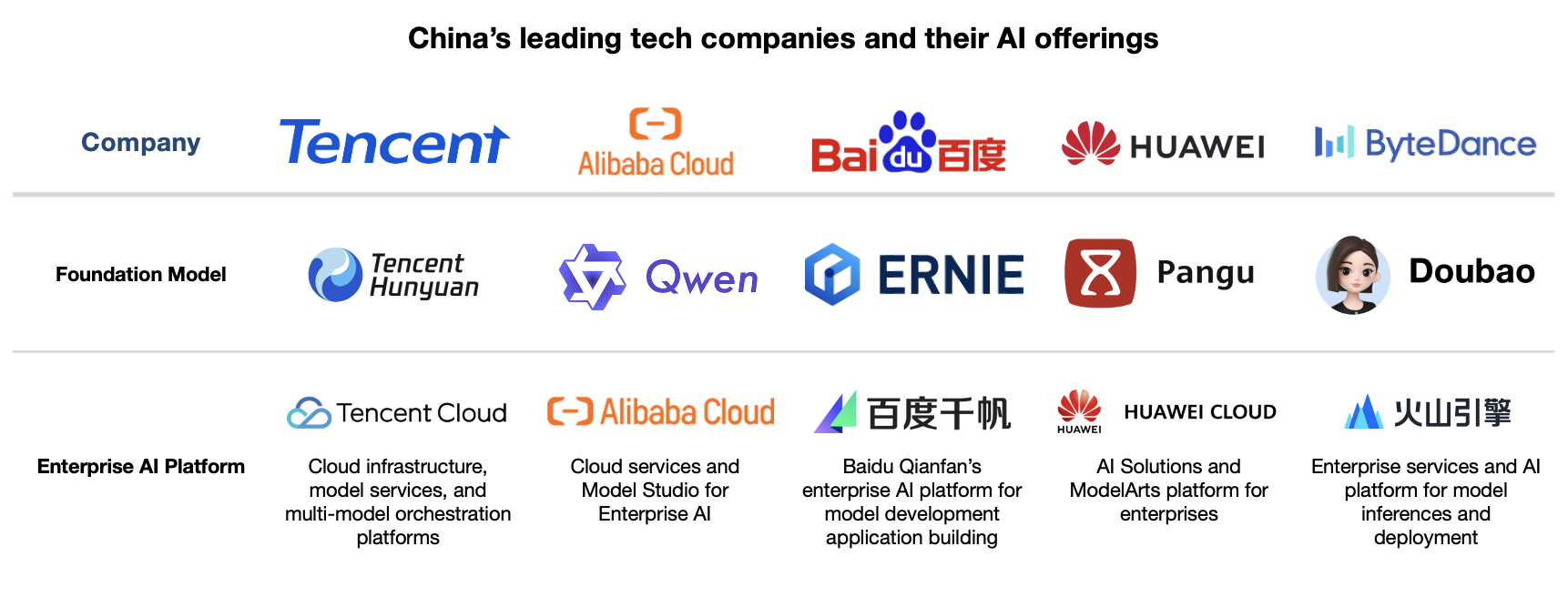
The domestic enterprise AI market in China is highly competitive, with leading tech firms offering advanced solutions. Alibaba Cloud develops enterprise agent solutions based on its Qwen large‑model family. Baidu provides access to its ERNIE foundation models and third-party models through the Qianfan platform. Huawei integrates its Pangu models into its comprehensive cloud services. Meanwhile, ByteDance commercializes its Doubao models through Volcano Engine.
Compared with Alibaba, Baidu, Huawei and ByteDance, Tencent’s differentiation centers less on foundation-model performance, and more on ecosystem reach, workflow integration, and its ability to embed AI into platforms businesses already use.
China’s regulatory framework for generative AI
Under the Provisional Administrative Measures of Generative Artificial Intelligence Services, public‑facing generative AI services operating within mainland China are subject to formal requirements covering personal‑information handling, training‑data governance, mitigation of unlawful content, intellectual‑property compliance, prevention of discriminatory outputs, and overall security governance. While these primary rules target services offered to the general public. Enterprise‑internal AI deployments, whole not directly subject to the same generative AI provisions, must still satisfy broader cross‑cutting obligations for data security, cybersecurity, and sector‑specific compliance rules.
Tencent delivers enterprise‑grade AI deployment options through Hunyuan model APIs alongside exclusive deployment configurations running on Tencent Cloud’s Virtual Private Cloud infrastructure, enabling organizations to retain stronger ownership and control over proprietary business datasets and underlying computing resources. Complementing this cloud infrastructure, Tencent Cloud’s Agent Development Platform delivers built‑in enterprise governance capabilities including identity authentication, workspace‑level permission management, granular controlled data access, flexible model selection, and configurable routing policies for AI agent workloads.
What will determine the success of Tencent AI in China?
Tencent’s key challenge is converting its existing ecosystem advantage into sustained enterprise AI adoption. WeChat, WeCom, Tencent Cloud, and workplace products provide the company with multiple routes into business workflows, but distribution alone does not guarantee commercial success. Tencent will need to demonstrate that enterprises repeatedly use its AI tools, integrate them deeply into existing workflows, and generate measurable productivity gains.
How Tencent is converting AI capability into enterprise value
- China’s expanding AI industry, digital population, and computing infrastructure provide a large-scale market for enterprise AI.
- Government policy, including the AI+ Initiative, is accelerating practical AI deployment across industry and public services.
- Tencent’s ecosystem of social, cloud, workplace, gaming, and content platforms gives Hunyuan multiple distribution channels.
- WorkBuddy, Hunyuan Translation, and Hunyuan 3D demonstrate how Tencent AI advances in productivity, internationalization, and creative production.
- Tencent’s long-term advantage will depend on whether it can convert its existing social, cloud, and workplace ecosystem into sustained enterprise adoption of Hunyuan and its AI applications. Internal adoption provides evidence of product maturity, but external enterprise validation will be the decisive test.
Author: Ming Yii Lai, with additional research by Kyle Gumangan