
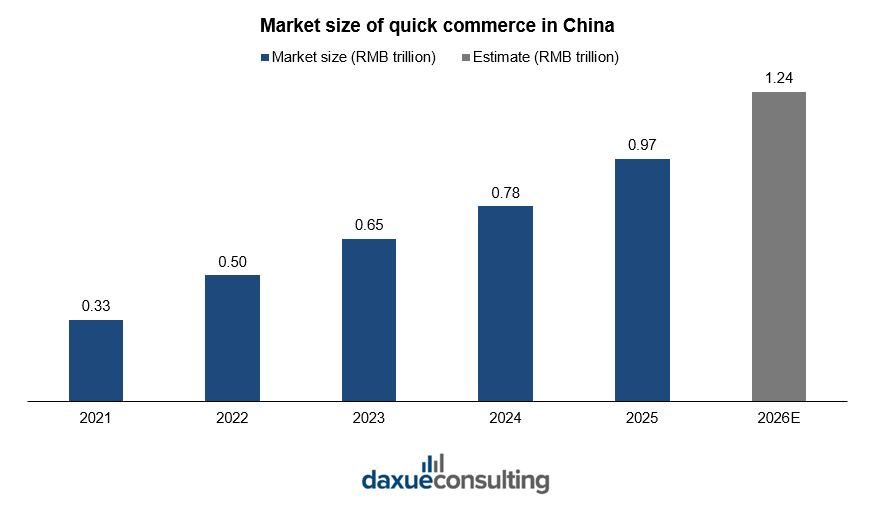
China’s quick commerce market is a structurall shift in e-commerce. The quick commerce market in China reached an estimated RMB 971.4 billion in 2025 and is projected to pass RMB 1 trillion this year, heading for RMB 2 trillion by 2030. The format means ordering online and having the order filled offline from local retail supply in 30 to 60 minutes. Orders travel the rider networks built for meal delivery, and the stock sits in supermarkets, convenience stores, pharmacies, and dedicated fulfillment sites within a few kilometers of the buyer. These figures count merchandise only, since restaurant food falls under catering.
The Ministry of Commerce and seven other agencies listed quick commerce alongside social and livestream commerce as formats the state supports in an August 2025 digital consumption directive. A parallel notice from the ministry and eight other agencies wrote supermarkets, convenience stores, and pharmacies into the emergency supply system, which gives state backing to the stores quick commerce draws its stock from.
The subsidy war that drove the quick commerce market in China through 2025 wound down at the end of the year, and growth held through the change.
How close the stock sits decides how big the market gets
Quick commerce sells from inventory already within a few kilometers of the buyer. Every local cell carries its own stock that service a 3 to 5 km radius’ single fulfillment node. So, the ceiling of the quick commerce market in China equals the number of cells multiplied by what each one holds. Stock position matters more than delivery speed. Each minute cut from delivery time lifts willingness to pay by 0.7%. If an item isn’t in the local cell, the sale is lost.
Both terms keep climbing. Early quick commerce ran on borrowed shelves, and a convenience store carries 1,000 to 1,500 SKUs picked for walk-in traffic. A purpose-built flash warehouse, which is built for quick commerce, carries 4,000 to 5,000, chosen from online demand data. Meanwhile, front warehouses, which are a broadeer category that include older fulfillment centers, stock more than 10,000 SKUs, up from about 1,000 a decade ago. Sites of this kind hold more than half of transaction value across the channel. Cell count follows the same path. Meituan Instashopping (美团闪购) covers 2,800 counties and cities, and its lower-tier flash warehouses passed 10,000 in September 2025. Orders and transaction value in those markets grew faster than in higher-tier cities. For brands this makes quick commerce a shelf-space question. Flash warehouse assortments come from local turnover data, so a SKU earns its cell by how quickly it sells.
SKUs per fulfillment format
| Format | SKUs per site |
| Convenience store | 1,000–1,500 |
| Flash warehouse | 4,000–5,000 |
| Front warehouse | 6,000–10,000+ |
| Conventional e-commerce | By millions |
Quick commerce is taking business from Taobao (淘宝) and JD (京东)
Quick commerce sales in this year’s 618 window from May 13 to June 18 reached RMB 62.8 billion and grew 112.3%. Conventional e-commerce platforms took RMB 863.6 billion over the same window and grew 0.9%. Much of this spike was subsidy-driven, but the fact that growth held after subsidies eased suggests habitual adoption.
The quick commerce market in China grows against two different rivals. Supermarket goods and fresh produce are its largest categories, an estimated 50% and 26% of the market. As such, quick commerce takes trips away from nearby stores and wet markets. In phones, appliances, beauty, and alcohol, it takes orders that used to go to Taobao and JD.
How “half-hour delivery” beat “three-day shipping”
The 2025 Double 11 window shows the second shift at scale. The quick commerce platforms led by Meituan Instashopping (美团闪购), Taobao Instashopping (淘宝闪购), and JD Miaosong (京东秒送) took RMB 67 billion in GMV, up 138.4% on the year. Total festival GMV across all platforms grew in single digits over the same window. On Meituan Instashopping, flash warehouse sales in 3C and appliances grew close to 500%, alcohol and mother-and-baby 300%, and beauty over 100%. A phone delivered in half an hour fills the order that Taobao or JD would have shipped in three days.
Online retail of physical goods grew 5.2% in 2025 and sits at 26.1% of total retail sales. So, the online pool these categories draw from has mostly stopped growing. That splits brand strategy in two. A grocery or fast-moving line uses quick commerce to hold its base, where stock rates and warehouse density decide the outcome. A phone, appliance, or beauty line uses it to take share, and much of that volume moves over from the brand’s own Taobao or JD flagship. In short, quick commerce is reallocating existing online spend, rather than expanding the whole ecommerce pie.
Three instashopping platforms, three different strengths
Three players hold most of the quick commerce market in China, each built on a different strength. Meituan Instashopping runs the deepest fulfillment network, with over 50,000 flash warehouses across 2,800 counties and cities by the end of 2025. Its average delivery time is 34 minutes. Taobao Instashopping draws on Taobao’s user base, and the service, food delivery included. The service drew 300 million monthly transacting buyers within four months of its April 2025 launch. Meanwhile, JD Miaosong runs on JD’s supply chain and leads in 3C and appliances, the high-ticket electronics where shelf platforms keep the lead. Furthermore, Meituan held above 60% of food-delivery GTV through 2025, and its share in quick commerce has moved with each subsidy round.
The bill for the 2025 subsidy war sits in the platforms’ accounts. Meituan posted a RMB 35.8 billion net profit in 2024 and a RMB 23.4 billion net loss in 2025, both on the group’s annual-report basis, with an operating loss of RMB 17 billion, as sales and marketing spending climbed to defend share against Alibaba’s push. Alibaba’s leadership told teams in early 2026 to keep investing in Taobao Instashopping for three years without concern for losses, aiming to pass Meituan’s share by summer 2026. Alibaba holds four times Meituan’s cash.
By December the war was already cooling, with Alibaba cutting its spending and per-order losses halving from the summer peak. The subsidies will not hold at this level, and the contest moves toward supply-side efficiency, which rests on fulfillment density and assortment. Platform choice follows category. A 3C or appliance line fits JD’s supply chain, an impulse or standard-goods line fits the traffic platforms, and a full-range grocery base sits with Meituan’s warehouse network.
Key takeaways on quick commerce market in China
- Quick commerce is set to pass RMB 1 trillion in 2026 and head toward RMB 2 trillion by 2030. The broad-based subsidy war that drove the market through 2025 began cooling in December, though targeted investments continue into 2026.
- The size of the market comes down to fulfillment density. Every local cell carries its own stock and holds a few thousand SKUs, so a product sells only when it sits in a warehouse within a few kilometers of the buyer. For brands this turns quick commerce into a shelf-space question, and the way in is the local assortment list.
- Quick commerce grows against two rivals at once. In groceries and fresh food it takes trips away from nearby stores and wet markets, and here it competes on stock rates and warehouse density. In phones, appliances, beauty, and alcohol it takes orders that used to go to Taobao and JD, and these categories grew fastest during the 2025 festivals.
- For 3C, appliance, and beauty brands, much of the quick commerce volume comes out of their own Taobao or JD flagship stores. The channel needs its own plan, since counting it as pure new demand overstates what it brings.
- Meituan, Taobao Instashopping, and JD each lead on one strength that rivals cannot copy quickly, with fulfillment for Meituan, traffic for Taobao, and supply chain for JD. Defending those positions is costly, and with subsidies easing, the contest is shifting to fulfillment efficiency.
Author: Ming Yii Lai, with additional research by Zekai Zhang