

In October 2022, Vuori entered China through a deliberately sequenced market rollout, prioritizing brand positioning over rapid physical scale. This approach reflects both the attractiveness and the competitiveness of the local activewear landscape: The Chinese market for yoga apparel alone is projected to reach USD 3 billion by 2028, as the country’s broader sportswear industry grows at a CAGR above 9%. Instead of aggressively opening physical stores, the California-based brand leveraged its global valuation of USD 5.5 billion and its ambition to operate in 15 international markets by 2026 to execute a highly controlled entry strategy. In this context, Vuori in China stands out through its proprietary fabrics rather than flashy logos. It also actively targets male consumers, successfully capturing an audience that female-focused activewear brands have historically overlooked.
Vuori in China goes online first before opening its first store
Vuori adopted a digital-first incubation strategy to de-risk its China entry and validate demand before committing to fixed retail costs. The brand launched on Tmall in October 2022 under its localized name “飞奥力Feiaoli,” using the platform as a controlled environment to test pricing elasticity, product mix, and consumer response. This phase functioned less as a sales push than as a data-mapping exercise, allowing Vuori to build a granular understanding of its potential audience.
Only after this digital foundation was established did the brand transition offline. A pop-up followed in August 2023, serving as a bridge between online insight and physical interaction. Vuori then opened its first permanent store at Shanghai’s Jing’an Kerry Centre in May 2024. By sequencing expansion in this manner, the brand ensured that physical retail was informed by localized consumer intelligence rather than assumption, turning offline presence into a calibrated extension of an already-defined customer base.

Vuori targets the underserved affluent urbanites
While many activewear competitors in China focus almost entirely on female consumers, Vuori targets affluent urban professionals of both genders, achieving a near 1:1 sales ratio between men’s and women’s apparel. This strategy taps into a structurally underserved segment: male users on Xiaohongshu are significantly more active in posting fitness-related content (160% more likely), yet premium options tailored to their preferences have historically been limited. Consumer feedback frequently highlights Vuori’s multi-scenario versatility, with apparel perceived as equally suitable for workouts and casual social settings.
At the messaging level, Vuori avoids performance-heavy narratives and instead centers on tactile experience. As Chinese consumers exhibit fatigue toward standardized compression gear, the brand emphasizes the “weightless” feel and softness of its DreamKnit and BlissBlend fabrics. This sensory focus translates directly into retail conversion, with Xiaohongshu reviews of the Jing’an Kerry Centre store repeatedly citing texture and hand-feel as the decisive factors behind purchase.

Vuori in China competes against Lululemon, Alo Yoga, and Maia Active
Assessing Vuori’s performance in China requires situating its controlled entry alongside the approaches taken by Lululemon, Alo Yoga, and Maia Active. Among these peers, Alo Yoga offers a cautionary contrast. Despite generating substantial digital visibility, the brand delayed formal market entry, allowing unauthorized Taobao sellers to fill the gap with counterfeits priced as low as RMB 39.9. This eroded brand equity before Alo established an official presence.
Vuori largely sidestepped this risk. Its value proposition is anchored in proprietary fabric technologies whose tactile qualities are difficult to imitate at low cost. As a result, the brand’s core differentiation proved resistant to copycat dilution, creating a structural moat that protected both pricing integrity and consumer trust during its early-stage expansion.
Vuori celebrates Chinese New Year without the cliché reds
During the 2026 holiday season, the brand launched a localized Chinese New Year collection aligned with the government-backed “Shopping in China” initiative.

Initiated by the Ministry of Commerce (MOFCOM), the 2026 “Shopping in China” campaign featured a massive Online Chinese New Year Shopping Festival running from January 19 to March 4, aimed at promoting traditional culture and upgrading consumption scenarios. Vuori capitalized on this state-sponsored spending surge by executing a Chinese New Year collection that demonstrated deep “cultural fluency.”
Rather than relying on cliché red-and-gold aesthetics or literal zodiac mascots, elements that modern Chinese consumers increasingly perceive as outdated, Vuori aligned the symbolic momentum of the Fire Horse with its own brand ethos of comfort and versatility. The collection emphasized performance essentials in understated colorways such as Misty Blue Heather and Oatmeal, reinforcing the brand’s minimalist positioning rather than obvious festive decoration.
Rather than treating the launch as a standalone product drop, Vuori synchronized robust Tmall availability with experiential activations in its Shanghai and Beijing stores, encouraging tactile discovery alongside online seeding.
This coordinated approach generated organic Key Opinion Consumer (KOC) reviews while reinforcing premium brand perception, allowing Vuori to translate cultural timing, policy momentum, and physical engagement into structured conversion rather than temporary attention.
Vuori faces localization hurdles in China
A key challenge Vuori faces in China lies in geometric localization, commonly referred to within the apparel industry as the “Asian fit.” While the brand’s proprietary ultra-soft fabrics create a strong defensive moat against counterfeiting, sizing and silhouette adaptation remain a structural vulnerability.
Domestic competitors such as Maia Active — recently acquired by Anta — have gained momentum by engineering products explicitly around the body proportions of Chinese consumers. In contrast, Vuori in China continues to rely largely on its global product line, which favors relaxed Californian silhouettes designed for Western physiques. This divergence becomes particularly visible at scale, where fit precision increasingly determines repeat purchase.
Social listening reinforces this friction point. On Xiaohongshu, consumers consistently praise Vuori’s fabric quality and sensory comfort, yet some express dissatisfaction with sizing and proportions. Reviews note that certain cuts can appear unbalanced or insufficiently flattering, introducing hesitation at the point of conversion despite strong product appeal.
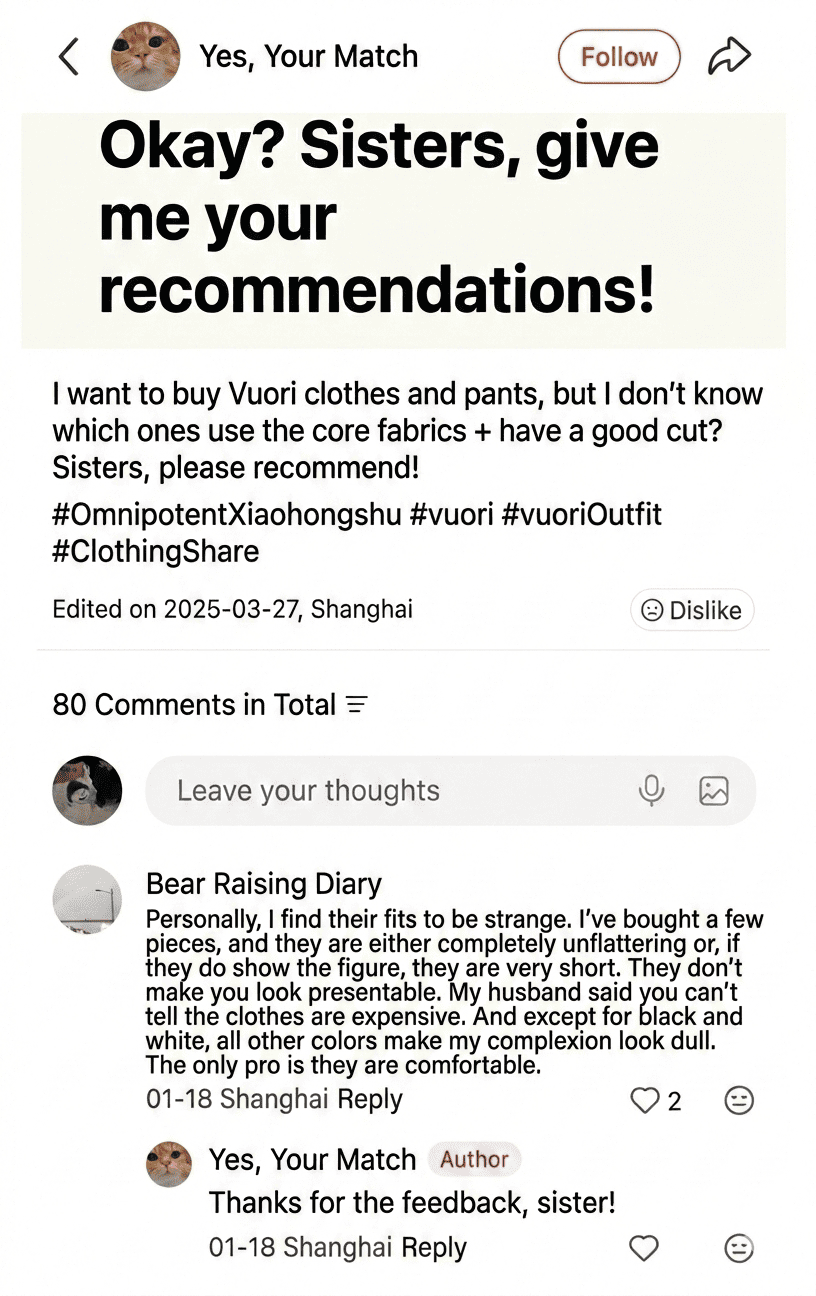
To address this constraint, Vuori is using its early-stage physical store presence as a data-gathering mechanism. By leveraging in-store feedback and fit-related observations, the brand is laying the groundwork for future localized “Asian fit” iterations. This transition will be critical for securing long-term retention and ensuring that tactile excellence is matched by proportional precision.
What Vuori in China reveals about premium activewear conversion
- Conversion now favors restraint over rapid expansion. Vuori’s performance in China shows that patient, controlled rollout strengthens credibility in a rational consumption environment, where overexposure can dilute brand trust rather than accelerate growth.
- Tactile experience has overtaken technical specification as the primary driver. As consumers grow fatigued with compression-heavy performance narratives, softness, drape, and physical comfort — anchored in proprietary fabrics — prove more effective at triggering purchase decisions.
- The men’s premium activewear segment remains structurally underpenetrated. By offering understated, multifunctional designs that transition between fitness and daily contexts, Vuori captured demand among urban men seeking quiet luxury rather than overt athletic signaling.
- Brand equity is protected through controlled physical scarcity. Avoiding premature physical expansion reduces exposure to counterfeiting and price erosion, while premium retail placement reinforces aspiration and pricing power.
- Peer-level validation outperforms celebrity amplification. Detailed Key Opinion Consumer reviews focused on fit and fabric feel generate stronger trust signals than broad influencer endorsements, aligning with how rational consumers verify value before purchase.