
In China’s hand cream market, basic moisturization, especially in the dry winters, has become the minimal requirement. Chinese consumers now assess hand creams using criteria similar to facial skincare, seeking products with brightening, anti-aging, and SPF benefits, driving them to use multiple hand cream products and extend hand cream use year-round. More pronounced in hand cream than in skincare and body care, scented hand creams are used as a way to express their personality and provide a sense of emotional healing. They’re also popular travel souvenir gifts because they’re affordable, practical, and culturally meaningful.
Hand cream dominates as specialist segments grow
In the first half of 2025, total tracked online hand care sales across Chinese e-commerce platforms reached RMB 1.59 billion, up 13.6% YoY, comprising five segments: hand cream, hand masks, nail care products, hand scrubs, and hand care gift sets.
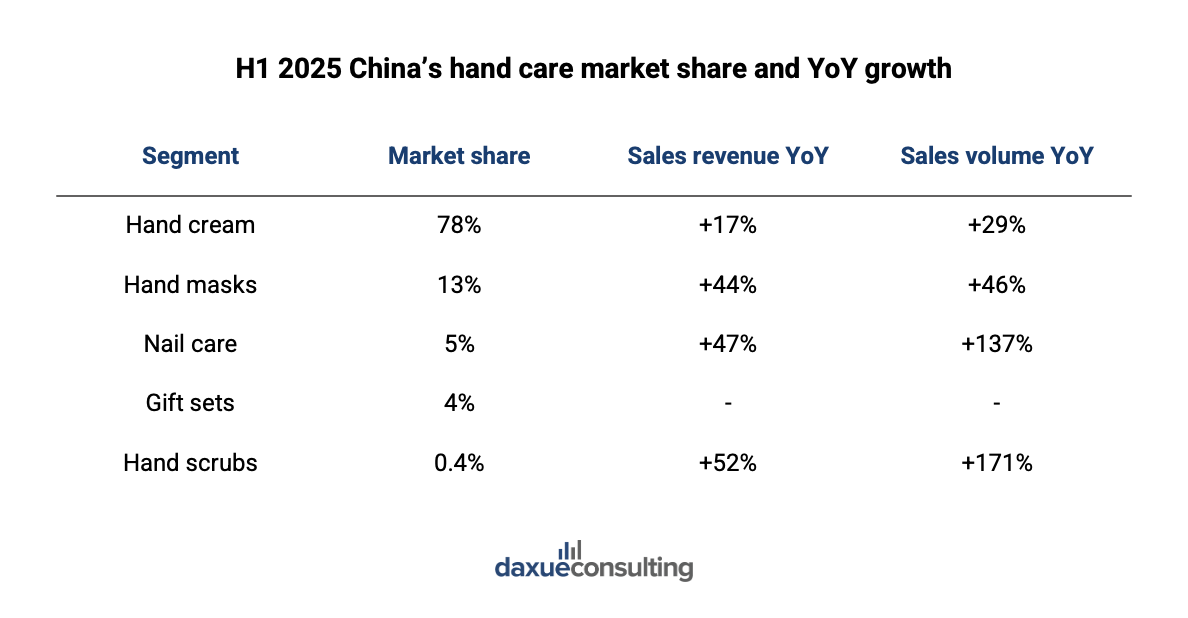
Hand cream leads the hand care market at 77.97%, though it grows more slowly than the other categories. The faster growth of hand masks and exfoliating products suggests Chinese consumers are adopting multi-step hand-care routines, extending facial skincare behaviors into the category. Hand masks hold a 13.03% market share and have seen over 40% increases in both sales volume and value, showing strong, ongoing demand. Nail care products compose 4.73% of the market and, despite their smaller share, show robust growth in sales volume and revenue. Although hand scrubs are among the smaller segments, their sales revenue and volume indicate rising interest in specialized exfoliating hand care products.
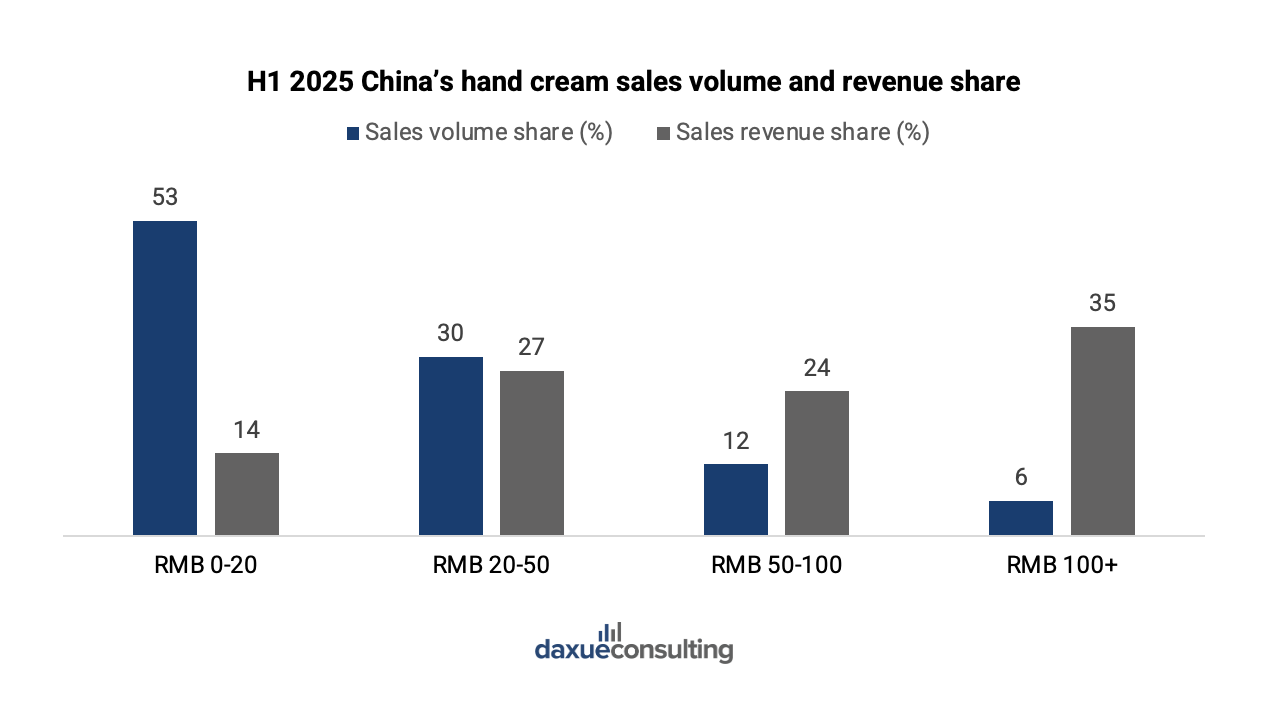
Within the hand cream segment, RMB 0-20 priced hand creams held more than half of sales volume, and RMB 20-50 priced hand creams held 29.8%, 50-100 with 11.9% share, and products priced above RMB 100 represent only 5.75% of sales volume but generated 34.78% of sales value. This creates a two-tier market: low-price products dominate unit sales, while a small premium segment captures a disproportionate share of sales revenue and market value.
Premium products capture disproportionate market value
While H1 2025 saw renewed volume growth, the 2024 pattern reveals the category’s underlying premiumization, where category value increased 2.8% even as sales volume declined 2.1%. This value growth stems from advanced formulations, improved sensory experiences, and brand positioning that goes beyond basic moisturizing. While mass products drive scale, premium efficacy‑focused formulations contribute disproportionately to market value.
Performance comes first, but experience matters
In 2025, women, primarily in urban areas, accounted for 81.41% of hand cream consumers. While they prioritize hand cream performance, they are paying more attention to the user experience.
According to 4,350 posts on Xiaohongshu (or RedNote), Chinese consumers value the moisturizing effect and texture (e.g., dryness relief, non-greasy feel, and no pilling), fragrance performance, packaging practicality, value for money, and suitability for different scenarios (e.g., office use, winter repair, overnight masking, and summer wear).
Whitening and brightening extends skinification to hands
The practice of 美白, or whitening and brightening the skin, is associated with correcting dullness, pigmentation, and uneven tones, aiming to add luminosity rather than simply lighten skin. In 2025, brightening ranked as the second most sought-after skincare demand, with 22% of Chinese consumers prioritizing it after moisturization at 34%. Online sales of brightening hand cream products surged 48.7% in 2025, showing how hand cream is shifting from a maintenance category to a treatment category.
Skinification is turning hand cream into targeted skincare
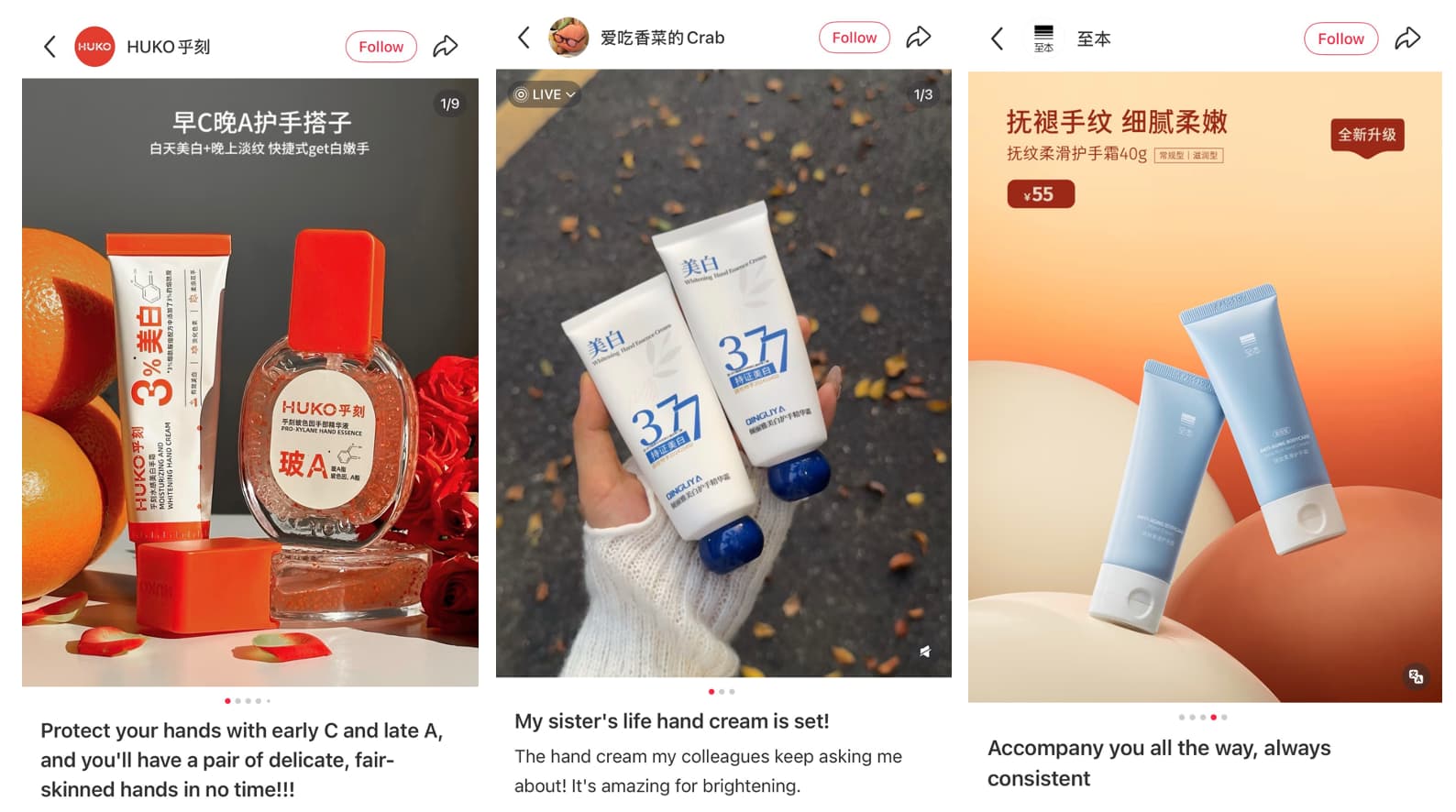
Chinese hand care brands are integrating facial-grade active ingredients into their hand formulations. For example, HUKO applies its facial-focused “ABC” anti-aging approach to hand products, featuring ingredients like Pro-Xylane, recombinant collagen, peptides, vitamin C, and niacinamide. Similarly, Qingliya’s 377 Brightening Hand Cream and Zhiben’s anti-aging hand cream also include well-known facial actives aimed at hand-specific repair and brightening. This trend has driven China’s functional active-ingredient segment to grow by 18.7% in 2025, far outpacing the overall hand cream market’s 5.4% growth rate.
Hand cream is a popular accessible luxury gift
Hand creams are a popular gifting option in China, combining practicality with emotional appeal through portability, brand presentation, and suitability for birthdays, festivals, and professional occasions.
When evaluating products for gifting, Chinese consumers carefully assess fragrance quality, lasting power, intensity, scent profile, and skin suitability, yet significant blind‑buy risk persists due to variable personal scent sensitivity, evolving aroma, and occasionally misleading marketing descriptions.
Hand cream lowers the financial barrier to luxury consumption by giving consumers access to branded packaging, fragrance, and gifting cues without the higher cost of perfume, fashion or leather goods.
Three routes to premiumization emerge
China’s hand cream market is shifting from basic moisturizing to more sophisticated formulations and improved user experiences, bridging between affordable, functional hand creams and high-end luxury products. The competition includes domestic skincare brands, specialty hand care companies, and international luxury brands.
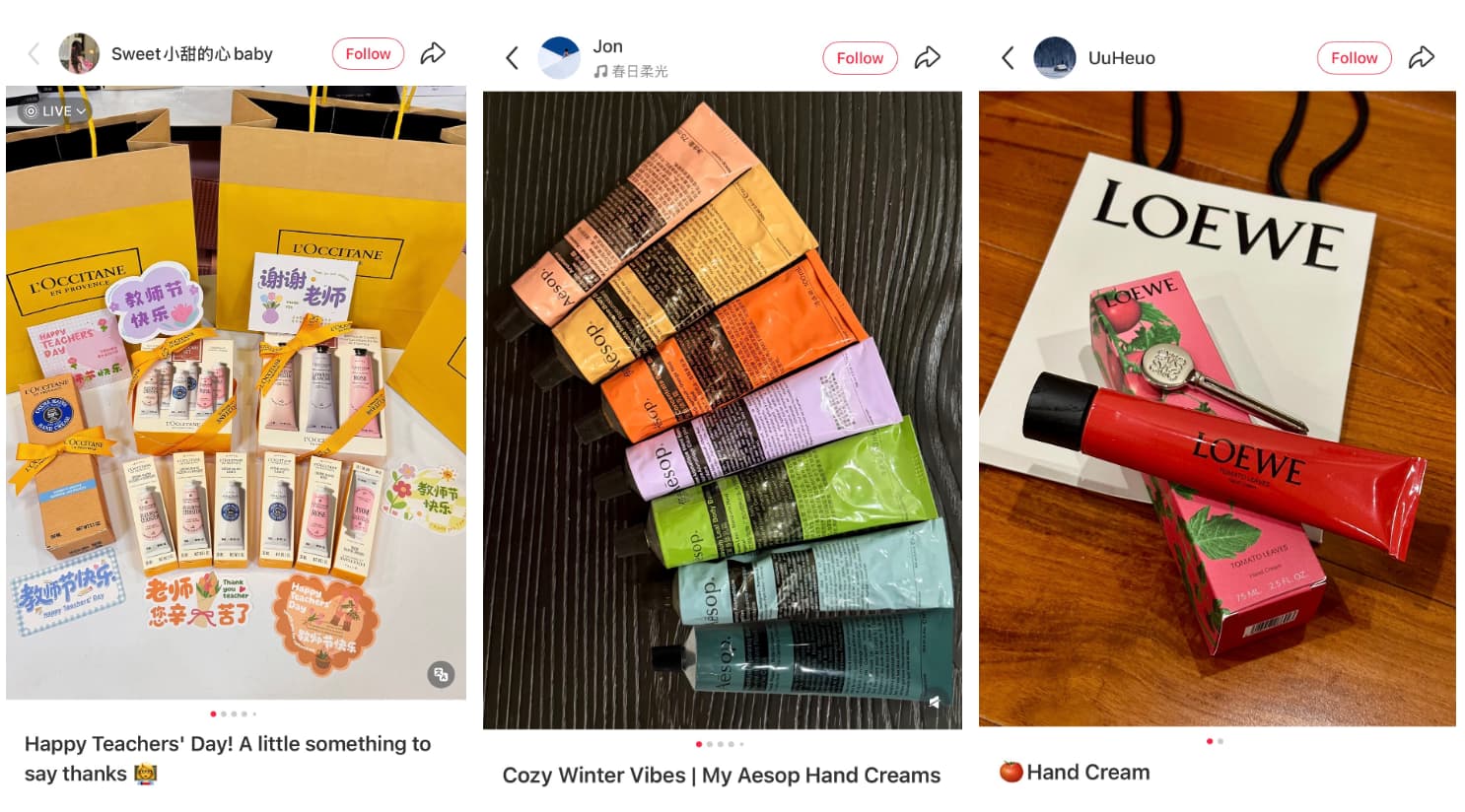
Three distinct routes to premiumization are emerging. Efficacy-focused brands like HUKO highlight advanced active ingredients and have expanded their facial skincare claims to include hand care. Sensory and gifting-oriented brands such as L’Occitane emphasize their fragrances and gifting appeal. Moreover, brand-equity-driven brands like Chanel, Prada, and Loewe extend luxury into the hand care market, enabling consumer luxury experiences through their packaging and accessible prestige.
While strong brand equity enables premium pricing, it also sets consumer expectations for formulation, scent, and performance. In China’s hand cream market, the strongest premium propositions combine these elements rather than relying on one alone.
How skinification, gifting and premiumization influence hand care
- Hand cream dominates China’s hand care market at 77.9%, although specialist treatments such as masks, nail care and scrubs are growing faster. While demand peaks in winter, hand cream is turning into a year-round daily essential.
- Chinese consumers are increasingly evaluating hand care using skincare standards. In addition to moisturization, they look for products addressing aging, dull skin, and other skincare concerns.
- Performance is the top purchase driver, with moisturization, formulation, texture, and scent as the key considerations. However, sensory experience and emotional appeal are becoming more important.
- Fragrance serves as personal expression and emotional comfort for daily use, while also making hand cream an ideal gift option.
Author: Sory Park, with additional research by Kyle