


China is the largest fruit-producing and consuming country in the world. In 2024, it produced 335 million tons of fruit, or around one-third of global output, while consumption reached 328 million tons. As public health awareness has increased, consumers are paying more attention to nutrition and healthy eating habits. In turn, consumers are incorporating fruits into their daily eating habits and paying more attention to the freshness, safety and nutritional value of fruits.
Download our China F&B White Paper
China’s fruit retail market has entered a mature growth stage
Fruit retail sales increased from USD 177.43 billion in 2021 to USD 223.11 billion in 2025, while the market is expected to continue growing to USD 265.52 billion by 2028. This market growth should be read as a shift in value, rather than a rise in fruit consumption. Chinese consumers already buy fruit through both offline and online channels, so accessibility is not the main competitive advantage anymore. The main value for consumers is freshness, which means the next layer of value comes from whether retailers can provide a stable high-quality supply of fruits and make the quality more visible before purchase.

Domestic production dominates, but imports shape premium consumption
Domestic production remains the foundation of China’s fruit supply, while imports play a smaller but more strategic role. China produced 335 million tons of fruit in 2024, compared with 9 million tons of fruit imports in 2025. Although imported fruits account for a much smaller volume, they serve a different role from domestic fruits: local supply covers everyday consumption, while imported categories help retailers turn seasonal demand, gifting, and self-reward into higher-value occasions.

Imported fruits create premium moments rather than everyday volume. In 2025, fresh durians were China’s largest imported fruit category, reaching USD 7.49 billion and 1.89 million tons. Fresh cherries ranked second, at USD 3.43 billion and 587,000 tons, with Chile accounting for almost all imported cherry volume. Durian’s appeal now comes from stronger supply, lower prices, and a more developed taste for tropical indulgence. Cherries work differently – their winter seasonality, red color, and gift-box format make them especially suitable for Spring Festival and family visits. Imported fruits mostly do not directly compete with domestic production. Instead, they complement everyday consumption of local fruits by addressing more specific consumer needs, especially around premium occasions and gifts.

Chinese consumers still buy fruit offline, but online is catching up
Chinese consumers continue to buy fruit offline, but online channels are facilitating access to fresh fruit. In 2025, the leading fruit purchase channels were offline supermarkets at 36.5%, fruit stores at 34.8%, and fruit stalls or vendors at 28.7%. E-commerce platforms such as JD and Pinduoduo reached 28.3%, already close to traditional fruit vendors. Offline consumption remains dominant because fruit is judged with the eyes and hands – color, ripeness, size, and damage are easier to check in person.

The Chinese fruit market is becoming more channel-specific: offline retail provides visible freshness, while online platforms provide convenience, comparison, access, and delivery speed. Furthermore, online fruit retail works best when it solves a different purchase mission. JD and Hema reduce quality risk through logistics and brand trust. Pinduoduo and community group buying make fruits more price-accessible for household purchases. Meituan and instant retail serve urgent needs, from office snacks to last-minute fruit plates. Tmall and brand stores fit premium gift boxes and seasonal campaigns.
Chinese consumers value freshness, safety and visible quality
Chinese consumers are becoming more selective about what makes fruit worth paying more for. In 2025, nearly half of consumers preferred organic or green-certified fruits with better taste and flavor, while more than 40% saw improved safety and lower pesticide residue as important for the industry. This changes the meaning of premium fruit – a higher price needs proof that consumers can see or understand, such as cleaner production, stronger origin credibility, or more consistent eating quality. For retailers, premiumization is less about charging more and more about reducing uncertainty.
Women, younger consumers and family buyers shape the quality upgrade
Women still appear more influential in household fresh-food decisions. They accounted for 53.7% of household fresh-food purchasing decision-makers in county-level fresh consumption, while men accounted for 46.3%. Female consumers also show stronger attention to nutritional components. For fruit brands and retailers, this makes health claims, origin transparency and quality assurance especially important in family-oriented and premium fruit decisions.
Younger consumers are viewing fruits as a lifestyle product and a visual object: a range of berries, fruit cups and gift boxes fit self-care, office snacking and Xiaohongshu-style sharing. The same logic appears in China’s juice and orange juice markets, where fruit-related products are becoming healthier, more premium, and more convenient. Fresh fruit sits inside this broader shift: it can be gifted, photographed, and used to signal a healthier daily routine.
Fruit gifting is turning freshness into social currency
Fruit gifting works in China because it carries health, politeness and low-risk social meaning. Alcohol can be too formal or unsuitable for some family settings; flowers can feel less practical. Fruit gift boxes solve this gap. During the Chinese New Year and Mid-Autumn Festival, premium mixed fruit boxes, cherries, citrus and grapes fit family visits, business courtesy and household sharing. The gift feels useful without losing the sense of care.
Fruit bouquets show how fruit gifting is becoming more visual. Although they are still a niche format, they capture a clear consumer shift: fruit can be arranged, photographed and delivered like flowers. Berry bouquets and fruit-flower gift boxes appear around Valentine’s Day, Mother’s Day, birthdays and same-city surprise delivery. The value comes from freshness, color, shape and timing. Fruit becomes giftable in the same way flowers are: presentation matters as much as the product itself.
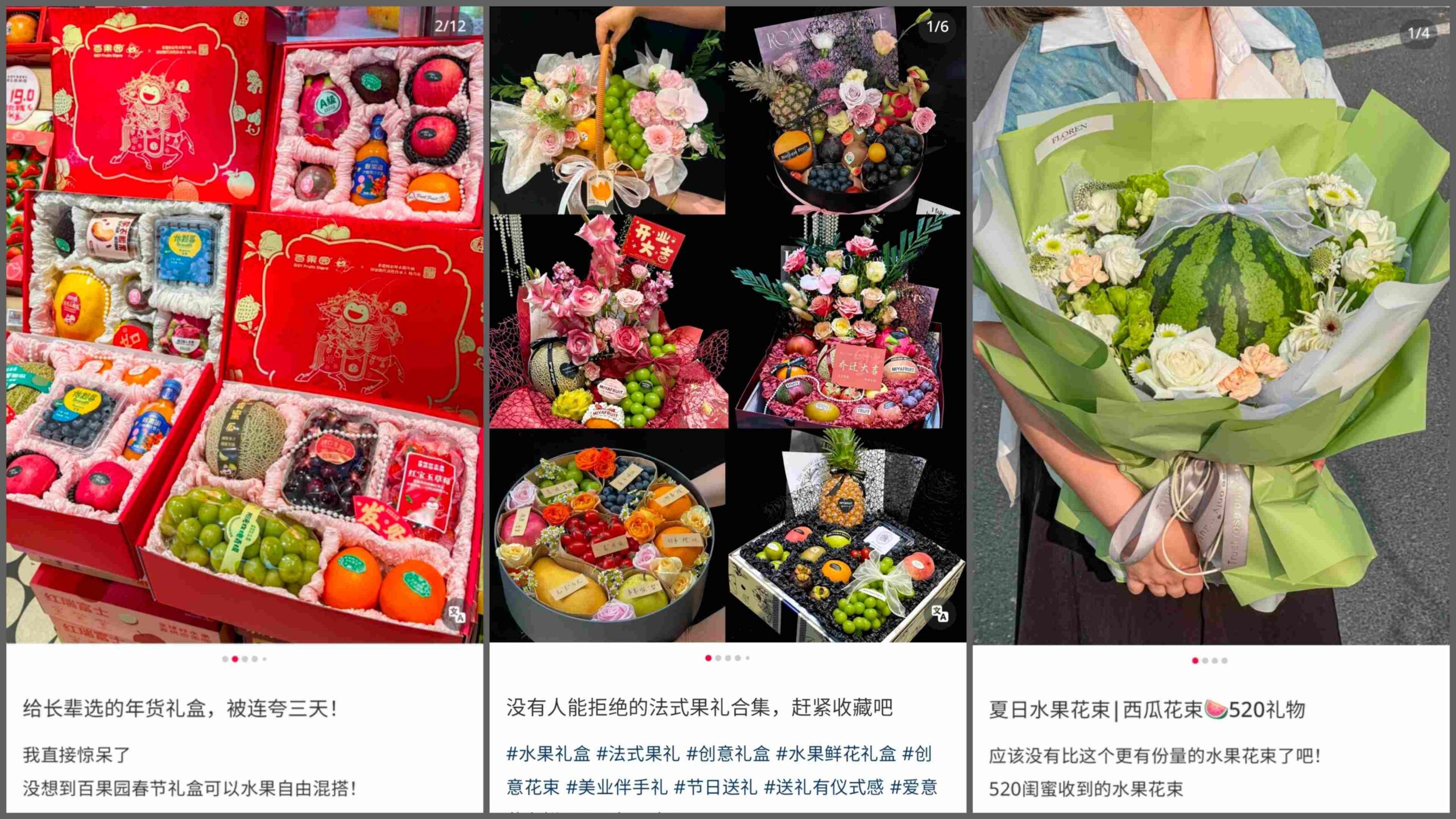
Another reason why fruit gifts are so popular is symbolism. Apples are associated with “peace apples” on Christmas Eve because 苹果 sounds close to 平安, turning a common fruit into a wish for safety and peace. Chinese New Year gifting follows a different logic, where citrus and cherries work better through auspicious color, round shapes and family sharing. What is newer is the way platforms, packaging, and supply chains turn symbolic fruit into a ready-to-send gift. Cherries, citrus, strawberries, and durians can now be sold in better-designed boxes, delivered faster, and presented as healthy but visually attractive gifts.
Fruit consumption in China varies by occasion
At home, fruit remains tied to family nutrition and post-meal sharing. Outside the home, younger consumers are using fruit more as a snack, a drink ingredient, or a convenient health-oriented treat during work and study breaks. In gifting, fruit works because it is practical, shareable, and easy to adapt to different relationships. These occasions require different retail formats: family packs for household replenishment, fresh-cut or ready-to-eat formats for daily snacking, and better-designed boxes for festivals and social visits.
How fruit consumption in China is changing
- China is the world’s largest fruit-producing and consuming country. China’s fruit retail sales reached USD 223.11 billion in 2025, after growing from USD 177.43 billion in 2021. The next stage of growth is driven more by trust and quality than by availability.
- Fruit imports reached USD 18.94 billion in 2025, led by durians and cherries.
- Domestic fruit covers everyday demand, while imported durians and cherries create higher-value occasions.
- Consumers are paying more attention to safety and visible quality, making grading and product transparency more important for retailers.
- Offline supermarkets and fruit stores remain the main purchase channels, but e-commerce is close to traditional vendors.
- Fruit gifting is not new, but it is becoming more commercialized through premium fruit supply, better packaging, instant delivery, and stronger demand for healthy but emotionally meaningful gifts.