

The “C-Beauty wave” has fundamentally reshaped the cosmetics market in China. It evolved from a trend of affordable alternatives to a sophisticated market where domestic brands claimed a dominant 55.2% share in 2024. The first generation of domestic successes, such as Florasis (花西子), Timage (彩棠), and Flower Knows (花知晓), scaled through cultural storytelling and cost-efficiency. Yet, a new strategic benchmark has been set by Mao Geping. Unlike its Chinese beauty peers, which often compete on “value-for-money” or the aesthetic whims of social media, Mao Geping has engineered a strategy of uncompromising premiumization. Founded in 2000 by the celebrated artist Mao Geping, the brand was famed for his transformative work on iconic Chinese dramas. Through premiumization, the brand has moved past the domestic “mass-market trap” to compete directly with global heritage brands.
The premiumization blueprint: Decoding the 85% “Luxury Moat”
Mao Geping’s competitive advantage begins with a pricing architecture that signals its luxury intent. While domestic competitors typically occupy the USD 15–30 price segment, Mao Geping’s core products, such as its Luxury Caviar Cushion Foundation, are priced in the USD 50–60 range. This aligns the brand more closely with global luxury giants like Giorgio Armani and Dior than with its local counterparts. This pricing is not an arbitrary marketing choice; it is a financial reflection of the brand’s “Professional Artistry” positioning. By benchmarking against international prestige brands, Mao Geping avoids the race-to-the-bottom price wars that have eroded the margins of other C-Beauty players.
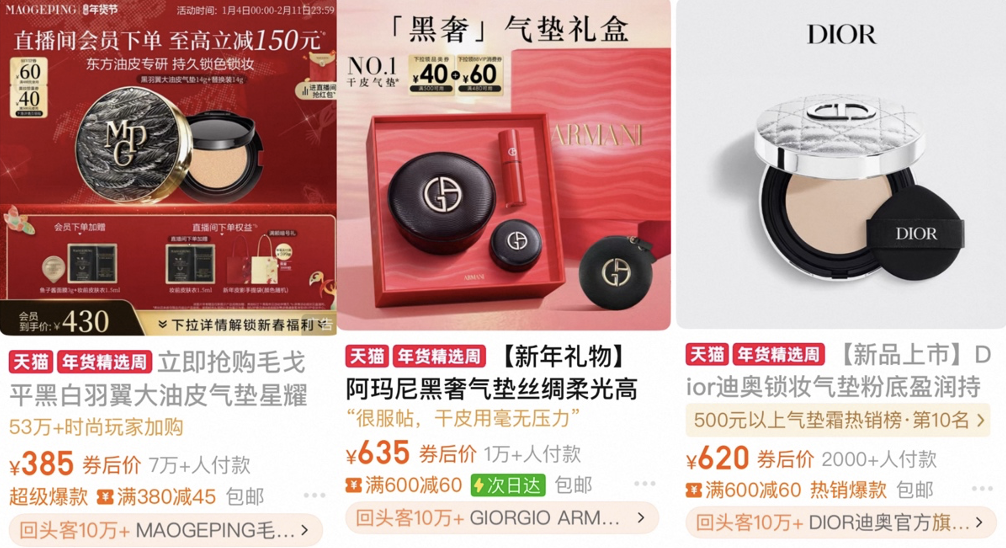
The financial effectiveness of this premium positioning is evidenced by the brand’s extraordinary profitability. According to 2024 and H1 2025 financial data, Mao Geping reported a staggering 84.8% gross profit margin. To put this in a consulting perspective, this significantly outpaces the general cosmetic industry average of ~58% and even established luxury leaders like Estée Lauder (74%). This ten-point lead over international giants serves as a “luxury moat.” It proves that consumers are not just buying a product; they are paying a premium for professional authority. According to the 2024 annual report, the brand’s revenue growth rose from RMB 1.57 billion in 2021 to over RMB 3.88 billion in 2024. This demonstrates that this high-margin model is highly scalable within the domestic market.

The vertically integrated artistry ecosystem and Cultural Capital
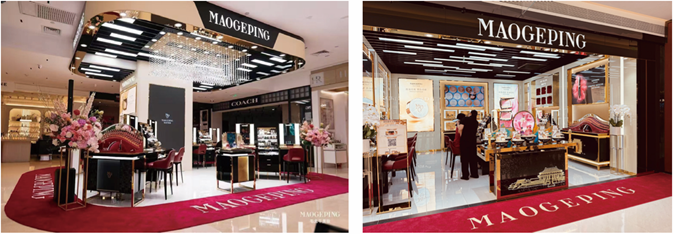
At the heart of the brand’s market resilience is its Vertically Integrated Artistry Ecosystem. It is a closed-loop business model that transitions Mao Geping from a mere product retailer to a cultural and technical authority. This ecosystem is sustained by a unique “Training Engine,” a network of 10 Makeup Artistry Training Institutes across China. These schools, which enrolled over 3,800 students in the first half of 2025, act as a critical talent pipeline. By training thousands of professionals in the founder’s specific “Light and Shadow” philosophy, the brand effectively manufactures its own brand ambassadors. These graduates often staff the brand’s 405 self-operated counters, where they provide high-touch, one-on-one personalized makeup consultations. This labor-intensive retail model creates a level of “expert dependency” that digital-only domestic brands cannot replicate.
Beyond logistics, Mao Geping has successfully solved a profound “technical pain point” for Asian consumers by reclaiming traditional Chinese beauty standards. Rather than following Western “contouring” techniques designed for Caucasian bone structures, the brand promotes “Light and Shadow Art” to enhance Asian facial features. This technical solution is deeply linked to “National Cultural Capital,” positioning the brand as a defender of Eastern aesthetics.
Cultural resonance as Mao Geping’s brand strategy
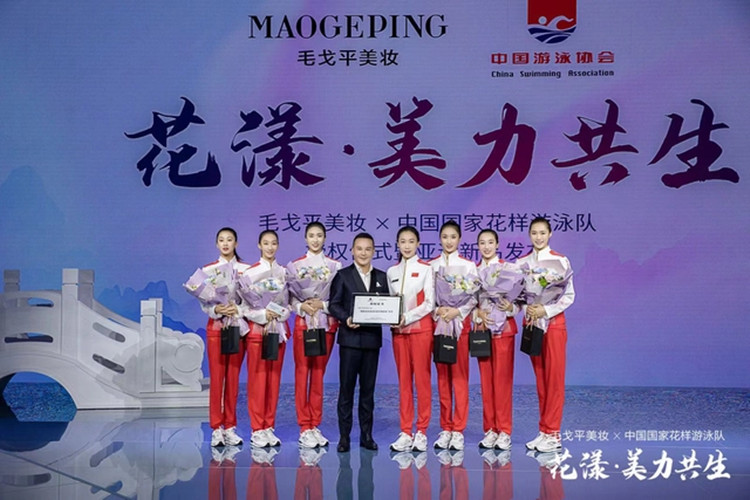
This cultural resonance is driven by high-profile crossover marketing, most notably the “Glow of the East” (气蕴东方) series. This collection, which has seen five successful iterations, integrates traditional Chinese culture into product design and consistently sells out upon launch. This includes serving as the official supplier for the 19th Asian Games in Hangzhou, where the “Asian Games Tribute” series was launched, further cementing its “national brand” status.
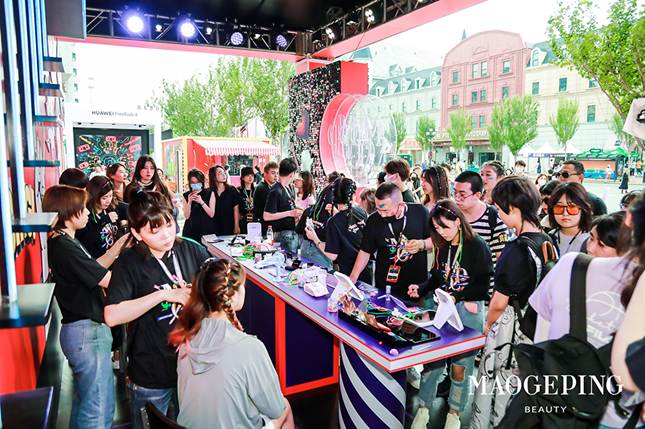
Simultaneously, the brand explores modern relevance through partnerships with the Strawberry Music Festival under the theme “乐出色·悦有young” (Live Colorful, Joyful & Young). This demonstrates a dual-track marketing strategy: anchoring the brand in traditional heritage while proving its “fitness” with the Gen Z demographic. Ultimately, the real test for Mao Geping isn’t just entering new markets. It’s on whether its unique artistry-driven ecosystem can be reframed as a scalable global luxury strategy that resonates beyond China’s domestic cultural context.
The global pivot: Artistry as the ultimate strategic test
Mao Geping is now entering its most critical phase: the transition from a Chinese icon to a global luxury contender. The brand’s international ambitions were formalized with the opening of its first official flagship in Hong Kong’s Harbour City in late 2024. This is a move positioned as a “crucial bridge” to the global stage. This global push is significantly de-risked by a heavyweight strategic partnership with L Catterton (the private equity arm of LVMH), signed in early 2026. This alliance is not merely about capital; it is a “global playbook” access pass. It was designed to plug Mao Geping into high-end international retail channels and optimize its governance for a global luxury audience.

The scalability challenge: Translating a domestic ecosystem to a global market
However, this expansion represents an ultimate test of the brand’s foundational strategy. The central question is whether a brand built on a deep, domestic ecosystem of training schools and personalized service can translate effectively to a global consumer base. The challenge lies in scalability: while the “Light and Shadow” technique is a universal art form, the high-touch, training-intensive model is difficult and expensive to replicate in Western markets with higher labor costs. As of H1 2025, overseas sales accounted for only 0.05% of total revenue, highlighting the vast gap between domestic dominance and global presence.
The success of Mao Geping’s global quest will depend on whether it can successfully “industrialize” its unique artistry into a universal luxury language. By shifting from a marketing-driven model to an authority-driven ecosystem, Mao Geping has achieved margins that rival the world’s most successful luxury conglomerates. For any brand looking to move up the value chain, the lesson is clear: long-term premiumization requires more than a high price tag. It requires a vertically integrated system of professional authority and cultural indispensability.
Mao Geping’s transition from domestic authority to global luxury
- By pricing products alongside global luxury giants like Dior and Armani (USD 30–57), Mao Geping has successfully bypassed domestic price wars to achieve a dominant 84.8% gross profit margin.
- The brand maintains its market authority through a “closed-loop” system that integrates professional makeup institutes with high-touch, personalized retail services.
- By solving technical beauty challenges specific to Asian facial structures, the brand uses “Light and Shadow Art” and national crossover marketing to build deep cultural resonance.
- While the LVMH-backed expansion into hubs like Hong Kong signals high ambition, the brand faces a critical challenge in scaling its service-heavy model across international markets.