
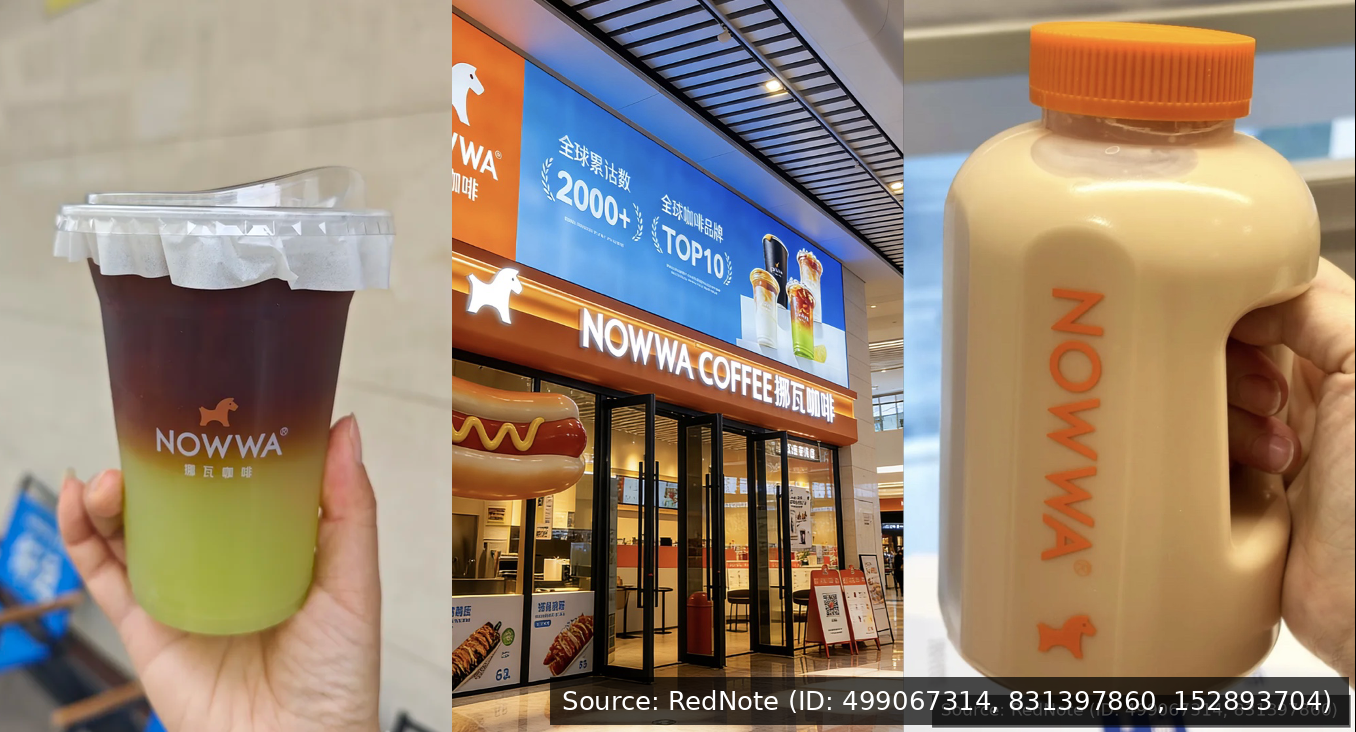
On December 11, 2025, NOWWA Coffee announced its global store count had crossed 10,000, the fourth Chinese coffee chain to get there after Luckin, Cotti, and Lucky Coffee. It did not get there through conventional franchising. Over 90% of its locations are store-in-store counters inside partner venues, and Meijiyia convenience stores alone host roughly 3,600 of them. Growth therefore came in waves. Each new partner chain brought hundreds of counters at once, so openings averaged around 800 a month but peaked at 1,800. Six weeks later, NOWWA closed a Series C worth hundreds of millions of RMB, with Yuanxing Capital investing for the fourth round running since 2020.
Download our China’s F&B industry white paper
Coffee beverage market size in China
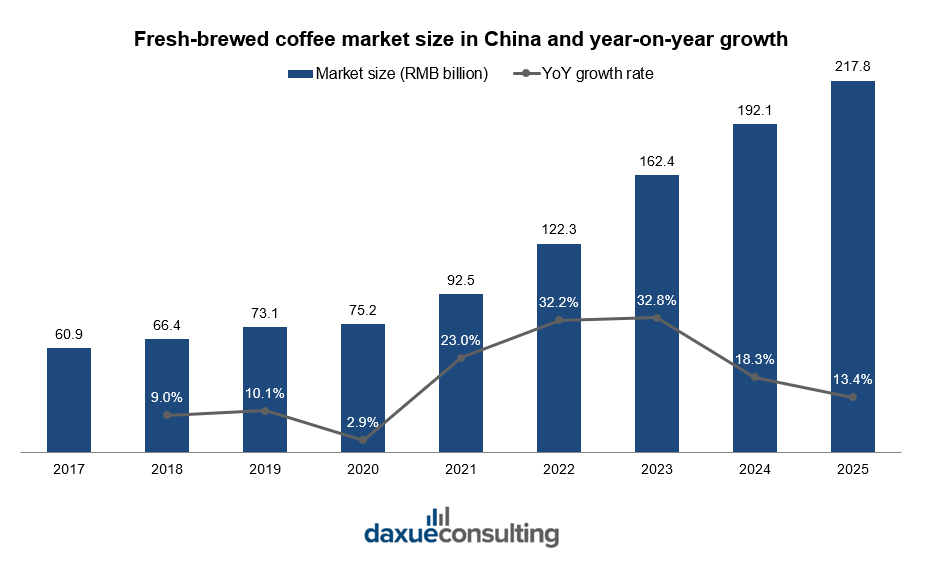
China’s fresh-ground coffee market hit RMB 217.8 billion in 2025, up 13.4% from the year before. The chain rate now approaches 40%, and 39,000 new coffee companies registered across the country in 2025 alone. The growth was not confined to established markets: Xi’an added 37.3% more coffee shops, Guangzhou 16.2%, and even Shanghai, already one of the world’s most coffee-dense cities, grew by 8.5%. By year-end, the market had four 10,000-store coffee chains.
NOWWA’s position in China’s coffee market: above the price war, open when competitors close
The 2023 price war split China’s fresh coffee market into a clear hierarchy. Starbucks holds the premium end. Luckin Coffee, Cotti Coffee, and Lucky Coffee compete in the RMB 8 to 15 band, where RMB 9.9 served as default promotional floor during the price war between 2023 to 2024. NOWWA sits at RMB 16.99, above all three. By average order value alone, it belongs closer to Starbucks territory than to the mass-market brands it is most often grouped with by store count.
Average coffee beverage price comparison between brands
| Brand | Avg. Order Value | Store Count | Primary Model |
| Starbucks | RMB 36.07 | 8,011 | Company-operated |
| NOWWA Coffee | RMB 16.99 | 10,000+ | Shop-in-shop (91.9%) |
| Luckin Coffee | RMB 14.28 | ~29,000 | Independent franchise |
| Cotti Coffee | RMB 10.48 | ~15,000 | Independent franchise |
| Lucky Coffee | RMB 8.14 | ~10,000 | Independent franchise |
The more specific finding is about time, not price. Over half of China’s convenience stores now operate 24/7. NOWWA in China, with its 10,000-store network sits inside that infrastructure. Luckin and Starbucks close. NOWWA does not. The early morning commuter grabbing coffee at 6am and the late-night worker at 11pm are not customers Luckin’s app-dependent model serves well. NOWWA’s positioning is defined as much by when it is available as by what it charges. That time-slot coverage is a structural advantage that store count alone does not capture.
NOWWA’s 10,000 stores are a distribution network, not a retail footprint
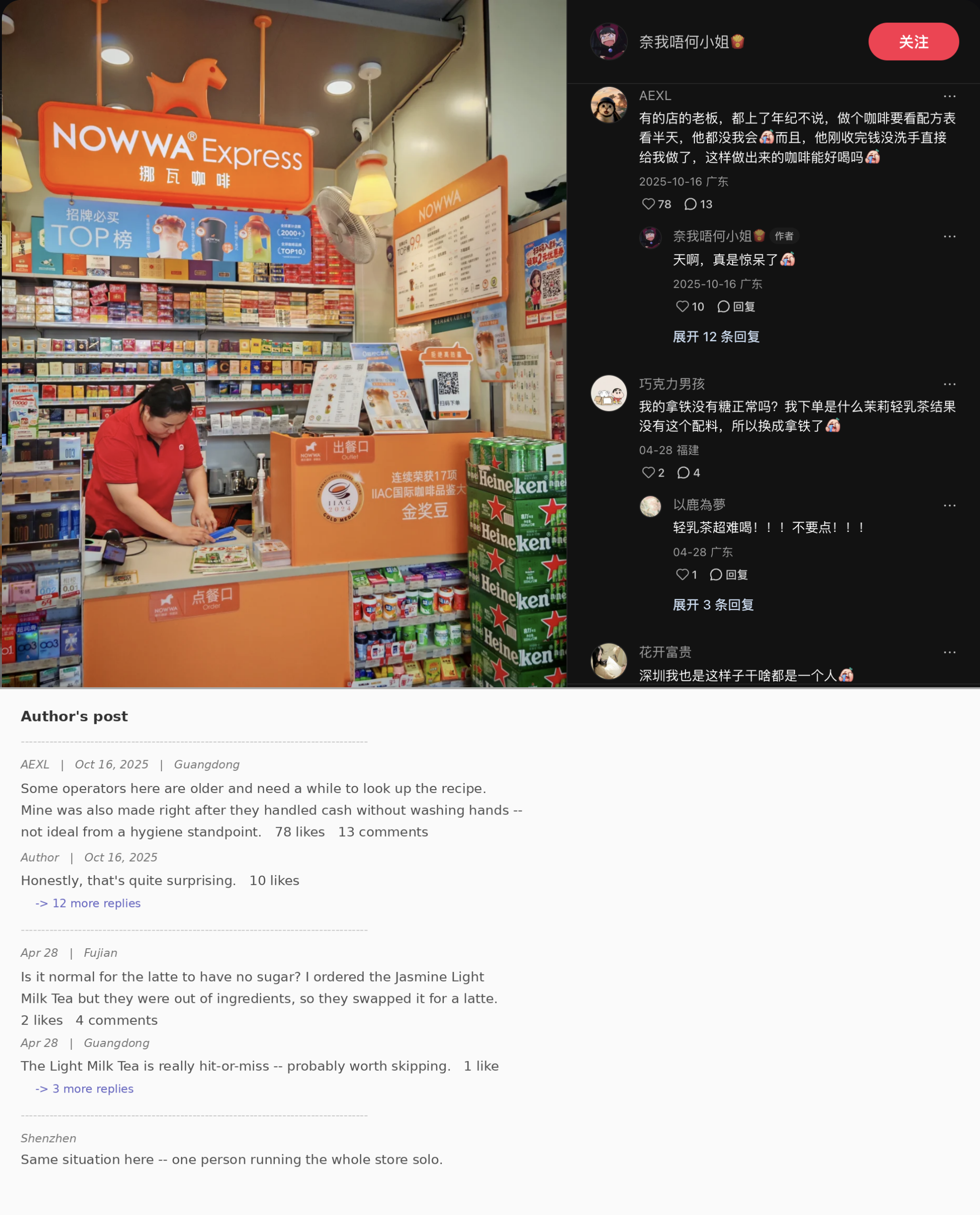
Of those 10,000 stores, 91.9% are not independent outlets. They are coffee counters placed next to convenience store cashiers, under what the industry calls a shop-in-shop model. Joining costs a partner RMB 10,000 in equipment deposit and a 2 to 4 square meter counter. No dedicated staff, no renovation. Existing clerks handle orders after a short training, and almost all new coffee revenue is incremental to the store. As of October 2025, Meiyijia alone contributed 3,635 outlets, or 46.2% of NOWWA’s national total. NOWWA did not solve a real estate problem. It inherited one its partners had already solved.
A health-first product lineup in a price-first market
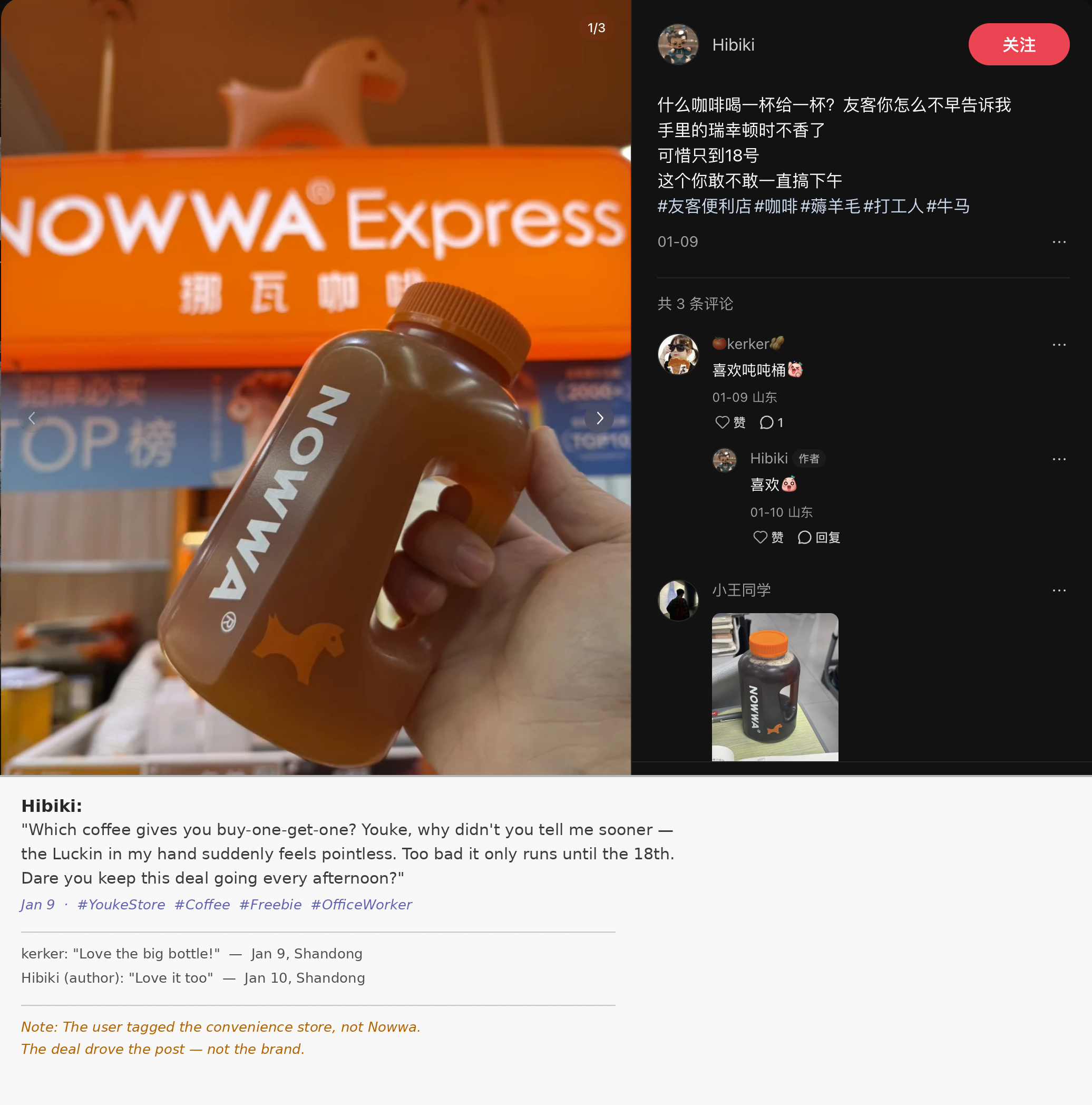
While Luckin and Cotti competed on RMB 9.9, NOWWA in China went in the opposite direction. Its official positioning is “no high calories,” with every product made to be 0 sugar, low fat, and low calorie. That is not a marketing claim. It is a product constraint the brand applies consistently, even at the cost of sales: the founder publicly noted NOWWA would skip the industry-standard Christmas caramel hazelnut latte because its calorie count is five to six times that of a standard latte. The 吨吨桶 fruit coffee series now contributes around 70% of revenue, and the lite coconut latte carries 50% less fat than the industry average. A health-first lineup gives consumers a reason to pay RMB 16.99 that has nothing to do with store format.
Digital infrastructure built to run 10,000 clerk-operated counters
NOWWA’s founding team came from Ele.me, and that background shows in how the brand operates. LBS data drives store placement and consumer targeting. The core customer profile, 22 to 35 year olds with 65% female, was not discovered through surveys. It was read off delivery data. That same data loop feeds product development: sweetness levels, milk foam ratios, and caffeine preferences from order history shape each new menu iteration. The harder problem is quality control across 10,000 locations where no dedicated barista exists. NOWWA’s answer is upstream standardization: a self-owned roasting factory that came online in 2025 and 15 national distribution centers ensure every convenience store counter receives the same inputs. The digital layer does not replace the missing staff. It makes the missing staff less of a problem.
Two structural gaps and one closing window
When 91.9% of locations sit inside someone else’s store, consumer memory attaches to the host, not the coffee brand. Founder Guo Xinjun publicly acknowledged this: NOWWA’s coffee brand identity lacks the sharpness of Luckin’s convenience, Cotti’s price, or Starbucks‘ space. The quality control problem runs along the same fault line. No dedicated baristas are what makes the cost model work, but it also means clerks handle cashiering, food prep, and coffee at the same time. Consumers also pointed out of inconsistent output and hygiene concerns that supply chain standardization cannot fully fix without changing the economics that make the model viable. The third challenge is external. In 2025, Luckin entered fruit vegetable tea, Lucky Coffee released 16 health-adjacent products in one menu update, and Gucheng entered coffee at RMB 8.9. NOWWA proved the health positioning could work. Larger competitors followed. The first-mover advantage is now a narrowing window.
How NOWWA coffee in China fits into China’s coffee adoption curve
China’s coffee market is still converting non-drinkers, not retaining existing ones. Third and fourth-tier cities are the industry’s main growth frontier, and residents in around half of China’s counties have only recently developed a basic coffee awareness, with many still associating it with prices around RMB 30 per cup. NOWWA in China, of its convenience store presence addresses both barriers at once. It puts branded coffee where first-time buyers already shop, and its fruit-forward, low-bitterness menu lowers the entry point for consumers who find traditional coffee too harsh. 55 to 65% of China’s population lives in third-tier cities and below, where per capita income growth is now outpacing first-tier cities. In many of these markets, a NOWWA counter inside a local convenience store is the first branded coffee experience a consumer encounters. That position is harder to replicate than any single product.
The operating model utilized by NOWWA is now being followed by other brands
The shop-in-shop format that NOWWA scaled is attracting followers. In November 2025, JD.com launched seven fresh (七鲜咖啡), built on the same embedded convenience store logic with a parallel standalone store track. Sinopec’s Tiki Coffee(易捷咖啡) has been running a comparable model inside petrol station convenience stores for longer. In the same price tier, KCoffee backed by Yum China’s supply chain and existing store network is showing the strongest expansion momentum among second-tier challengers. NOWWA demonstrated that light-asset coffee distribution at scale is viable. That proof of concept is now available to anyone with an existing retail network and the willingness to act on it.
Key takeaways on NOWWA coffee in China
- The shop-in-shop model compressed what would have taken years of conventional franchising into 15 months. The cost structure is different enough that the comparison barely applies.
- Cheap distribution did not mean cheap pricing. NOWWA’s average order value of RMB 16.99 sits above Luckin and Cotti, built on a health-first product line rather than promotional discounts.
- Embedding inside 24/7 convenience stores gave NOWWA access to time slots that independent coffee chains do not cover. Early mornings and late nights are structural advantages, not marketing wins.
- Scale and brand recognition are not the same thing. When 91.9% of stores sit inside someone else’s space, consumer memory tends to attach to the host. That gap does not close on its own as the store count grows.
- NOWWA proved the model works. That proof is now available to any brand with an existing retail network. JD.com, Sinopec, and KCoffee have already taken note. The first-mover window is narrowing.
Author: Ming Yii Lai, with additional research by Zekai Zhang