
Pop Mart’s strategy in 2026 is to turn one global hit into a portfolio, and to move its overseas business from viral online sales to stores it controls. The numbers say the first part is working and the second is costing money. In 2025, Pop Mart (泡泡玛特, popmart.com.cn in China) grew revenue 184.7% to RMB 37.1 billion, with THE MONSTERS, the IP behind Labubu, bringing in 38.1% of it, according to its 2025 annual results filed with HKEX. In the first half of 2026, growth fell to 23.8%, overseas revenue dropped 11.1% and THE MONSTERS slipped to 26% of sales, per the 2026 interim results. Founder Wang Ning now calls 2026 a “year of operational adjustment.” Our reading: the IP machine is healthier than the share price suggests, and the overseas rebuild is where the risk sits.
Pop Mart in 2026: the key figures
| Indicator | 2024 | 2025 | H1 2026 | Source |
| Revenue | RMB 13.0 bn | RMB 37.1 bn (+184.7%) | RMB 17.2 bn (+23.8%) | HKEX annual, HKEX interim |
| Profit attributable to owners | RMB 3.1 bn | RMB 12.8 bn (+308.8%) | RMB 5.0 bn (+10.1%) | HKEX filings |
| Gross margin | 66.8% | 72.1% | 69.7% (H1 2025: 70.3%) | HKEX filings |
| THE MONSTERS (Labubu) revenue | RMB 3.0 bn, 23.3% of total | RMB 14.2 bn, 38.1% | RMB 4.5 bn, 26.0% (-7.5%) | HKEX filings |
| Overseas revenue (outside mainland, HK, Macao, Taiwan) | RMB 4.2 bn | RMB 16.3 bn (+291.9%) | RMB 5.0 bn (-11.1%) | HKEX filings |
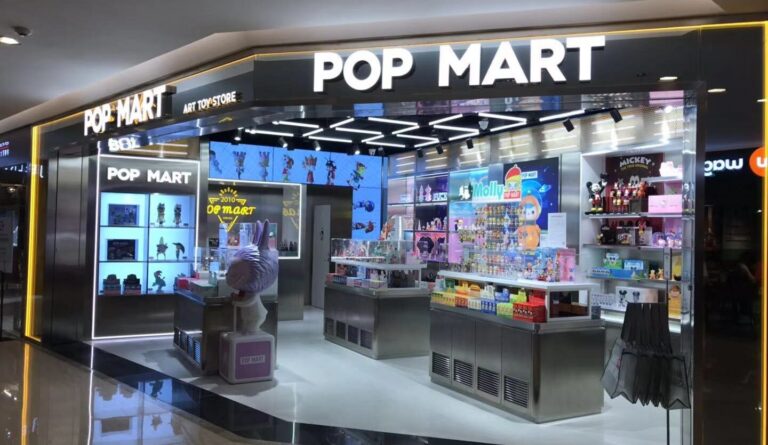
| Stores worldwide | 521 | 630 | 676, plus 2,827 roboshops | Cailian Press, HKEX interim |
| Registered members, Chinese mainland | 46.1 m | 72.6 m | 82.4 m | HKEX filings |
| Inventory turnover | 102 days | 123 days | 201 days | HKEX filings |
Pop Mart publishes no full-year 2026 forecast beyond the target of “no less than 20%” revenue growth that Wang Ning gave in March, reported by Cailian Press. In August he told analysts that lifting sales was “not the primary goal” this year, according to the 21st Century Business Herald, and the paper reported him saying the company would most likely miss the growth target it had set at the start of the year.
The IP machine is healthier than the share price suggests. The real risk sits abroad, where Pop Mart is swapping viral online sales for costly stores.
Daxue Overview
We have looked at Pop Mart from several angles since 2021: the blind box economy in 2021, China’s collectible toys market and our Pop Mart profile in 2025, meng culture the same year, and emotional purchases in 2026. Based on that research and on the 2026 filings, our overview fits in three points:
- China is the engine. Mainland revenue grew 47.3% in H1 2026, members made 92.9% of sales and the repeat purchase rate passed 50%.
- The portfolio is broadening. Revenue outside THE MONSTERS grew about 40% (our calculation), led by Twinkle Twinkle.
- Abroad, the bet is retail. Pop Mart is replacing viral online sales with its own stores, and the overseas margin fell from 44.1% to 30.3% in the process.
How Pop Mart got here
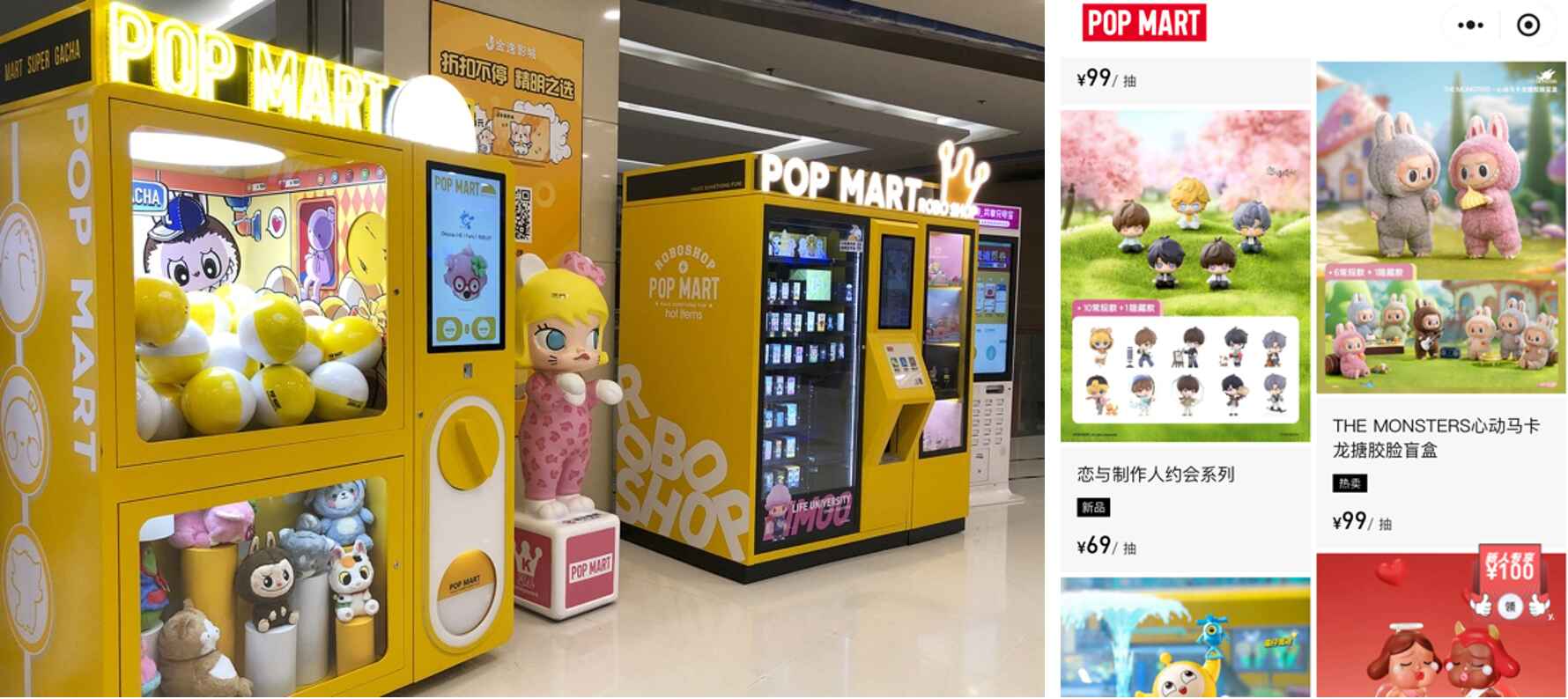
Pop Mart opened its first shop on 17 November 2010 in Zhongguancun, Beijing, selling trendy goods “like a supermarket”, Jiemian reported. In 2015 a Japanese collectible, Sonny Angel, brought in RMB 30 to 40 million, close to 30% of revenue. Customers kept asking for one other name, Molly, and in 2016 Wang Ning went to Hong Kong to meet its designer, Kenny Wong, according to PEdaily. Molly was then sold in blind boxes (盲盒, mang he): a sealed box at a fixed price, with the buyer not knowing which figure is inside. That format, plus a network of roboshops in malls and metro stations, carried the company to its Hong Kong listing on 11 December 2020. We covered the product lines, the MEGA collector range and the early channel mix in our profile of Pop Mart and China’s designer toy market; this article stays on strategy.
Labubu changed the scale of the business. The character, drawn by Hong Kong-Belgian artist Kasing Lung for THE MONSTERS series, sold steadily in China for years before celebrity posts in 2024 took it worldwide, as we described in our 2025 profile. By 2025 the plush pendant version, clipped to handbags from Bangkok to London, had made plush toys Pop Mart’s largest category: RMB 18.7 billion, or 50.4% of revenue, against 21.7% a year earlier, per the annual results. Overseas revenue nearly quadrupled, and the Americas went from RMB 0.8 billion to RMB 6.8 billion in a year.
What we said about Pop Mart before, and what still holds
Daxue has written about Pop Mart since its blind box years. Going back over those pieces against the 2025 and 2026 filings is a useful test of where the business is solid and where it was riding a wave.
| What Daxue said | When | Status in 2026 |
| Pop Mart led the blind box market but held only 8.5% of it; the market structure was “not stabilized” | 2021 | Outdated. Pop Mart’s 2025 revenue was ten times that of TOP TOY, the next listed challenger |
| Pop Mart was moving away from blind boxes toward plush and other categories | 2025 | Confirmed. Plush reached 57.2% of revenue in H1 2026 |
| Offline channels still matter for Gen Z buyers | 2025 | Confirmed, and now the core of the overseas plan |
| Pop Mart had built “an IP empire with significant competitive barriers” | 2025 | Largely true in China; less proven abroad, where online sales fell 44% in H1 2026 |
| 43% of past blind box buyers planned to buy fewer, citing repetitive designs and rising prices | 2025 | Partly confirmed: Labubu resale prices collapsed, yet China revenue still grew 47.3% |
| Labubu works as social currency for lonely young consumers | 2026 | Still true in China, weaker abroad as the novelty fades |
The call that aged worst is the 2021 one. A market leader with 8.5% share in a fragmented field looked easy to catch; five years later Pop Mart is the only player in the category with a global IP portfolio. The 2025 view of an “IP empire” was right for China. Outside China it was written at the top of a cycle.
Pop Mart’s IP model: less Labubu, more IPs
Labubu’s decline matters less than what happened to the rest of the catalogue. Revenue excluding THE MONSTERS rose from RMB 9.1 billion in H1 2025 to RMB 12.7 billion in H1 2026, a 40% increase (our calculation from the HKEX interim results). Six artist IPs passed RMB 1 billion in six months, and eleven passed RMB 100 million.
| IP | H1 2025 revenue | H1 2026 revenue | Change |
| THE MONSTERS (Labubu) | RMB 4,814 m | RMB 4,454 m | -7.5% |
| Twinkle Twinkle (星星人) | RMB 389 m | RMB 2,650 m | +580.6% |
| CRYBABY | RMB 1,218 m | RMB 1,633 m | +34.0% |
| DIMOO | RMB 1,105 m | RMB 1,619 m | +46.5% |
| SKULLPANDA | RMB 1,221 m | RMB 1,551 m | +27.1% |
| HIRONO | RMB 728 m | RMB 1,009 m | +38.5% |
| MOLLY | RMB 1,357 m | RMB 901 m | -33.6% |
Twinkle Twinkle is the clearest proof that Pop Mart can make a second hit on purpose. It went from 2.8% of sales to 15.4% in a year. MOLLY is the warning. The character that built the company turned 20 in 2026 and lost a third of its revenue, despite anniversary exhibitions in Hong Kong, Shanghai and Beijing. Popularity in this category decays, and the company knows it: the annual report talks about making THE MONSTERS “an evergreen world-class IP”, a goal it has yet to reach with any character.
The mechanics behind the portfolio have not changed much. Pop Mart signs artists, owns or co-owns their characters, and controls design, production and retail. Artist IPs made 89% of revenue in H1 2026 and licensed IPs 10.3%, so the company pays relatively little in royalties compared with toy makers that rent famous characters. Format matters as much as the character. A plush pendant with a vinyl face is worn on a bag, outside the home, so every buyer becomes a small billboard. Plush revenue grew 60% in H1 2026 while figure toys were flat (+0.3%).
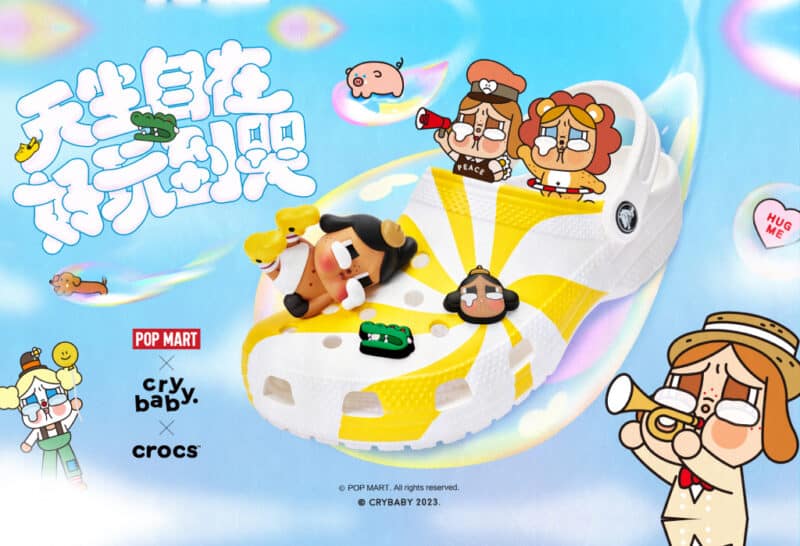
Content is where Pop Mart is spending the most effort, with the least to show so far. In 2026 Labubu appeared at the opening and closing ceremonies of the FIFA World Cup, as the first Chinese original IP invited, according to the interim report, and appeared in Milan during the Winter Olympics. Pop Mart’s COO Si De said in March that Labubu picture books and a film were in preparation, per Cailian Press. Disney keeps characters alive through films; Sanrio does it through a constant flow of products and licences. Pop Mart is now trying both, and it is too early to say whether a film will do for Labubu what the bag pendant did.
Pop Mart’s global expansion: from viral to retail
Abroad, Pop Mart is doing what we would expect of a brand whose first wave came through TikTok and resellers: it is trading online volume it does not control for stores it does.
| Region (H1 2026) | Revenue | Change | Offline change | Online change | Stores (Jun 2025 to Jun 2026) |
| Asia Pacific | RMB 2,575 m | -9.7% | +16.2% | -39.8% | 69 to 90 |
| Americas | RMB 1,892 m | -16.5% | +19.5% | -45.6% | 41 to 86 |
| Europe and others | RMB 506 m | +5.9% | +49.8% | -59.0% | 18 to 45 |
| China (incl. HK, Macao, Taiwan) | RMB 12,201 m | +47.3% | +35.1% | +62.7% | 443 to 455 |
In March, Si De said U.S. stores lacked capacity and online sales made up too large a share, and that the goal was for offline sales to slightly exceed online, according to Cailian Press. Six months later the Americas mix had moved from 37% offline to 53%. Strategy delivered, then. The cost shows up in the margins. The overseas segment result (operating profit before other income) fell from 44.1% of segment revenue in H1 2025 to 30.3% in H1 2026, while the China segment rose from 48.1% to 53.0% (our calculation from segment data in the interim results). Depreciation of right-of-use assets overseas, essentially store leases, rose from RMB 75 million to RMB 210 million.
Store productivity abroad is also falling. Dividing overseas retail store revenue by the number of overseas stores at the end of each half gives roughly RMB 19.5 million per store in H1 2025 and RMB 13.7 million in H1 2026, a drop of about 30%. This is a rough calculation of ours (new stores have not been open for the full period), but the direction is clear. Mainland China went the other way: about RMB 12.9 million per store against RMB 8.9 million a year earlier.

Wang Ning’s own diagnosis was blunt. He said 2025 looked good on paper but the numbers “hid many flaws” (一俊遮百丑), and that customers finding stores sold out or queuing should not be normal, as reported by the 21st Century Business Herald. Staff numbers passed 12,000 by June 2026, up from 10,879 at the end of 2025, per the HKEX filings.
Why the China business keeps growing
The mainland is now the strongest part of the group. China revenue grew 47.3% in H1 2026 to RMB 12.2 billion, 71% of the group. Pop Draw (抽盒机), the WeChat and app-based blind box draw, grew 83.3% to RMB 2.1 billion and is now 43% of China online sales (our calculation); Douyin grew 74%. Members made 92.9% of mainland sales, with a repeat purchase rate of 51.6%, per the interim results.
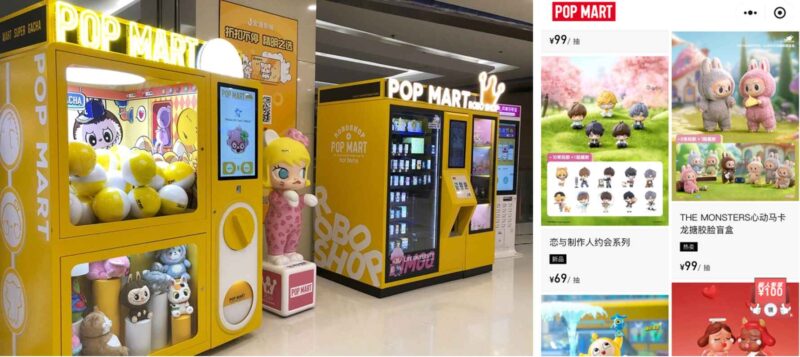
Two things explain it. First, scarcity ended. After a large restock in June 2025, Labubu resale prices fell fast: the hidden “Ben Wo” figure from the third-generation series went from close to RMB 5,000 to RMB 700-800 by September 2025, Cailian Press found, and by January 2026 Yicai reported that several Labubu series on Tmall shipped within 48 hours and some resold below list price. That hurt speculators and the share price, but it turned Labubu from an investment back into a RMB 99 purchase that ordinary buyers can actually make. Second, Pop Mart keeps adding reasons to visit: its POP LAND theme park reopened with four new zones, the POP BAKERY dessert brand opened its first store in Aranya, and wholesale and other revenue in China more than doubled to RMB 553 million.
The rise of emotional spending supports all of this. As we wrote in our analysis of China’s emotional purchase trend, young consumers buy small affordable items for comfort and belonging, and a RMB 99 Labubu blind box fits that budget better than most luxury goods.
About Daxue Consulting
- A market research and strategy consulting firm focused on China, founded in Beijing in 2012, with offices in Shanghai, Beijing and Hong Kong and more than 800 projects delivered.
- On this topic, we have published research on China’s collectible toys market, Pop Mart and the designer toy market, meng culture, emotional purchases and nostalgic IP and co-branding.
- Brands we have worked with include L’Oréal, Lancôme, Clarins, LVMH, Swatch, Ferrero and Decathlon.
- Our positioning: consumer understanding and brand positioning for international brands in China, from social listening on Xiaohongshu and Douyin to market entry and route-to-market.
Working on a character IP, a co-branding or a launch in China? Request a consultation with our team.
Competition: who can catch Pop Mart?
| Company | 2025 revenue | Growth | Gross margin | Model |
| Pop Mart | RMB 37.1 bn | +184.7% | 72.1% | Owned artist IPs (90%), own stores, app and roboshops |
| TOP TOY (MINISO group) | RMB 3.6 bn | +87.9% | 32.1% | Multi-brand toy retailer; own products above 55% of revenue |
| Bloks (布鲁可) | RMB 2.9 bn | +30.0% | 46.8% | Building-block figures, mostly licensed IPs such as Ultraman |
Sources: Pop Mart HKEX annual results; TOP TOY prospectus figures reported by Jiemian; Bloks 2025 results reported by Jiemian.
Gross margin shows how different the three models are. TOP TOY, which refiled for a Hong Kong IPO in March 2026, is a retailer that is building its own IP; Bloks rents most of its characters. Pop Mart owns its characters and its channels, so it keeps about 72 cents of every yuan after product cost. Nobody in the Chinese listed toy sector comes close to that today. The challenge is more likely to come from outside the toy category: anime and game companies, guochao (国潮) brands with cultural IP (see our piece on guochao and cultural confidence), and counterfeiters.
The main risks for Pop Mart
Concentration and fashion risk
THE MONSTERS fell from 38.1% to 26% of revenue, which reduces dependence; it also shows how fast a hit can cool. Analysts expected H1 2026 revenue of about RMB 20 billion and adjusted profit of RMB 6.7 billion, per the 21st Century Business Herald, and the company missed both. Shares closed down 22.19% at HK$169 on the day of the 2025 results, according to Cailian Press, after peaking at HK$339.8 in August 2025, per Yicai. Broker views are split: Morgan Stanley kept an overweight rating with a HK$214 target, calling the overseas online drop a one-off reset, while China Merchants Securities International kept a sell rating with a HK$127 target.
Inventory and currency
Inventory turnover rose from 123 days at the end of 2025 to 201 days in June 2026, with stock built ahead of overseas store openings, per the interim results. Write-downs remain small (RMB 23 million), but slower sales abroad would raise them. Exchange losses of RMB 720 million, against a RMB 120 million gain a year earlier, cut profit sharply. Excluding foreign exchange, profit before tax grew about 24%, broadly in line with revenue (our calculation), which makes the profit miss look less operational than the headline.
Counterfeits and regulation
Chinese customs intercepted 1.83 million suspected infringing Labubu products between January and late August 2025, Wang Jun, deputy head of the General Administration of Customs, said in August 2025, as reported by Jiemian. Fakes damage the brand where Pop Mart has few stores to set the reference. On regulation, the State Administration for Market Regulation’s 2023 blind box guidelines ban sales to children under 8 and require guardian consent above that age. A China News Service investigation in July 2026 found the age limits widely ignored by sellers. Tighter enforcement would touch Pop Draw and roboshops first, though with a buyer base of young adults the revenue impact should be limited.
Daxue Take
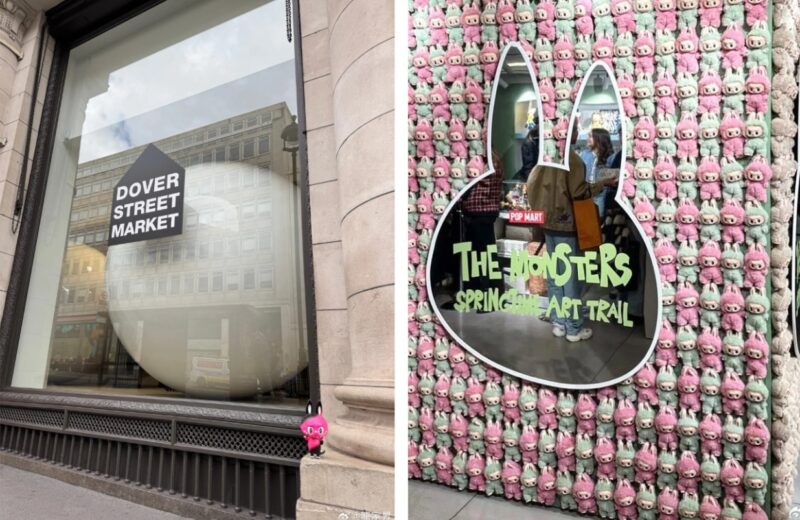
Pop Mart’s choices remind me of several things I wrote on LinkedIn this year. In July 2026 I wrote that companies in China rarely treat the light-asset versus heavy-asset question as “the structural choice it actually is.” Pop Mart’s overseas shift is exactly that choice: from Amazon, TikTok and its own app to flagship leases in places like Bangkok and Sydney, with two more planned on Times Square and Fifth Avenue in New York, and fixed costs that stay when the queues go.
In another July 2026 post I described brands building “a café, an immersive exhibition, a pop-up that is very soon forgotten,” and argued that few treat the next step, “teaching customers a skill or a code they keep,” as the structural move it should be. Pop Mart runs many exhibitions. Its strongest asset may be different: fans who know every series, every hidden figure and how to style a Labubu with a bag, a code they learned and keep. Writing about HOKA in September 2025, I noted that in China “timing and community matter as much as product,” and that a niche can be the way into the mainstream. Labubu followed that path, from collector circles to celebrity bags. The open question for 2027 is whether the mainstream stays once the niche feeling is gone.
Daxue Recommendations
According to our experience with international brands in China, three lessons come out of the Pop Mart story, and they apply well beyond toys.
- Own the place where buyers come back: a store, an app, a membership. A viral moment on Douyin or Xiaohongshu is a start, not a business.
- Rework the format before you look for new characters. Pop Mart grew in 2025 with existing IPs in a new form, the plush pendant.
- Keep your own data on sell-out. A brand selling only through distributors sees a downturn months after it starts.
The most useful part of the story is ownership. Pop Mart controls most of its value chain, from artist contracts to the app where members draw blind boxes, and that is why it could absorb a 7.5% fall in its biggest IP and still grow China revenue by almost half. Abroad, where much of the 2025 boom ran through social media and marketplaces it did not control, online sales fell 40% to 60% in a year. Many brands entering China plan exactly that kind of entry, a spike on Douyin or Xiaohongshu and the hope that it lasts. In our experience a spike pays off only when the brand already has a place, physical or digital, where the new buyers come back, and a brand selling through distributors also has less data to see a downturn coming.
A viral spike pays off only when the brand owns a place where new buyers come back. Pop Mart owned it in China, not abroad.
Format is cheaper to copy. Pop Mart did not need new characters to grow in 2025; it put existing ones into a wearable plush pendant. Brands with heritage IP, from luxury houses to museums, can ask the same question of their own assets, alone or with a partner, as our work on nostalgic IP in China and the Crocs strategy in China shows.
FAQ about Pop Mart’s market strategy
What is Pop Mart’s business model?
Pop Mart signs artists, develops their characters into owned IPs and sells them as figures, plush toys and other products through its own stores, roboshops, app and e-commerce flagship stores. Artist IPs made 89% of revenue in H1 2026.
How much does Labubu earn for Pop Mart?
THE MONSTERS, the series that includes Labubu, generated RMB 14.2 billion in 2025 (38.1% of revenue) and RMB 4.5 billion in the first half of 2026 (26.0%), down 7.5% year on year, according to Pop Mart’s HKEX filings.
Why did Pop Mart’s overseas revenue fall in 2026?
Overseas revenue fell 11.1% in H1 2026 because online sales dropped 40% to 60% across regions as Labubu’s popularity normalised. Offline sales grew 16% to 50% as Pop Mart opened stores, but not enough to offset online.
Who are Pop Mart’s main competitors in China?
Listed competitors include TOP TOY, owned by MINISO (RMB 3.6 billion revenue in 2025), and Bloks (RMB 2.9 billion), alongside 52TOYS and many smaller designer toy brands. Pop Mart’s 2025 revenue was more than ten times TOP TOY’s.
Is Pop Mart still growing in China?
Yes. China revenue (including Hong Kong, Macao and Taiwan) grew 47.3% to RMB 12.2 billion in H1 2026, with online sales up 62.7% and retail stores up 38.2%.
As a conclusion
As a conclusion, Pop Mart’s market strategy in 2026 has two halves that move in opposite directions. The IP portfolio is broadening, with Twinkle Twinkle and four other characters growing faster than Labubu fell, and the China business has never been stronger. The overseas business is in a costly transition from viral online sales to owned stores, with lower margins and higher inventory. If we were advising on the next 18 months, we would watch three numbers in the 2026 annual results: overseas revenue per store, inventory days, and the share of revenue from IPs launched after 2023. If those improve, the “adjustment year” will have been a pit stop, as Wang Ning put it in March, comparing the company to an F1 car stopping to “rest, refuel and change tyres”, per Sina Finance. If they do not, 2025 will have been the peak. Which of your brand’s assets could become a code your customers keep?
At Daxue Consulting, we follow Pop Mart because its trajectory shows how Chinese consumers reward a brand that keeps giving them new characters and new reasons to come back, and how quickly a hit cools once it becomes easy to buy. Our brand audit and consumer understanding projects look at the same questions this article raises: how a brand is perceived on Xiaohongshu and Douyin, how it is priced against local challengers, and which channels actually drive repeat purchases. For market entry and channel choices, see our business strategy services.
I founded Daxue Consulting in Beijing in 2012, and since then we have delivered more than 800 projects. Our mission is to guide businesses to holistic growth in China, through consumer research, market analysis, tech-enabled data collection and strategy consulting, with teams in Shanghai, Beijing and Hong Kong. Two of our values shaped this article: intellectual humility, which meant checking our own 2021 and 2025 views against Pop Mart’s filings, and the belief that knowledge is meant to be shared. If you are facing similar questions for your brand in China, contact our team.
About the author
Matthieu David-Experton is the founder and CEO of Daxue Consulting. He arrived in China in 2009, founded Daxue in Beijing in 2012 and lives in Shanghai. Since then his team has delivered more than 800 projects for international brands, from consumer understanding to market entry and route-to-market, and Daxue has written about Pop Mart since 2021. He studied at ESSEC and at Peking University’s Guanghua School of Management, hosts the China Paradigm podcast and writes regularly on retail and channels in China on LinkedIn.