

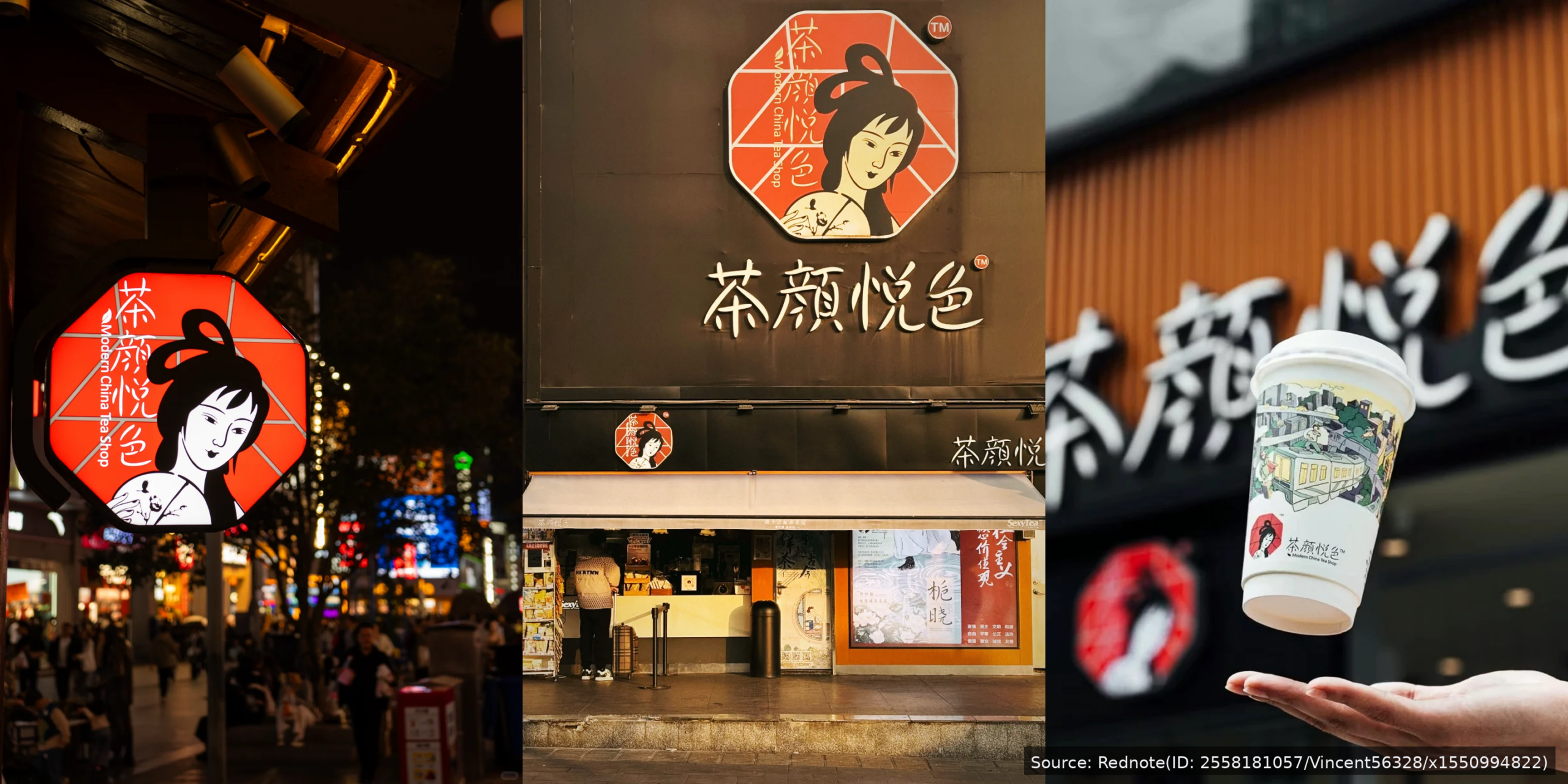
Chayan Yuese (茶颜悦色), the Changsha tea brand that retired its English name Sexy Tea in 2022, ran 734 stores as of April 2026, every one of them operated by the company itself, and more than half of them in its home province of Hunan. In April 2026, Mixue (蜜雪冰城) counted 44,836 stores and CHAGEE (霸王茶姬) passed 7,000. Both grew through franchising, and both became public companies in 2025. The market they all compete in is big and nearly full. China had 449,000 tea-drink stores at the end of 2025, 3.5% more than a year earlier, and Hongcan Big Data put the year’s sales at an estimated RMB 187 billion, up 6.4%. Whether Chayan Yuese’s choice is a mistake or a defense of the brand decides what other food and beverage brands should copy from it.
| Brand | Stores (April 2026) | Revenue | Net profit | Growth model |
| Chayan Yuese | 734 | About RMB 3 billion (2024, reported) | About RMB 450 million (2024, reported) | All stores self-operated, private company |
| Mixue | 44,836 | RMB 33.56 billion (2025) | RMB 5.88 billion (2025) | Franchise, listed in Hong Kong |
| CHAGEE | 7,099 | RMB 12.91 billion (2025) | RMB 1.19 billion | (2025) Franchise, listed on Nasdaq |
A brand built on queues and defended in court
Queues built this brand, and people still line up whenever it enters a new city. Chayan’s first store outside Hunan opened in Wuhan in December 2020, with an official queue estimate of eight hours, scalpers charging RMB 500 a cup on opening day, and a WeChat search index that tripled in a day. In April 2026, its third entry into Shenzhen still drew queues of over six hours, with scalpers charging RMB 88. Almost all stores sit in one province, so people who cannot buy the tea at home line up when they travel and post about it, and the posts reach cities the brand never entered.
Courtcases over brand name and the rather risky English name itself
A Guangzhou company sold tea under the lookalike name Chayan Guanse (茶颜观色) for years, so the product itself is easy to copy. The company’s real asset is the name and the city behind it. It sells Chinese-style fresh tea at RMB 15 to RMB 18, and drinking one is part of visiting Changsha. Snacks, tea bags, and merchandise sell alongside the cup as souvenirs, which already brings in money beyond the counter. So it fought for the name in court, winning RMB 1.7 million in a 2021 unfair-competition ruling and getting the copycat’s trademark declared invalid in 2022, the same year it retired its own risky English name Sexy Tea. Yet the pop-up that drew 50,000 queue tickets in 2021 closed within months, and by 2026 business media described the brand as past its peak. A queue proves attention. Whether attention turns into steady sales is still an open question.
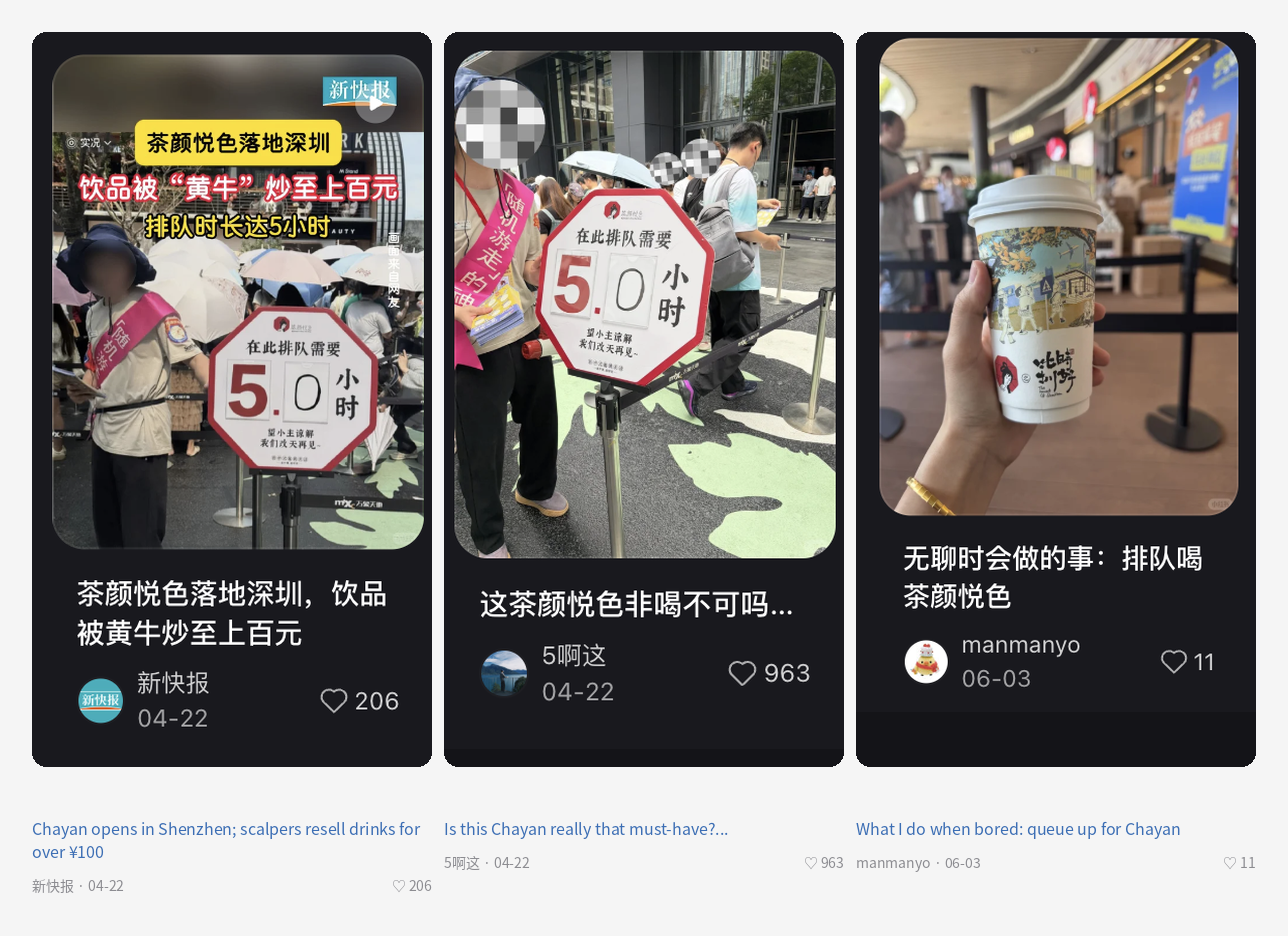
Source: RedNote, designed by Daxue Consulting, Chayan’s Shenzhen opening queue posts
The expansion stopped, and the profit stayed flat
A chain that never franchises will always open stores slowly. Chayan Yuese ended 2023 with fewer than 600 stores. By January 2025 it had about 757, more than 150 new stores in one year. By April 2026 it had 734. In fifteen months, it added almost nothing. Money is an unlikely reason, since its reported profit runs around RMB 450 million a year. Thus, either it slowed down on purpose to stay scarce, or new stores failed and closings cancelled out openings. The public record does not say which. But the company entered Shenzhen again in April 2026, so it still wants new cities. That makes the second reading more likely. The pause also left a door open at home. By the end of 2024, CHAGEE had opened more than 110 stores in Hunan, selling Chinese-style tea in the province that made Chayan Yuese famous.
The profit is just as flat. Media reports put net profit at about RMB 500 million in 2023 and RMB 450 million in 2024, on revenue of about RMB 3 billion. The company is private and publishes no numbers of its own. Mixue listed in Hong Kong in March 2025 and reported RMB 33.56 billion in 2025 revenue, up 35.2%. CHAGEE listed on Nasdaq in April 2025 and earned RMB 1.19 billion in net profit in 2025, a year when its profit fell 52.4%. The two revenue figures are hard to compare, since a franchise chain sells supplies to franchisees rather than tea to drinkers. Profit is the cleaner measure. Even in its worst year, CHAGEE earned more than twice what Chayan Yuese reportedly earned in 2024. One thing does favor Chayan Yuese. Its profit barely moves, while CHAGEE’s halved in one year. A flat profit can be stagnation, or it can be a choice. A company owned only by its founders can settle for steady money, and since June 2024 that is exactly who owns Chayan Yuese. The brand is famous and stable. It has not yet shown it can grow.
The growth is now made elsewhere
Opening stores one by one grows profit slowly. In 2023 the company reportedly earned about RMB 500 million with fewer than 600 stores, which puts profit per store at under RMB 900,000 a year, and the real figure is lower still, since the total also includes income from outside the tea stores. At that rate, even fifty new stores would add less than a tenth to profit. Thus, the company found two other ways to grow. The first is creating new names. By late 2024 it ran 101 coffee shops, 82 lemon-tea stores, and 21 teahouses under sub-brands, which took it into the coffee market in China, and in March 2025 the brand family passed 1,000 stores. No one outside the company knows whether these lines make money, since the sub-brands publish no numbers. The only public signal is that they kept opening through 2025. They also do not dilute the main brand. The new stores carry other names, so Chayan Yuese itself stays rare.
Online sales, heading overseas
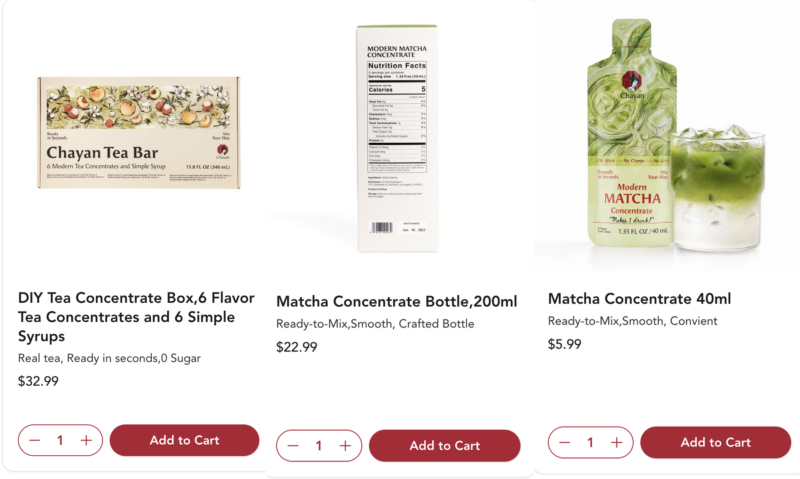
The second is goods. In September 2024 the company opened its first snack and grocery store in Changsha, stocking more than 150 retail products. In July 2025 it entered North America with no stores at all, selling snacks, tea, and merchandise on Amazon, TikTok Shop, Walmart, and its own site. Its bread snack sells there at about five times the China price. Part of that gap is import cost. The rest only holds if buyers accept it, and with no queue and no fresh tea behind the shelf, what they accept it for is the name. Goods also sidestep the store problem. A bag of snacks needs no lease and no staff, and it can sell in places where the company may never open a counter. For a brand whose store count barely grows, goods are the growth that costs it nothing it cares about.
IPO question
In June 2024, five institutional investors, Shunwei Capital and Source Code Capital among them, exited Chayan Yuese, and its shares went back to the structure it had before outside funding. That separates it from its rivals in one more way. Mixue and CHAGEE now answer to public shareholders, who expect growth every quarter. Chayan Yuese answers to its founders. An owner like that can keep the stores scarce and the profit flat for as long as it chooses, and no fund manager can force its hand. The same structure sets its limit. Listed rivals can raise money whenever they need it, while Chayan Yuese can only spend what its tea, its goods, and its sub-brands earn. For other brands, the takeaway is concrete. Choosing between scale and scarcity is also choosing whose money to take, and Chayan Yuese has now chosen no one’s.
Key takeaways on Chayan Yuese
- Chayan Yuese runs 734 stores while its franchised rivals run from 7,000 to more than 40,000, and every one of its stores is its own. That gap is the cost of opening every store with your own money.
- The queue is still the marketing. Shenzhen openings in April 2026 drew six-hour lines and RMB 88 scalper prices, six years after Wuhan queued eight hours, though the skip-the-line premium has fallen from RMB 500. Tight supply in one region can buy the attention that others buy with marketing budgets.
- The attention is real, and it has not become growth. The store count went from about 757 in January 2025 to 734 in April 2026, and reported profit slipped from about RMB 500 million in 2023 to RMB 450 million in 2024. A strong brand does not grow a business by itself. It needs products and channels that turn attention into steady sales.
- The real expansion happens away from the main brand. The brand family passed 1,000 stores through coffee and lemon-tea sub-brands, and the company sells snacks in North America at about five times the China price without a single store there. Sub-brands and goods let the main brand grow its business while staying rare.
- Since five investors exited in June 2024, the company’s shares are back to their pre-funding structure. That lets it accept flat profit for as long as it chooses, and it gives up the option its rivals took, raising money from the public. A brand choosing between scale and control is also choosing whose money to take.
Author: Ming Yii Lai, with additional research by Zekai Zhang