

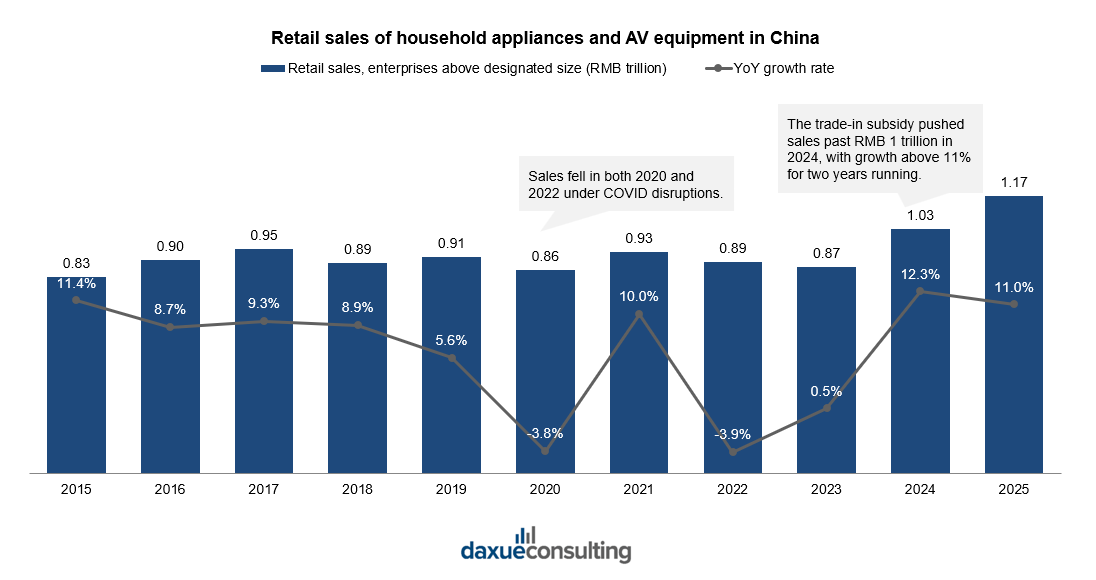
The household appliances market in China closed 2025 with two numbers pointing in opposite directions. The official large-retailer series of household appliances and AV equipment recorded RMB 1.17 trillion in 2025 sales, up 11.0% and a record. All-channel data shows the market itself shrank, with total appliance sales of RMB 893.2 billion, 4.3% below the 2024 total of RMB 933 billion. Trade-in subsidies had to be redeemed through registered retailers. This moved sales into the official series and pulled demand forward. The large-retailer series fell by double digits in every month of the fourth quarter of 2025. This divergence reflects subsidy redemption requirements, which concentrated sales in registered retailers rather than expanding total demand.
In 2026, Beijing renewed the program. The coverage was cut from twelve categories to six, and limited subsidies to high-electrical-efficiency models. Retail sales fell 6.9% from January to May 2026, against growth of 30.2% a year earlier. Air conditioners, the largest category, opened 2026 down 13.8%. Demand has moved from first purchases to replacement and upgrades, and smart features do most of the persuading. Exports turned positive, up 4.3% from January to May 2026, and Europe’s record-hot summer is lifting orders for Chinese air conditioners. The retail increment has moved from shelves to content commerce and instant delivery. 2026 demand.
The 2026 trade-in program for household appliances in China pays out without lifting sales
Beijing renewed the trade-in program for 2026 with a first tranche of RMB 62.5 billion, limited to six categories of top-efficiency models at 15% of the sale price. Range hoods, gas stoves, and dishwashers left the list. Through June 20, payouts covered 132.9 million units of appliances and digital devices combined. It was worth RMB 451.6 billion in sales, while appliance retail fell 6.9% from January to May. Appliances last around a decade, so a household that swapped its refrigerator at a discount in 2025 has left the market until the 2030s. The 2024 and 2025 rounds spent years of future demand in advance, and the 2026 round keeps redemptions flowing through a shrinking market.
January–May category results separate past subsidy intake from current subsidy status. Air conditioners, refrigerators, washing machines, and water heaters kept national support yet declined; with air conditioners down 13.8% in the first quarter, since the subsidized years drew the most replacement forward in these saturated categories. Range hoods and gas stoves grew after leaving the list in January, as renovation timing sets their replacement cycle and their 2025 base was low. Dishwasher sales declined sharply, confirming that subsidy dependence was highest where organic penetration remained low.
In short, each category’s 2026 performance follows how much of its future demand the subsidized years consumed. The support that remains shapes product mix. Top-efficiency models took 78.3% of first-quarter TV unit sales, and brands need qualifying versions of their volume models to keep access to the demand the program still funds.
The new-home channel shrinks on a schedule set in 2023–2025
Appliance demand from housing arrives when homes are delivered, so completions measure this channel directly. Housing completions fell 23.4% from January to May 2026, and residential completions fell 25.0%. The next three years are already booked. Homes completing through 2028 were sold and started between 2023 and 2025. New starts fell 22.6% over the same five months, so the delivery pipeline keeps thinning into 2028 and 2029. New-home sales fell 10.8%, and any recovery in sales reaches appliance purchases only after the two-to-three-year construction lag. Meanwhile transactions have moved to existing homes, which took 69% of housing deals in 30 tracked cities from January to May. Existing-home turnover feeds appliance demand through renovation, the same trigger that lifted range hoods in the category data above. For planning, the new-home channel is a measured and scheduled decline. The demand floor now sits on the appliances already installed in homes.
The smart home trend gives the appliance industry its second growth curve
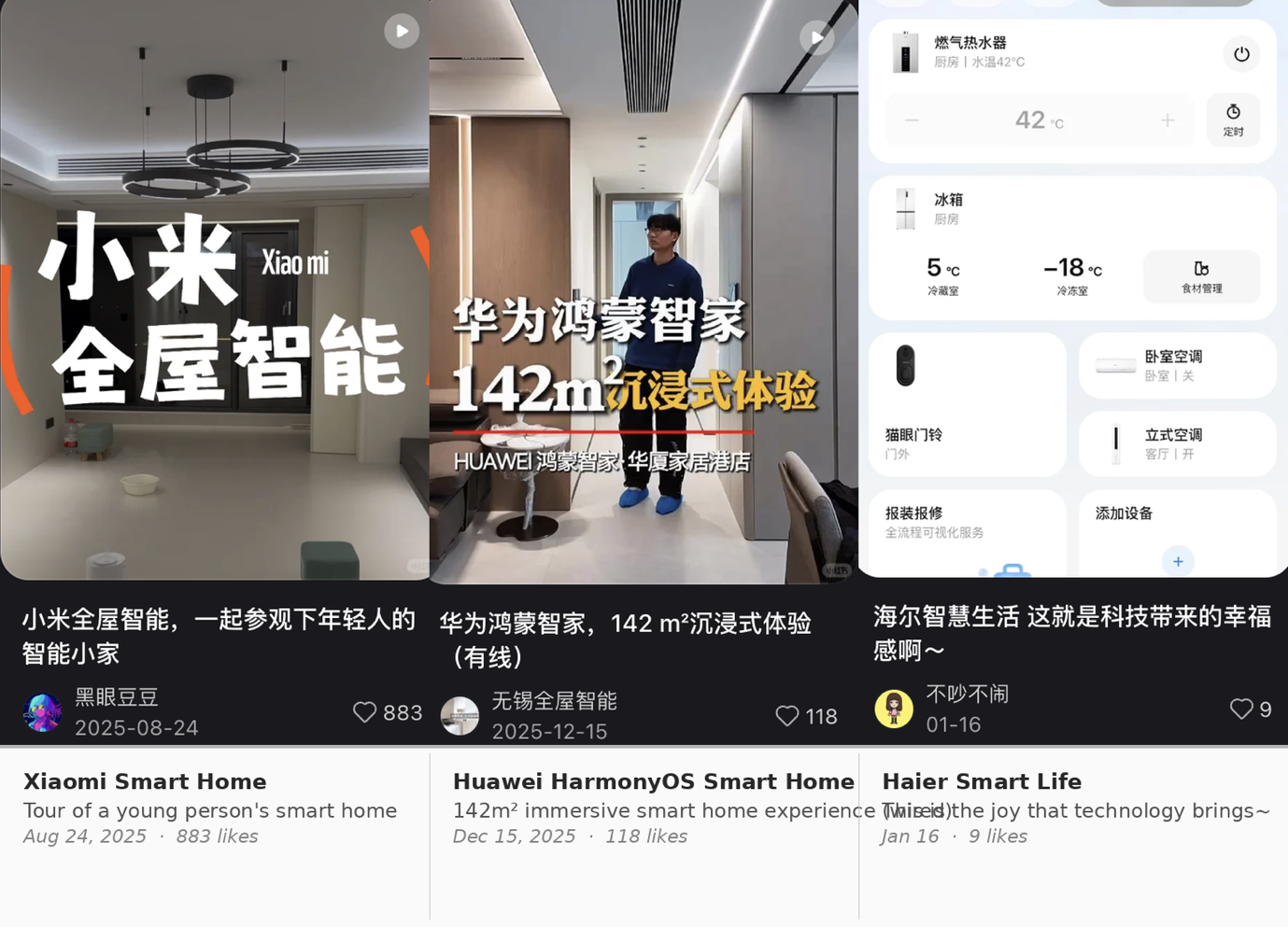
China’s appliance industry peaked as a hardware volume business during the subsidy years. Meanwhile, the remaining growth in the household appliances market in China runs through smart home, which Beijing manages as a strategic industry. The State Council’s AI Plus action plan sets smart terminal adoption targets above 70% by 2027 and 90% by 2030, with smart home listed among them. The December 2025 policy notice (发改环资〔2025〕1745号) added smart-home products to purchase subsidies. National standards now grade appliance intelligence from L1 to L5, and Haier, Midea, Hisense, TCL, Huawei, and China Mobile released a unified interconnection standard in March. The subsidy shapes demand, the grades rank products, and the interconnection standard makes brands work together.
Units now track replacement, so revenue growth comes from value per unit and from connected sets sold together. Basic connectivity has stopped earning a premium in lead categories. Smart models already take 69.4% of online air conditioner sales, while offline range hoods sit at 12.4% and hold smartening runway. A standards-body expert places most brands at L2 to L3, which leaves L4 and L5 products as the open pricing field. Interconnection turns one replacement purchase into a multi-device decision. The first products on the unified standard debuted this spring. For 2026 lineups the margin sits in L4-capable models, low-penetration categories, and bundles inside one ecosystem among Mijia (米家), HarmonyOS Connect (鸿蒙), or Haier (海尔)’s Three-Winged Bird.
Chinese household appliances are cooling off Europe’s record summer
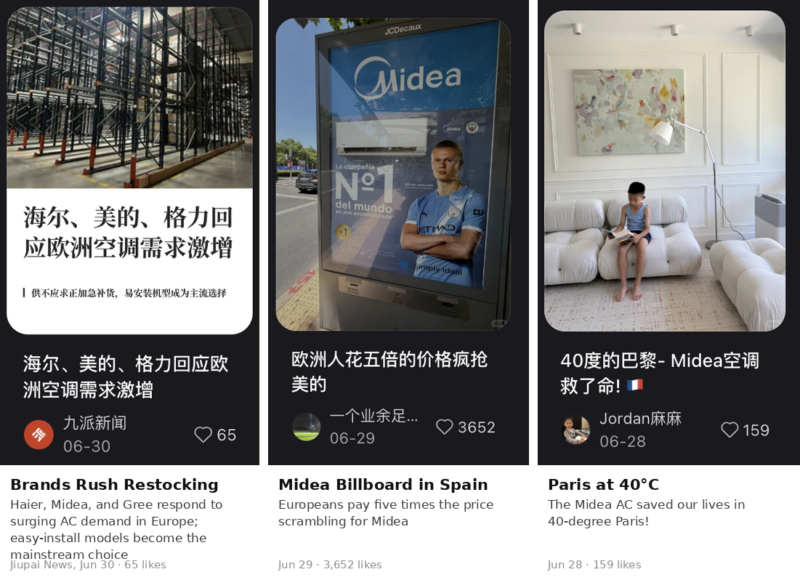
For the household appliances market in China, Europe’s second straight record summer is demand that domestic policy cannot create. And Chinese air conditioner brands captured it. Midea’s PortaSplit, a plug-in split unit built for European apartments where drilling rules and €1,000 installation fees block conventional systems, sold over 200,000 units this year, double the 2025 pace, with sellouts across Germany and France.
Sales through German e-commerce channels rose 37% in May, Midea’s shipments to Spain and France jumped 108%, and Chinese customs recorded exports to France, the Netherlands, and Belgium more than doubling from January to May. Europe’s five best-selling air conditioner brands all come from outside the EU, with Midea (美的), Haier (海尔), and Gree (格力) at the top.
Around 20% of European households own air conditioning, while the United States stands near 90%, so each hot season converts more of that gap into orders. The summer surge adds to growth already in place. Appliance exports grew 4.3% from January to May, Haier earned 51.1% of 2025 revenue overseas, Midea reached 42.9% with overseas sales growing 15.9%, and own brands make up 87% of Hisense’s overseas revenue. However, export margins remain exposed to euro volatility and shipping costs, which could temper profitability despite volume gains.
Key takeaways on household appliances market in China
- The 2026 subsidy pays for replacements that would have happened anyway. Retail fell 6.9% through May with payouts still flowing, so plans built on the 2025 curve overstate demand.
- Replacement demand sets the market’s floor. Housing completions fell 23.4% from January to May and the delivery pipeline keeps thinning into 2028, so demand comes from the appliances already installed in homes.
- Smart home carries the industry’s second growth curve. State targets put smart terminal adoption above 70% by 2027, and margin sits in L4-capable models and ecosystem bundles.
- Overseas markets supply the growth. Chinese brands hold the top of Europe’s air conditioner market this record summer. Overseas revenue reached 51.1% for Haier and 42.9% for Midea.
- The retail increment sits in content commerce and instant delivery. Channel budgets weighted to shelf retail will trail where new sales happen.
Author: Ming Yii Lai, with additional research by Zekai Zhang