


Updated on April 3, 2026
In 2025, Huawei booked RMB 880.9 billion in revenue and RMB 68 billion in net profit, nearly back to the level before the US sanctions. The company that started in 1987 with RMB 21,000 and a sales agent contract is now rebuilding its own chips, operating system and car business.
- Revenue: RMB 880.9 billion, up 2.18%, against a record of RMB 891.37 billion in 2020 (KrASIA).
- Net profit: RMB 68 billion, up 8.7%.
- R&D: a record RMB 192.3 billion, or 21.8% of revenue (TechNode).
- Cars: intelligent automotive solutions grew 72%, and 589,100 vehicles were delivered through its auto alliance, up 32%.
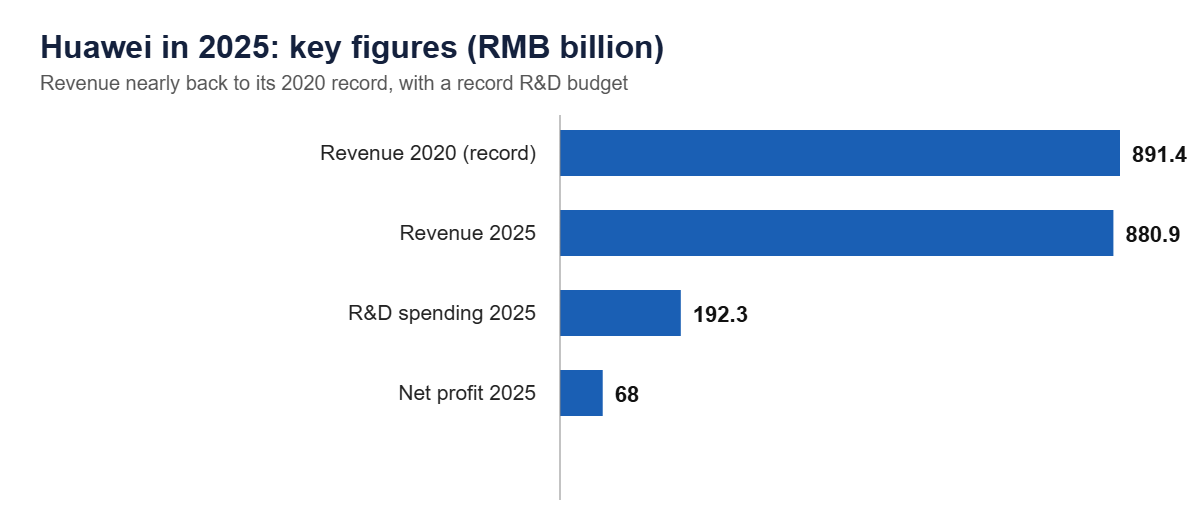
Huawei in 3 figures
- RMB 880.9 billion: revenue in 2025, with net profit of RMB 68 billion.
- RMB 192.3 billion: R&D spending, a record 21.8% of revenue.
- 36 million: devices running HarmonyOS 5 or 6 at the end of 2025, with more than 10 million registered developers.
How Huawei started: from a sales agent to a networking group
Huawei transformed from a small sales agent company to a multinational networking corporation in just 25 years. It became the largest telecommunications equipment maker, with 21 R&D institutions all over the world, including Europe and the USA.
About half of the 140,000 employees of Huawei were working in research centers around the world, including the USA, Europe, South America and Asia. At the end of 2013, the company recorded CNY 240 billion in revenue, more than 2 times higher than in 2012. Its products and services were sold in more than 140 countries, and it served 45 out of the 50 largest telecoms providers.
The company entered the market through innovation and technological firsts
The company was starting as a sales agent for a Hong Kong firm. It was founded in 1987 by the former military officer Ren Zhengfei, as a company owned by its employees, with an initial capital of RMB 21,000.
The milestones show how fast the group moved up:
- 1992: first own switch, the C&C08 digital telephone exchange;
- 1997: first overseas contract, with Hutchison Whampoa in Hong Kong;
- 2001: member of the International Telecommunication Union, with sales of US$552 million;
- 2004: start of branding overseas, with contracts from Vodafone and British Telecom;
- 2005: for the first time, foreign orders exceeded domestic sales;
- 2010: entry into the Fortune Global 500.
Huawei did strong investment in R&D from the beginning ,with new centers in Australia and India to strengthen the relationship with European countries. This is still the core of the model.
What changed after 2019: the sanctions and the rebuild
The US sanctions cut Huawei from advanced chips and from Google services on its phones. The effect on the figures is visible: revenue peaked at RMB 891.37 billion in 2020, and it took until 2025 to come back near that level.
The company answered in three ways:
- Own software: more than 36 million devices run HarmonyOS 5 or 6, and AppGallery offers more than 350,000 apps and services;
- New businesses: intelligent automotive solutions grew 72% in 2025, and more than 1.4 million passenger vehicles were equipped with Huawei ADS by the end of the year;
- Devices at the core: devices, including smartphones and wearables, still represent about 39% of revenue, up 1.6%, and overseas markets are about 30% of the total.
The Consequence is a different company from the one we described in 2013. It sold telecom equipment to carriers in 140 countries. Today the center of gravity is China, the consumer and the car..
“We are moving toward a future that is full of uncertainty, so we have to remain true to our strategy.”
Meng Wanzhou, rotating chairwoman of Huawei, on the 2025 annual report, quoted by KrASIA.
Three misconceptions about Huawei
- “The sanctions broke Huawei.” They broke the old model, not the company: revenue is back within 1.5% of its 2020 record, and net profit grew 8.7% in 2025.
- “Huawei is a phone brand.” Devices are about 39% of revenue. The rest comes from networks, computing, power and cars.
- “Huawei sells mostly abroad.” It did in 2005, when foreign orders passed domestic sales. In 2025, overseas revenue was about 30% of the total.
Daxue Take
What we see in our research is that Huawei is a case of a Chinese group that turned a political limit into an industrial plan. Here is how we would think about it for a foreign company.
- As a supplier: a foreign component maker may still sell to Huawei’s civil businesses, such as cars and power. The limit is the export rules of its own country, which can change.
- As a competitor: a foreign consumer electronics brand meets a rival that owns its chips, its software and its sales channels. It may be more realistic to compete on a niche than on the whole range.
- As a partner: HarmonyOS, with more than 10 million developers, may be a channel for apps and services in China. The limit is that it ties the app to one ecosystem.
What to watch next
- Huawei’s revenue in 2026 against the RMB 891.37 billion record of 2020.
- HarmonyOS devices after 36 million at the end of 2025, and the number of apps beyond 350,000.
- Deliveries of the Harmony Intelligent Mobility Alliance after 589,100 vehicles in 2025.
- Related reading: Huawei and Xiaomi and Huawei in the European market.
- Our own work on technology groups: see our China market research services.
FAQ about Huawei
How did Huawei start? In 1987, in Shenzhen, with RMB 21,000 and a sales agent contract for a Hong Kong firm. It was founded by Ren Zhengfei, a former military officer.
How much did Huawei earn? RMB 880.9 billion in revenue and RMB 68 billion in net profit in 2025, according to its annual report.
How much does Huawei spend on R&D? RMB 192.3 billion in 2025, a record 21.8% of revenue.
What is HarmonyOS? Huawei’s own operating system. More than 36 million devices ran version 5 or 6 at the end of 2025.
About Daxue Consulting
Daxue Consulting is a market research and strategy consulting firm focused on China, founded in Beijing in 2012, with offices in Shanghai, Beijing and Hong Kong. We have delivered more than 800 projects for international brands. To discuss technology strategy in China, see our market research services or contact our team.