
A foreign company that hires a consulting firm in China in 2026 is usually buying answers to three questions: where in China its product has a real market, how much of the business it should own, and which channels deserve the budget this year. The third answer changes faster than most head offices plan. Daxue Consulting has worked on these questions for foreign brands since 2012, from offices in Shanghai, Beijing and Hong Kong, through market research, consumer understanding, strategy and route-to-market work.
What does a consulting firm in China do for a foreign company?
Consulting in China covers two jobs that are often sold separately in Europe or the US: research (what is the market, who buys, through which channels, at what price) and strategy (what to do about it, in what order, with which partners). For a foreign company the two are hard to split. A market entry plan built on desk research from headquarters tends to miss the local challenger that took the category two years ago, or the channel where most of the volume now sits.
At Daxue, the work falls into five service lines, each with its own page: China market research, customer understanding, business strategy (which includes China market entry), management consulting and branding. In my June 2026 post marking the firm’s 14th year, I listed what the 800+ projects since 2012 have covered: “consumer understanding, market entry, market acceleration, where-to-play / how-to-play projects, growth models analysis, brand positioning, learning expeditions.”
Why foreign companies still need outside help in China in 2026
Foreign companies keep arriving, with less money each. China registered 70,392 new foreign-invested enterprises in 2025, up 19.1%, while the foreign capital actually used fell 9.5% to RMB 747.7 billion, according to Ministry of Commerce data. The first half of 2026 followed the same pattern: 31,617 new foreign-invested enterprises, up 5.3%, and foreign capital used down 5%, as reported by Yicai.
| Indicator | Figure | Source |
| New foreign-invested enterprises, 2025 | 70,392 (+19.1%) | Ministry of Commerce via China Daily, Jan. 2026 |
| Foreign capital actually used, 2025 | RMB 747.7 billion (-9.5%) | Ministry of Commerce via China Daily, Jan. 2026 |
| New foreign-invested enterprises, H1 2026 | 31,617 (+5.3%) | Yicai, July 2026 |
| EU Chamber members saying business got harder | 68% | China Briefing on the EU Chamber 2026 survey |
| EU Chamber members ranking China top-3 for current investment | 53%, a record low | China Briefing |
| Online share of retail sales of physical goods, 2025 | 26.1% | National Bureau of Statistics, Jan. 2026 |
Divide one Ministry of Commerce figure by the other and the average new foreign-invested enterprise brought about RMB 10.6 million of capital in 2025, against roughly RMB 14 million in 2024 (our calculation, using the published growth rates to rebuild 2024). That is a drop of about a quarter in one year. More foreign companies are coming in, each with less capital on average.
More foreign companies set up in China in 2025, about 70,000, but each came with roughly a quarter less capital than a year before.
Sentiment is mixed. In the EU Chamber’s 2026 business confidence survey, 68% of members said doing business in China had become harder, yet the share reporting a worsening environment fell for the first time since 2021, China Briefing reports. Competition from private Chinese companies was the second most cited challenge, at 47%. In our consumer research we often see the same thing from the shopper’s side. The foreign brand is compared with a domestic one that is cheaper, quicker to launch and often better at social commerce.

Light or heavy: decide how much to own before deciding how to sell
The first strategic question is ownership. Should a company own its stores, its factory, its team and its data in China, or rent them through a partner? I raised it on LinkedIn on July 6, 2026, arguing that companies rarely frame it properly: “Few treat it as the structural choice it actually is.” I used Gap, Volkswagen, Estée Lauder, L’Oréal and BASF as examples. Three of them sit at very different points on that scale.
Gap went light. In February 2023, Baozun took over Gap’s business in mainland China, Hong Kong and Macau, running its stores and online shops under a franchise. Gap said the sale would move it to “a more asset-light, cost-effective model,” Retail Dive reported, for a primary consideration of USD 40 million. Volkswagen chose a middle route: in July 2023 it paid about USD 700 million for 4.99% of XPeng and agreed to co-develop two electric models for China, targeted for 2026. That price put XPeng at about USD 14 billion (our calculation). BASF went heavy. Its Zhanjiang Verbund site in Guangdong cost about EUR 8.7 billion, employs more than 2,000 people, and most of its output will go to customers in China.
None of the three choices is right in general. Each fits a view of how long the company expects to stay, how fast its category moves and how much local know-how it can build in-house. In our market entry work this is often the question clients have not asked themselves explicitly, and it shapes everything after it: who owns the consumer data, who sets prices during a livestream, who carries the stock when a channel collapses. Our 2023 analysis of joint ventures in China looked at the same trade-off from the partnership side.
Route-to-market in China: why channel plans age in months
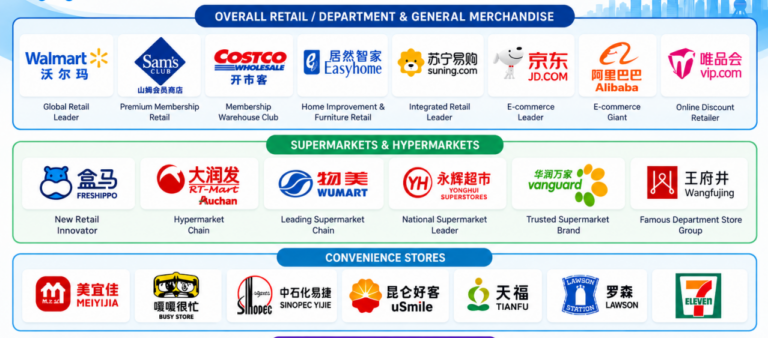
The second question is where to sell, and the answer moves. Pangdonglai (胖东来), a grocery and department store group with a little over ten stores in two Henan cities, passed RMB 20 billion of sales by November 8, 2025, against RMB 17 billion for the whole of 2024, according to Jiemian, citing the company’s own figures. That works out at more than RMB 1 billion per store (our calculation). Yonghui (永辉超市), long a national reference in supermarkets, closed 381 stores in 2025 and rebuilt hundreds more on the Pangdonglai model; it forecast a net profit of about RMB 250 million for the first half of 2026, back in the black, as Beijing Daily reported.
I wrote about this reversal on LinkedIn on September 10, 2026. Yonghui “was THE retail chain when I arrived in China in 2009.” My conclusion then is the one we apply to route-to-market projects: “The channels worth prioritizing shift faster than most multinationals can update their strategy, and the line between offline and online has essentially disappeared.”
The official data back the second half of that sentence, with a twist. Online sales of physical goods reached 26.1% of retail sales in 2025, per the National Bureau of Statistics. So about three quarters of retail still happens offline, and that offline share still grew by about 3% (our calculation). The store matters, but its sales are now shaped by instant retail apps, livestream prices and membership clubs. Our route-to-market analysis goes into these mechanics, and our guide to distribution in China covers the partner side.
How Daxue Consulting approaches a China project
Our method rests on two questions, “where to play” and “how to win.” The first covers the choices made before spending: market sizing, segmentation, product and market fit, which cities and which consumers. The second covers execution: channels, pricing, naming, messaging, partners. A project can cover one side or both, depending on what the client already knows.
Market entry and market potential
A China market entry project at Daxue usually runs in three steps: an external market assessment (competitors, value chain, consumer and channel trends, market sizing), strategic planning (target segments, value proposition, localization, marketing mix, partner strategy) and an action roadmap for the first two to three years, with investment scenarios and revenue models. Concept testing with consumers, retailers, importers and experts happens before launch, when it is still cheap to change course.
Consumer understanding
Many launches that disappoint in China rest on an assumption about the consumer that nobody tested locally. Our consumer research combines surveys, focus groups, in-depth interviews, online diaries, ethnography and sentiment analysis on Chinese social media. We also work well beyond Shanghai. For our 2025 emerging-tier market report, as I wrote in October 2025, “We scraped and analyzed millions of social media posts from lower-tier cities.”
Strategy, route-to-market and partners
Business strategy work covers channel prioritization, distributor and supplier screening, pricing architecture, business plans and turnaround. On route-to-market projects we map each partner’s roles and responsibilities (wholesalers, key accounts, O2O platforms, livestream agencies, membership clubs, discount chains) and decide which ones the brand should own and which it should rent. Learning expeditions and retail visits put executives in front of Chinese retail formats in person.
Management consulting and branding
Once a company is operating, management consulting covers operational questions such as lean management, employee engagement surveys and crisis management. Branding covers Chinese brand naming, brand positioning, brand equity, IP collaborations and brand books. The full list of research tools is on our methodologies page.
Daxue Consulting case studies in China
These cases are published on our site. Each starts from a different business question.
| Client or sector | Question | What Daxue did |
| Carambar Terry’s | Should we enter China’s chocolate market? | Market attractiveness, consumer segments, product-market fit, an 18-month entry roadmap with investment and ROI targets |
| Functional beverage company | How do we enter and sell? | Competitor benchmarking, retail visits, expert interviews, social listening and focus groups for positioning, channels and budgets |
| Prestige fragrance brand | What is our route into mainland China? | Market potential, competitor and consumer research, go-to-market strategy and a five-year business plan |
| Andros | Which new products will Chinese consumers want? | Social listening, consumer diaries, focus groups and nine concept tests |
| Uruguay’s National Meat Institute (INAC) | Where can Uruguayan beef grow in China? | 40+ industry interviews, a survey of 1,000 imported-beef consumers, e-commerce data analysis |
| Global automotive supplier | What do Chinese drivers expect from car interiors? | Industry research, expert interviews and focus groups to define consumer segments |
Other client stories, including L’Oréal, Camus Cognac, L’Occitane, Clarins and Ubisoft, are on our clients page.
What Daxue said about entering China in 2014 and 2023, and what still holds
In 2014 our page on how to enter the China market listed the classic barriers for foreign producers: asymmetric information, the wrong entry strategy, no access to distribution, unreliable partners and cultural distance. It also warned that most foreign firms chose indirect distribution through local intermediaries, and that each intermediary added to the shelf price. In 2023 we wrote that joint ventures still made sense for access to local talent, suppliers and regulators, but came with risks of unequal control and conflicting goals.
| What Daxue said | When | Status in 2026 |
| Information asymmetry is the first barrier | 2014 | Still true, though the gap is now about speed more than access: data exists, but goes stale within months |
| Intermediaries raise prices and weaken control | 2014 | Truer than before: livestream pricing and instant retail now set prices the brand does not control |
| Most foreign firms rely on indirect distribution | 2014 | Still common; Gap handed its whole China business to Baozun in 2023 |
| Joint ventures give access to local know-how and networks | 2023 | Still true, with a new twist: foreign firms now buy technology from Chinese partners, as Volkswagen did with XPeng |
| Joint ventures carry risks of unequal control | 2023 | Unchanged; it is the price of the light-asset route |
The point that aged best is the warning about intermediaries. The point we underestimated in 2014 was how fast Chinese competitors would catch up. We wrote then about foreign producers competing with each other in China; today the strongest rival in many categories is a domestic brand.
My view as Daxue’s founder
I arrived in China in 2009 and founded Daxue in Beijing, where the first clients came in 2012. “Back then, WeChat was just a few months old,” I wrote in June 2026. Two of my recent posts apply directly to anyone hiring a China consultant this year.
The first is my September 2026 post on Pangdonglai and Yonghui. Its point: “That kind of reversal is exactly why route-to-market planning in China has gotten harder to pin down.” A channel plan written in a head office in March may be out of date by Double 11. The second is the July 2026 post on light versus heavy assets discussed above. Put together, they describe a China strategy that fixes the long-term commitments (how much to own, which consumers to serve) and revisits the channel mix often.
Plan the long-term commitments once and the channel mix often. In China, a channel plan written in March can be out of date by Double 11.
I have also warned against copying the market. In July 2026 I wrote that over three years I had “watched brand after brand answer this by building the same thing: a café, an immersive exhibition, a pop-up that is very soon forgotten.” Our article on brand education in China develops the alternative.
Our consulting teams in Shanghai, Beijing and Hong Kong
Daxue Consulting works from three offices, plus a commercial representation in Singapore, South Korea and France. Participant recruitment, fieldwork and analysis are managed in-house. With more than 30 full-time project managers and connections across the country, we cover all of China for data collection.
| Office | Address |
| Shanghai | Room 901, Pan Pacific Building, No. 1250 Beijing West Road, Jing’an District, Shanghai |
| Beijing | Dongzhong Jie #40, Dongcheng District, Beijing |
| Hong Kong | 33 Hillier St, Sheung Wan, Hong Kong |
Phone: +86 21 5386 0380. Email: dx@daxueconsulting.com.
Why companies choose Daxue as their China consulting firm
Research and strategy sit in the same team, so the recommendations come from the people who ran the fieldwork. Our project managers are local Chinese, overseas-educated Chinese and China-educated foreigners, which helps when a finding from a focus group in Chengdu has to be explained to a board in Paris or Chicago. We have worked in beauty, apparel, automotive, luxury, food and beverage, pharmaceuticals and B2B industries. And a market entry study with us can end in a no-go; sometimes that is the most useful answer a client gets.
Where we would start in 2026
If you are planning a first entry, start with the ownership question before the marketing plan. Decide which assets you need to control in China (pricing, consumer data, product development) and which a partner can carry, and write it down; it will decide your partner contracts. Then size the market by city tier and channel, not only nationally. A product that works in Shanghai can be invisible in Luoyang, and the reverse is more common than head offices expect.
If you are already in China and growth has stalled, look at the channel mix first. Check where your category actually sells today, including instant retail, membership stores and discount snack chains, and compare it with where your distributors are paid to sell. Our working hypothesis in such cases is that the gap between the two explains much of the slowdown. Then listen to consumers again. The local competitor that took your share probably answered a complaint that sits in your own product reviews.
In both cases, plan the long-term commitments once and the channel mix often. We would review the route-to-market at least once a year, and after any major shift such as a key account closing stores or a platform changing its fees.
Planning to enter China or rethinking your channels? Daxue Consulting runs market entry, consumer research and route-to-market projects from Shanghai, Beijing and Hong Kong. Contact our team for a proposal.
FAQ about consulting in China
What does a China consulting firm do?
It helps foreign companies decide whether, where and how to sell in China. Typical work includes market sizing, consumer research, competitor benchmarking, market entry strategy, route-to-market and partner selection, branding and Chinese naming, and operational support once the business is running.
How much does a China market entry study cost and how long does it take?
It depends on scope: the number of cities, the research methods (desk research, interviews, surveys, focus groups) and whether the deliverable is a go or no-go decision or a full roadmap. Each Daxue proposal sets out the scope, timeline and budget. Write to dx@daxueconsulting.com with your question and target market.
Which cities does Daxue Consulting cover?
All of China. The teams work from Shanghai, Beijing and Hong Kong, and fieldwork (interviews, focus groups, store visits, surveys) is run wherever the target consumers live, including lower-tier cities.
Should a foreign company enter China alone or with a partner?
It depends on how much control the company needs over pricing, consumer data and product, and on how long it plans to stay. Gap handed its China business to Baozun in 2023; Volkswagen bought a stake in XPeng; BASF built its own EUR 8.7 billion site. Each fits a different strategy. A market entry study should compare the options before any contract is signed.
What is route-to-market in China?
Route-to-market is the set of channels and partners that bring a product from the brand to the consumer: distributors, wholesalers, key accounts, e-commerce platforms, instant retail apps, livestream agencies and membership stores. In China the priority between them changes quickly, so the plan needs regular review.
In conclusion
In conclusion, a China consulting project in 2026 has to settle how much to own, which consumers to serve and which channels to fund this year, knowing the channels may change next year. Foreign companies keep arriving, about 70,000 new entities in 2025, but with lighter structures and less capital each. We would advise any of them to settle the ownership question first, size the market by tier and channel, and review the route-to-market at least once a year.
Daxue Consulting is a market research and strategy consulting firm focused on China, working with foreign companies since 2012. Our mission is to guide businesses to holistic growth in China, through consumer research, market analysis, tech-enabled data collection and strategy consulting, from our offices in Shanghai, Beijing and Hong Kong. Two of our values shaped this article: intellectual humility, which meant checking what we wrote in 2014 and 2023 against today’s market, and the belief that knowledge is meant to be shared. Tell us about your project and we will come back with a market entry or research proposal, or write to dx@daxueconsulting.com. You can also explore our China market research services.
About the author
Matthieu David-Experton is the founder and CEO of Daxue Consulting. He arrived in China in 2009, founded Daxue in Beijing in 2012 and lives in Shanghai. Since then his team has delivered more than 800 projects for international brands, from consumer understanding to market entry and route-to-market, and Daxue has written about entering the China market since 2014. He studied at ESSEC and at Peking University’s Guanghua School of Management, hosts the China Paradigm podcast and writes regularly on retail and channels in China on LinkedIn.