
The pace of change and the intertwining of online and offline sales make China route-to-market projects all the more complex in 2026.
1. The retail landscape is being constantly redrawn
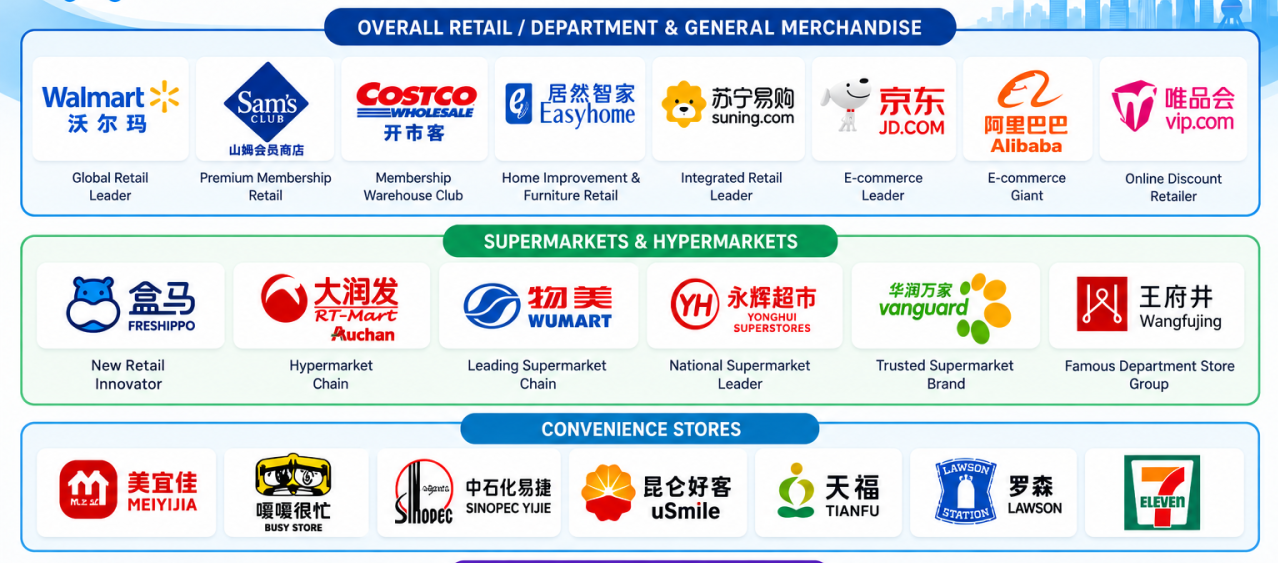
Things are changing fast in retail in China. Pangdonglai (胖东来 in Chinese), a provincial grocery chain from Henan, which was unknown outside of China only 3 years ago, has become a national reference for how retail should be thought of in 2026. On the other hand, the well-established Yonghui (永辉超市) has closed hundreds of stores while its profit ultimately soared. Sam’s Club (山姆), while maintaining high standards for brands and keeping tight margins, keeps its momentum and is a main sales channel for many of our clients even thought it only has 50 locations in China. Snack discount chains like Mingming Hen Mang (鸣鸣很忙) have crossed 14,000 stores and Hao Xian Lai (好想来) has opened more than 20,000 in just three years (half of Starbucks locations worldwide). The hierarchy of “must-win” channels in China shifts fast, often faster than large multinationals can keep up with.
For Daxue Consulting’s team, that means RTM projects need to be articulated between the principles of deployment (R&R, channels, margin share, etc.) and the tactical and more frequent adjustments that need to be anticipated.
2. Offline cannot be thought of separately from online instant retail (即时零售) anymore
Through Meituan Shangou (美团闪购), JD Daojia (京东到家), and Hema (盒马), a bottle of shampoo bought at 11 pm is delivered by 11:30 in a city like Shanghai. Brands that measure distribution on a purely numerical basis are missing a significant share of where their category sales actually happen, and the gap with weighted distribution (the actual reach) keeps widening. In other words, considering offline retail is not about foot traffic; it is largely about density of residential population. Approaching offline RTM without considering O2O means missing the fastest-growing segment.
3. The role of the offline store has shifted
In China’s emerging-tier cities (let’s say beyond tier-3 if we align on the definition of the various tiers), especially where retail is not as high-end as in higher-tier cities, visiting a hypermarket, supermarket, or the main commercial street is still a proper leisure outing. Whether in high- or low-tier cities, offline shopping today is about discovery, tasting, limited editions, content for social media, and exploring gifting options. Our recent article on shopping malls in China shows it: the malls that activate experiences are outperforming the competition. This offline presence influences online sales at the same time. Looking at past data of clients, we found out that the closure of shops or the offline delisting from some points of sales converted in poorer online sales in the vicinity.
4. Live streaming is challenging pricing architecture
A live stream on Chinese social media platforms like Douyin or Taobao Live can affect your suggested retail price offline as well as instant retail, such as through bundles, gifting SKUs, “exclusive” samples, and time-limited promotions. Distributors ultimately get reduced margin expectations, KA buyers will negotiate with the brands, and the same brand needs to deal with various price points that it does not control.
In conclusion, every partner’s role needs to be defined, and most importantly, monitored. R&R (Roles and Responsibilities) as well as the digitization of engagement with different layers of the value chain (onboarding, repurchase, KYC on the final consumers, etc.) are key topics and need to be considered for offline and online topics.
Wholesalers, distributors, modern trade KAs, O2O platforms, instant retail aggregators, live stream MCNs, membership clubs, discount chains — the R&R matrix needs to be all the more creative and tailor-made for each channel while keeping the overall structure in view. Adapting the distribution architecture does not mean jumping in the last wave but it means to articulate the various options a brand has to leverage the partners’ assets properly.
Author: Matthieu David, edited by Sory Park