
For most of the past fifteen years, the real contest in China’s sports footwear market was between Nike and Adidas. That has changed. China’s sports footwear market reached RMB 229 billion in 2024, and the brands competing for it look nothing like they did a decade ago. ANTA Sports, the company behind FILA’s premium sneakers and Kolon Sport trail shoes, reported RMB 80.2 billion in revenue in 2025. Nearly all of which was earned at home, while Nike’s Greater China business made USD 6.6 billion and slid 13% from the year before.
The easy reading is that Chinese shoppers have turned away from foreign brands. Yet, ANTA’s own numbers say otherwise: the ANTA label brought in RMB 34.8 billion. Under half the group’s total, with the rest coming from brands it acquired or licensed. On, the Swiss running brand, grew its Asia-Pacific sales 101% year over year in the second quarter of 2025 with China as the main engine. The real divide is not foreign versus local. It is one company spreading across every price tier with a portfolio of international brands, while Nike relies mostly on one.
For most of 2021 and 2022, Nike and Adidas were losing China together. Both saw revenue fall and faced consumer backlash from the Xinjiang cotton controversy. These brands watched domestic brands move upmarket and take market share. Since then, their paths have split completely. Nike’s Greater China revenue fell 13% in fiscal 2025, continuing a decline that has run for several years. Adidas grew its China business 13% the same year, its fastest rate of any major market. The same headwinds hit both brands. That one recovered and one did not suggest the headwinds were not what determined the outcome.
Nike’s decline is structural
Nike’s China troubles built over several years through decisions that made sense on a global balance sheet but backfired in practice. Around 2020, under CEO John Donahoe, Nike began pulling back from wholesale distribution to push customers toward its own stores and app. In China, this meant cutting ties with Topsports and Pou Sheng. These retail networks had built Nike’s presence in lower-tier cities. About 70% of China’s population lives outside first-tier markets. Those relationships, once abandoned, did not come back easily.
Nike’s China revenue share slid from 18.6% to 14.2% between 2021 and 2025, while its market share in the country slipped from 25% to 24% as ANTA grew from 14% to 19% over the same period. On the product side, Nike’s marketing in China has long depended on the Jordan brand. It has carried real cultural weight for the generation that grew up watching Michael Jordan in the 1990s. That connection fades with Gen Z consumers who did not, and who found domestic brands more immediately relevant to their lives.
Nike was also late to the platforms where Chinese shoppers actually spend their time: its Douyin flagship only opened in 2024, years after competitors had established themselves on the app. The brand went from trendsetter to struggling to adapt to shifting consumer demand. When the 2021 Xinjiang boycott hit on top of all this, it landed on a brand already structurally weakened. The damage has compounded since. Nike projects another 20% decline in Greater China for the current quarter. The company has told investors the China recovery will not complete until fiscal 2027.
Adidas took the hit, then rebuilt from the ground up
Adidas bore the Xinjiang fallout more severely than any other major sportswear brand. When consumer backlash against the company’s stance on Xinjiang cotton broke in March 2021, Adidas’ Tmall sales fell an estimated 78% year over year in April. Dozens of Chinese celebrity ambassadors cancelled their contracts almost immediately. The company’s China store footprint shrank by roughly 2,000 locations. By 2022, Greater China annual revenue had dropped 36% to around USD 3.5 billion, and its market share in China fell from 19% to 10% between 2019 and 2023. What followed is where the divergence starts. Rather than waiting out the backlash, Adidas restructured how it operated in China.
CEO Bjorn Gulden put the logic plainly in the 2025 annual report: “I can’t force the consumer in China to buy the same product as in Norway.” The company gave its China teams real authority over product decisions rather than asking them to execute a global template. The investment showed most clearly in footwear. The Adizero series, Adidas’ flagship racing shoe, drove double-digit growth in Running across Greater China in 2025, while the line’s wearing rate among Chinese runners rose significantly over the same period. Adidas had gone from a brand Chinese runners were boycotting to one they were racing in. The Xinjiang episode cost Adidas real revenue and several years of momentum. Being forced to rebuild its China operations produced a more locally grounded business than it had before the crisis.
ANTA and Li-Ning both rose in China’s sports footwear market
China’s sports footwear market is not one market anymore. It has split into three distinct parts, each with its own standards for what a serious shoe looks like. Running is the largest: more than 400 million people in China run regularly, and 749 organized road races were held in 2024 with more than seven million participants. Trail running and outdoor sport have grown alongside it. The gorpcore aesthetic, outdoor technical gear worn as everyday streetwear, has turned Salomon and HOKA into aspirational choices for urban Chinese consumers who have never hiked a mountain.
Fashion sneakers remain a separate category, driven by basketball culture, Rednote drops, and limited-edition releases. The sports footwear market in China reached RMB 229 billion in 2024, and this split is partly why it keeps growing: consumers in each segment are now willing to pay more for shoes that speak specifically to them. ANTA and Li-Ning both benefited from the guochao(国潮) wave, but only one built brands for all three parts of this market.
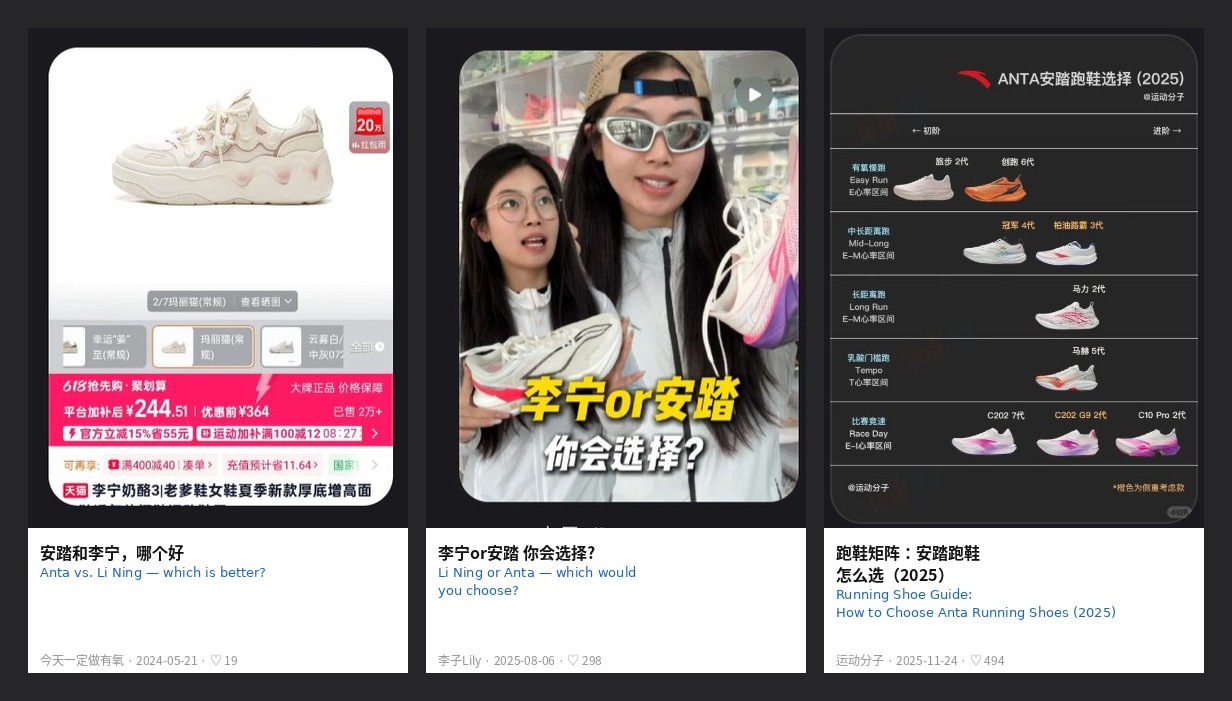
ANTA built credibility in a Chinese way, then it bought the rest
Before ANTA became a portfolio company, it spent years building the one thing that is hardest to buy: the connection between its shoes and Chinese sporting achievement. In 2009, it became the official partner of the Chinese Olympic Committee, a relationship that lasted 16 years. At the 2021 Tokyo Olympics, ANTA’s “Champion Dragon” uniforms and footwear accompanied 777 Chinese athletes, with 88 winning medals. At the 2022 Beijing Winter Olympics, freestyle skiing gold medalist Eileen Gu competed in ANTA gear and became one of the most-watched athletes of the Games.
ANTA’s shares had risen 67% in the months since signing her, and its Tmall trading volume jumped 35% from the year before following the Games. The Olympic relationship was not just about visibility. ANTA’s Olympic Champion running shoe, for instance, incorporated biomechanical data from more than 100 Chinese Olympic champions and samples from 7,700 runners, a shoe built specifically for Chinese athletic physiology. By 2025, ANTA held an estimated 21.8% market share in China’s sportswear market, the largest in the country for four consecutive years. ANTA then took that foundation and built a portfolio of foreign brands on top of it, one for each segment of China’s fragmented footwear market.
FILA is the clearest illustration of how the portfolio works
ANTA acquired the rights to operate FILA in China in 2009. Globally, the FILA brand belongs to South Korean group Fila Holdings. In China, ANTA owns everything: design, distribution, retail. In 2025, FILA generated RMB 28.47 billion in revenue and RMB 7.42 billion in operating profit, a figure that exceeded the ANTA brand’s own operating profit of RMB 7.21 billion for the first time. An Italian brand that ANTA bought for its China rights is now the group’s largest profit contributor. Under new CEO Jiang Yan, FILA launched its “One FILA” strategy in early 2025, pushing into tennis and golf as its premium footwear anchors.
FILA became the exclusive sportswear sponsor of the China Open Tennis Championships and launched the FILA Golf Women’s Elite Tournament, while separately investing in functional lightweight running shoes to grow its footwear revenue share. The strategy reflects a deliberate effort to root FILA’s premium positioning in sport performance rather than fashion alone.
Kolon Sport, the Korean outdoor brand, grew turnover nearly 70% to over RMB 6 billion in 2025 and reported a breakthrough in footwear, the category where outdoor brands historically struggle to compete against specialists. It is the official partner of China’s national climbing team. The logic running through all of this is the same one ANTA applied to itself through the Olympics: pair each brand with the national team that matches its sport, build credibility from the top down, then sell shoes to everyone beneath it.
Li-Ning’s sneaker moment was real yet the business behind it is under pressure
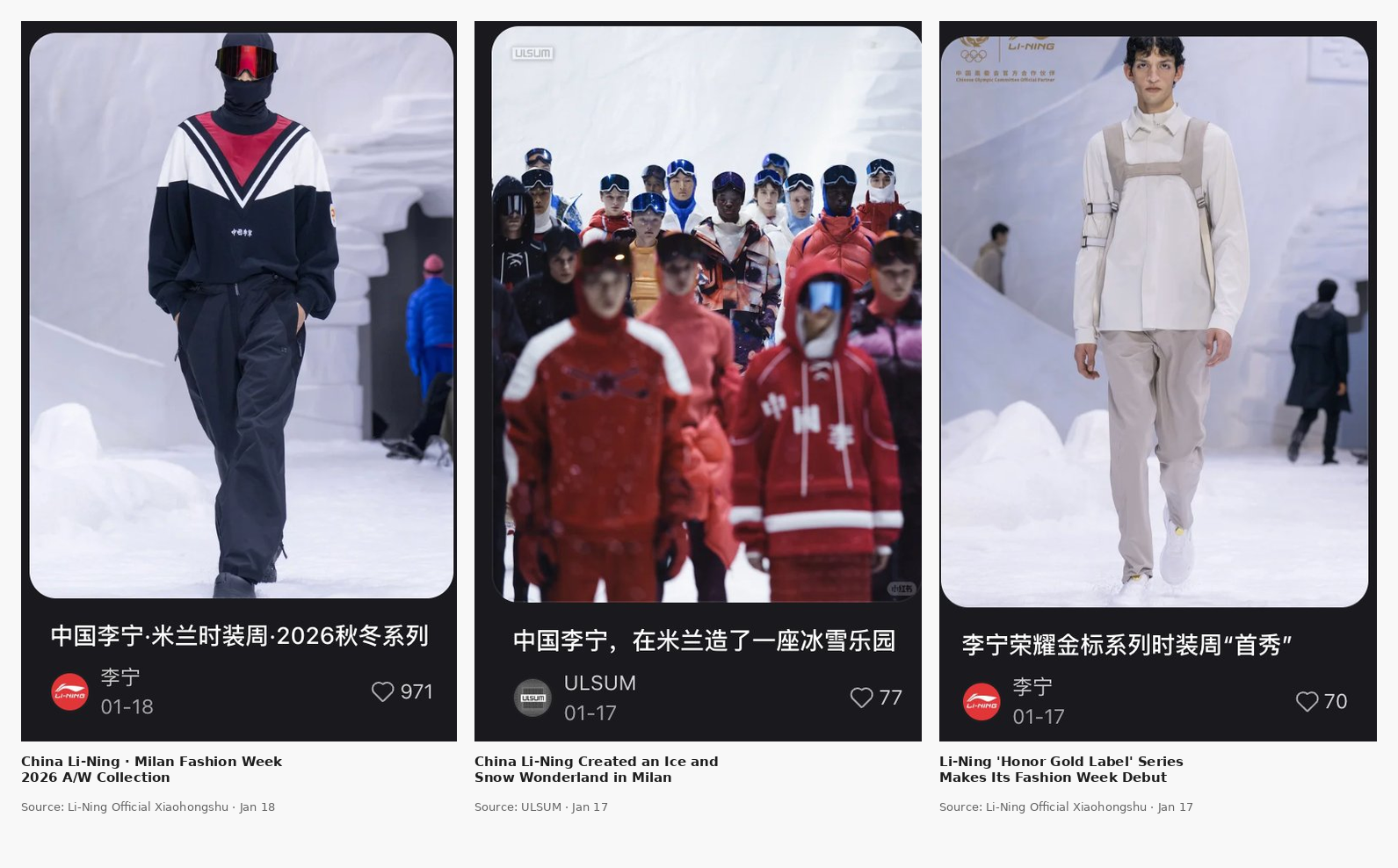
Li-Ning’s rise was real, and it started with a specific shoe. At the 2018 New York Fashion Week, the brand walked a collection stamped with “中国李宁” in bold characters. The Wade basketball shoes from that show sold out in seconds on Tmall at USD150 a pair. Li-Ning had done something no Chinese sports brand had done before: made its shoes feel worth a foreign-brand price. The years that followed pushed that further. Li-Ning introduced hunger marketing for its sneakers, limiting supply and pushing flagship models to RMB 1,299 and RMB 1,599 per pair, prices that exceeded Nike and Adidas in the same category.
For a few years, it worked. Then the numbers started moving in different directions. Revenue grew from RMB 22.6 billion in 2021 to RMB 28.7 billion in 2024 and RMB 29.6 billion in 2025, but revenue growth has been decelerating: 3.9% in 2024, 3.2% in 2025. Net profit tells a more direct story. It peaked at RMB 4.1 billion in 2022, fell to RMB 3.2 billion in 2023, RMB 3.0 billion in 2024, and RMB 2.9 billion in 2025. Gross margin, which had been 53.0% in 2021, sat at 49.0% in 2025. Li-Ning was selling more shoes each year and making less on each one.
Li-Ning’s lifestyle focus lost ground to performance brands
The structural problem is that Li-Ning’s entire footwear position was built around fashion and cultural pride, the lifestyle sneaker segment. That segment still exists, but as China’s footwear market moved toward performance and specialization, it stopped being where the growth was. Running shoes required technical credibility Li-Ning had not built. Trail and outdoor required a brand rooted in terrain, not a runway. Basketball shoe sales fell 21% in 2024. ANTA could offset weakness in one brand with growth in another. FILA’s operating profit alone in 2025 exceeded Li-Ning’s total net profit by more than two and a half times. Li-Ning had no equivalent fallback. The revenue line kept growing. The profit line told the real story.
Key takeaways on the local and international sports footwear brand comparison in China
- Adidas grew 13% in China in 2025 after rebuilding its local operations from the ground up. On’s Asia-Pacific sales rose 101% in Q2 2025, led by China. Nike, by contrast, is projecting another 20% decline in Greater China for the current quarter. The common variable among the brands’ losing ground is not their nationality. It is how long it took them to respond to a market that had moved on
- FILA’s operating profit reached RMB 7.42 billion in 2025, exceeding the ANTA brand’s own RMB 7.21 billion for the first time. Kolon Sport, a Korean outdoor label, grew nearly 70% to over RMB 6 billion the same year. ANTA won China’s footwear market by building a portfolio where no single brand carries the full weight, and where none of the growth depends on national pride.
- Li-Ning’s revenue grew from RMB 22.6 billion in 2021 to RMB 29.6 billion in 2025. Its net profit fell from RMB 4.0 billion to RMB 2.9 billion over the same period. Gross margin dropped from 53.0% to 49.0%. Li-Ning captured the cultural moment better than any other domestic brand. What it did not build was a second brand to fall back on when the moment passed.
- Running, outdoor and trail, and lifestyle sneakers each have their own consumers, their own price logic, and their own standards for what a credible brand looks like. Brands that cover more than one of these segments are structurally better positioned than those that do not. ANTA holds 21.8% of China’s sportswear market and is still growing. Li-Ning holds one segment at compressing margins. Nike holds one brand across all three and is losing ground in each.
Author: Ming Yii Lai, with additional research by Zekai Zhang